
Are you ready to sculpt powerful legs, boost your cardiovascular endurance, and unlock new levels of functional strength? This comprehensive legs conditioning workout is expertly designed to challenge your entire lower body while pushing your aerobic capacity. Fusing a dynamic mix of running, plyometrics, bodyweight movements, and foundational strength exercises like deadlifts, this routine is your ticket to a fitter, stronger, and more resilient physique. Dive in to discover how this high-intensity, full-spectrum workout can transform your performance and elevate your fitness journey.
Unleash Your Potential: The Ultimate Legs Conditioning Workout
In the realm of functional fitness, a robust lower body is non-negotiable. Strong legs are the foundation for almost every athletic endeavor, from sprinting to jumping, lifting, and maintaining balance. This ultimate legs conditioning workout is a meticulously crafted program designed to forge unbreakable lower body strength, explosive power, and unwavering cardiovascular stamina. It’s more than just a leg day; it’s a full-system challenge that integrates diverse movement patterns to enhance overall athleticism and conditioning.
This routine is inspired by high-intensity interval training (HIIT) and functional movement principles, blending traditional endurance with powerful strength work. You’ll engage multiple muscle groups simultaneously, burning significant calories, improving metabolic conditioning, and building lean muscle mass throughout your legs, glutes, and core. Prepare to push your limits and experience a profound sense of accomplishment.
Why Focus on Legs Conditioning?
The benefits of a dedicated legs conditioning regimen extend far beyond aesthetics. A strong, well-conditioned lower body contributes to:
- Enhanced Athletic Performance: Improved speed, agility, jumping ability, and power in any sport or physical activity.
- Increased Metabolism: Leg muscles are large and metabolically active. Training them intensely boosts your resting metabolic rate, aiding in fat loss and overall body composition.
- Injury Prevention: Strong legs, glutes, and a stable core provide better support for joints like knees and ankles, reducing the risk of injuries during daily activities and high-impact sports.
- Better Cardiovascular Health: High-volume leg workouts significantly challenge your heart and lungs, improving cardiovascular efficiency and endurance.
- Improved Functional Strength: Movements like squats and deadlifts mimic real-life actions, making everyday tasks easier and safer.
- Mental Toughness: Pushing through challenging leg workouts builds resilience, discipline, and mental fortitude that translates to other areas of life.
The Workout Breakdown: Details and Philosophy
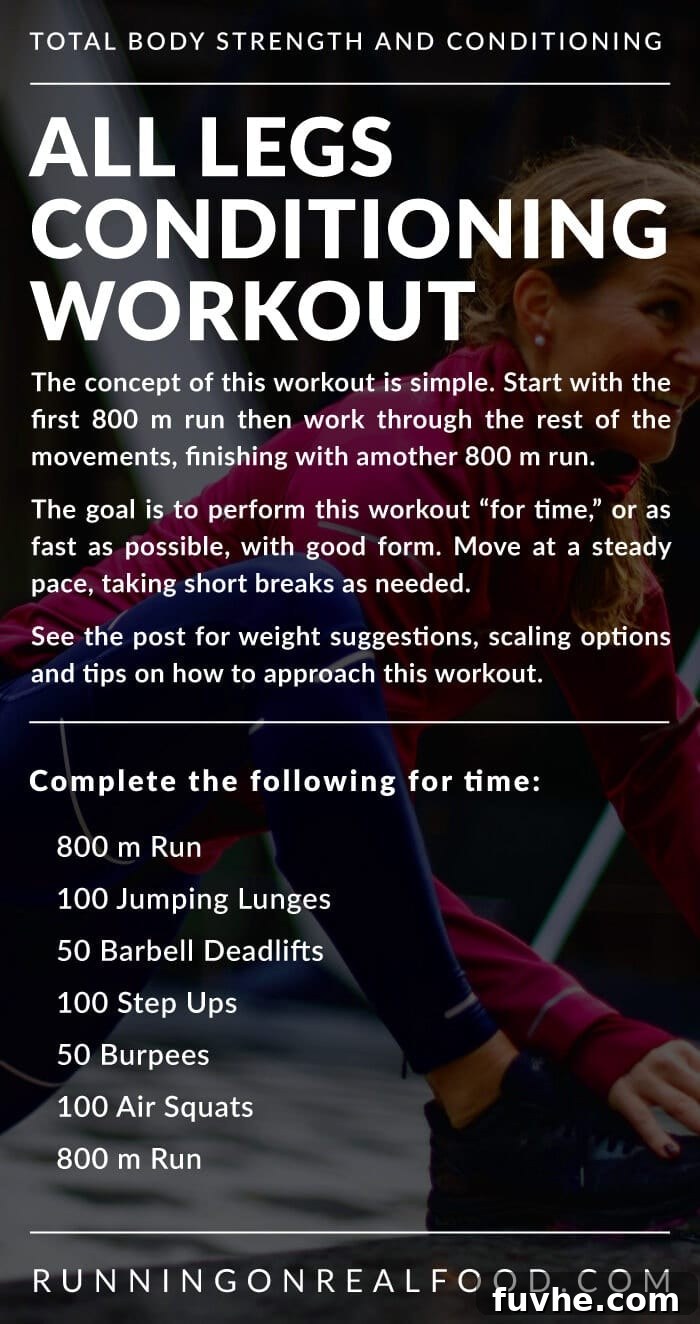
This workout is structured to be performed “for time,” meaning your objective is to complete all the prescribed movements as quickly as possible while maintaining excellent form. It’s a single, high-volume circuit that starts and ends with a challenging run, sandwiching a series of strength, plyometric, and bodyweight exercises designed to fatigue your muscles and test your grit.
The design philosophy behind this workout is simple yet effective: combine endurance with strength. The runs elevate your heart rate and build aerobic capacity, while the subsequent exercises target muscular strength, power, and local muscular endurance. The continuous nature of the workout, with minimal rest between movements, enhances your overall work capacity and metabolic conditioning.
For this intense session, you’ll need a barbell with appropriate weights for deadlifts and access to a running path or track. Let’s get started!
The Ultimate Legs and Cardio Gauntlet:
Perform the following sequence for time, focusing on precision and powerful execution:
- 800 m Run: A vigorous opening to elevate your heart rate and prepare your body.
- 100 Jumping Lunges: A dynamic plyometric exercise for explosive leg power and endurance.
- 50 Barbell Deadlifts: A foundational strength movement to build posterior chain power and total-body strength.
- 100 Step Ups: A unilateral exercise focusing on glute and quad strength, along with balance.
- 50 Burpees: The ultimate full-body conditioning exercise, testing strength, endurance, and coordination.
- 100 Air Squats: A classic bodyweight movement for muscular endurance in the quads, glutes, and hamstrings.
- 800 m Run: A final push to truly test your cardiovascular endurance and mental fortitude.
Mastering Each Movement: Form and Tips
Proper form is paramount to both the effectiveness and safety of this workout. Take the time to understand each movement, and prioritize quality over speed, especially when first attempting this routine.
1. 800 m Run: Strategy and Pacing
The 800m run is a significant distance that bookends this workout. It’s not a casual jog; it should be a challenging, yet sustainable, pace. Aim for a pace that feels “comfortably uncomfortable” – a speed you can maintain without completely burning out before the next exercise. Focus on consistent breathing and a smooth stride. Think of it as a strong effort that primes your body for the work ahead, and then a final sprint to the finish line.
2. 100 Jumping Lunges: Explosive Power
Jumping lunges are a fantastic plyometric exercise that builds explosive power, agility, and muscular endurance in your quads, hamstrings, and glutes. Start in a lunge position, with one leg forward and the back knee hovering just above the ground. Explode upwards, switching your legs in mid-air, and land softly into the opposite lunge position. Ensure your front knee stays behind your toes and your torso remains upright. To tackle 100 reps, break them into smaller, manageable sets (e.g., 10-20 reps) with minimal rest. Focus on controlled landings to protect your joints.
3. 50 Barbell Deadlifts: Strength Foundation
The deadlift is one of the most effective full-body strength exercises, heavily engaging your posterior chain (glutes, hamstrings, lower back) and core. Approach the barbell with your feet hip-width apart, shins close to the bar. Hinge at your hips, keeping your back straight and chest up, grasping the bar with an overhand or mixed grip just outside your shins. Drive through your heels, extending your hips and knees simultaneously to stand tall, pulling the bar up along your legs. Lower the bar with control by reversing the movement, initiating with a hip hinge. For 50 reps, perform them in quick, consistent sets of 5-10 repetitions, focusing on form above all else. Avoid rounding your back at any point.
4. 100 Step Ups: Unilateral Strength
Step-ups are excellent for building unilateral leg strength, targeting your glutes and quads while improving balance and stability. Use a sturdy box, bench, or platform that brings your thigh roughly parallel to the ground when your foot is placed on it. Step onto the box with one foot, driving through your heel to stand up fully, bringing your other leg up onto the box (or just hovering it). Step back down with control. Alternate legs with each rep, or perform a set on one side before switching. You should be able to complete these unbroken, maintaining a steady, rhythmic pace. Focus on using the stepping leg to drive the movement, rather than pushing off the ground with the trailing leg.
5. 50 Burpees: The Ultimate Conditioner
The burpee is a total-body conditioning beast. From a standing position, squat down and place your hands on the floor. Kick your feet back into a plank position. Perform a push-up (optional, but highly recommended for this workout). Jump your feet back towards your hands, then explode upwards into a jump, clapping your hands overhead. This full-body sequence tests your strength, endurance, and coordination. Maintain a steady, unbroken pace. Even if it’s slow, keep moving. Breaking them into sets of 5-10 with very short rests can help you get through 50 reps.
6. 100 Air Squats: Endurance and Form
Air squats are a fundamental bodyweight exercise that builds muscular endurance in your quads, glutes, and hamstrings. Stand with your feet shoulder-width apart, toes slightly pointed out. Keep your chest up and back straight as you lower your hips back and down, as if sitting into a chair. Aim to get your hips below your knees. Drive through your heels to return to the standing position, squeezing your glutes at the top. For 100 reps, find a sustainable rhythm. You should aim to complete these mostly unbroken, perhaps with a short pause every 20-30 reps. Focus on depth and consistent form.
Weight Suggestions for Deadlifts
Choosing the right weight for your deadlifts is critical for safety and effectiveness, especially with the high volume in this workout. The goal is to challenge yourself without compromising form or risking injury. Remember, this is a conditioning workout, not a max-strength test.
- Men: Aim for 185-225 lbs.
- Women: Aim for 125-155 lbs.
These are general suggestions. If you are new to deadlifts or high-volume lifting, start significantly lighter. The weight should allow you to complete 5-10 reps in a set with excellent form, even when fatigued. Err on the side of caution. It’s better to finish the workout with slightly lighter weight and perfect form than to risk injury with a weight that’s too heavy.
Scaling Options: Customize Your Challenge
This workout is designed to be tough, but it’s also highly adaptable. Whether you’re a beginner or an elite athlete, you can adjust the difficulty to match your current fitness level. Consistency is key, so find a scaling option that allows you to complete the workout with good form.
To Make It Easier (or for Beginners):
- Reduce Run Distances: If 800m feels too long, reduce the runs to 400m. This still provides a cardiovascular challenge without over-fatiguing you for the rest of the workout.
- Cut Reps in Half: A common scaling method is to halve all the repetition counts (e.g., 50 jumping lunges, 25 deadlifts, 50 step-ups, 25 burpees, 50 air squats). This significantly reduces the total work volume.
- Modify Jumping Lunges: Replace jumping lunges with reverse lunges or walking lunges. This removes the plyometric impact while still building leg strength and endurance.
- Lighter Deadlifts: Use a significantly lighter barbell, dumbbells, or even a kettlebell for the deadlifts if the suggested weights are too heavy.
- Burpee Modification: Remove the push-up and/or the jump at the top. Simply step back into a plank, step forward, and stand up.
To Make It Harder (or for Advanced Athletes):
- Increase Explosiveness: For jumping lunges, focus on maximizing height and speed.
- Add Weight to Bodyweight Movements: Hold a kettlebell or dumbbell during step-ups and air squats to increase the load and challenge.
- Faster Pacing: Push the pace on runs and transitions between exercises, striving for a new personal best time.
- Increase Deadlift Weight: If you are proficient with the suggested weights, consider a slight increase while strictly maintaining form.
- Wear a Weight Vest: For an ultimate challenge, perform the entire workout while wearing a weighted vest.
Pre and Post-Workout Routines
Dynamic Warm-Up: Prepare Your Body (5-10 minutes)
Never skip your warm-up! A dynamic warm-up prepares your muscles, elevates your heart rate, and improves joint mobility, significantly reducing the risk of injury.
- Light Cardio (2-3 minutes): Jogging, jumping jacks, or cycling.
- Leg Swings (10-15 per leg): Forward and backward, and side-to-side.
- Torso Twists (10-15 per side): Gentle rotations to mobilize the spine.
- Walking Lunges (10-12 per leg): With or without a torso twist.
- Air Squats (10-15 reps): Focus on full range of motion.
- Glute Bridges (10-15 reps): Activate your glutes.
- Good Mornings (10-15 reps, bodyweight): Gentle hinge movement for hamstrings and lower back.
Static Cool-Down and Stretching: Aid Recovery (10-15 minutes)
After such an intense workout, a proper cool-down helps lower your heart rate, remove metabolic waste, and improve flexibility, which is crucial for recovery and preventing stiffness.
- Light Jog or Walk (5 minutes): Gradually bring your heart rate down.
- Quad Stretch (30 seconds per leg): Standing or lying.
- Hamstring Stretch (30 seconds per leg): Seated or standing toe touch.
- Glute Stretch (30 seconds per leg): Figure-four stretch.
- Calf Stretch (30 seconds per leg): Wall or curb stretch.
- Hip Flexor Stretch (30 seconds per leg): Kneeling lunge stretch.
- Pigeon Pose (60 seconds per leg): For deeper hip and glute stretch.
Fueling Your Performance: Nutrition and Hydration
An intense workout like this demands proper fueling and recovery. Ensure you are adequately hydrated before, during, and after your session. Post-workout, prioritize a meal or shake rich in protein and complex carbohydrates to replenish glycogen stores and support muscle repair and growth. Quality sleep is also a non-negotiable component of effective recovery.
More Workouts to Ignite Your Fitness Journey
If you loved the challenge and effectiveness of this legs conditioning workout, you’re in for a treat! Explore these other dynamic and performance-enhancing routines to keep your fitness journey exciting and progressive:
- Strength and Treadmill HIIT Workout: Combine the power of strength training with the intensity of high-interval treadmill work for a complete conditioning experience.
- 40-Minute Kettlebell and Rowing Workout: Leverage the versatility of kettlebells and the cardiovascular benefits of rowing in this efficient, full-body session.
- Kettlebell and Barbell Conditioning Workout: A powerful fusion of two classic strength tools to build raw power and endurance.
- Push, Pull, Legs and Core Superset Workout: A comprehensive program designed to hit every major muscle group with effective supersets for maximum efficiency and growth.
Conclusion: Embrace the Challenge
This all-encompassing legs conditioning workout is a powerful tool to elevate your fitness. It’s more than just a series of exercises; it’s a test of your physical and mental limits, designed to build a foundation of strength, endurance, and functional athleticism. By consistently challenging yourself with this routine, you’ll not only see significant improvements in your lower body power and cardiovascular health but also foster the mental toughness required to conquer any fitness goal. Remember to listen to your body, prioritize proper form, and celebrate every step of your progress. Go forth, train hard, and build the resilient, powerful legs you deserve!