

Dominate Your Fitness: The Ultimate Full-Body 30-Minute EMOM Workout Challenge
Are you ready to redefine your fitness in just 30 minutes? This dynamic, full-body EMOM workout is expertly designed to push your conditioning, amplify your strength, and build your endurance, leaving no muscle untouched. Whether you’re a seasoned athlete or looking to inject new intensity into your routine, this challenge offers a potent blend of high-intensity intervals and functional movements, guaranteeing a complete and highly effective workout in a surprisingly short amount of time. Get ready to experience a new level of physical and mental resilience as you conquer each minute, one rep at a time.
For those unfamiliar, EMOM stands for “Every Minute On the Minute.” This training style dictates that you begin a set of repetitions at the top of each minute. Once you complete the prescribed reps, any remaining time within that minute becomes your rest period. This structure is incredibly effective for maintaining a consistent pace, managing your intensity, and ensuring you accomplish a significant volume of work. EMOM workouts are not just about physical exertion; they also train your mental fortitude, encouraging efficient movement and strategic pacing to maximize both work and recovery within a fixed timeframe.
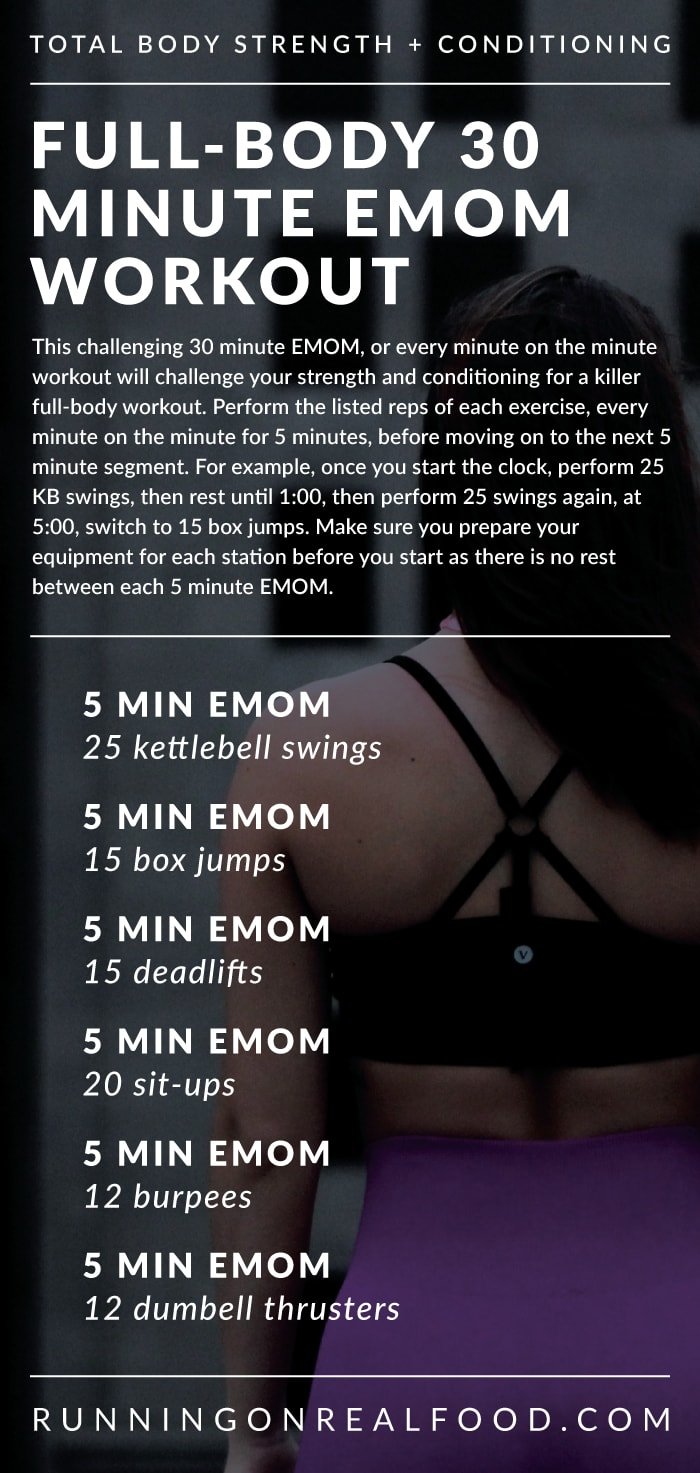
The 30-Minute Full-Body EMOM Challenge: Workout Structure and Details
This comprehensive 30-minute EMOM workout is meticulously structured into six distinct 5-minute EMOM blocks, seamlessly flowing from one exercise to the next. You’ll engage with a total of six different, powerful movements: burpees, box jumps, deadlifts, kettlebell swings, sit-ups, and dumbbell thrusters. The design ensures that you’ll dedicate five intense minutes to each exercise, completing five rounds of that specific movement before transitioning. This continuous cycle means you’ll switch to a fresh challenge every five minutes, keeping your body guessing and your metabolism soaring.
To optimize your training experience and maintain the high intensity this workout demands, pre-planning is key. Before you even begin, take the time to set up each exercise station with all the necessary equipment. This proactive approach eliminates any wasted seconds between segments, allowing you to fluidly “hop into” each new 5-minute block without interruption. Prepare your barbell, kettlebell, dumbbells, and box in advance, ensuring everything is within arm’s reach. Your focus should be solely on performance, not on searching for gear.
Essential Equipment for Your EMOM: Adaptable Options
To fully embrace the versatility and intensity of this 30-minute EMOM, certain equipment will enhance your experience. However, don’t let a lack of specific gear deter you; we’ve provided excellent alternatives to ensure everyone can participate and achieve a challenging workout.
- Kettlebell for Swings: A kettlebell is ideal for perfecting the dynamic, hip-hinge movement of the swing. Its unique shape allows for a powerful, continuous motion. If a kettlebell isn’t available, a heavy dumbbell held by both hands on one end can serve as a suitable substitute, mimicking the resistance and allowing for a similar explosive movement pattern.
- Barbell for Deadlifts: The barbell is a cornerstone for deadlifts, enabling you to lift significant weight and develop foundational strength. For those without access to a barbell, heavy dumbbells or even a pair of heavy kettlebells can be used effectively. Focus on maintaining proper form and engaging your posterior chain, regardless of your chosen implement.
- Box or Bench for Box Jumps: A sturdy plyometric box or a robust gym bench is perfect for box jumps, challenging your explosive power and coordination. Should these not be at your disposal, jump squats offer an excellent, equipment-free alternative. Jump squats will still elevate your heart rate and build lower body power, focusing on a controlled landing and powerful ascent.
- Dumbbells for Thrusters: Dumbbells are the primary tool for thrusters, allowing for a fantastic full-body, compound exercise. If dumbbells are unavailable, a barbell can be used for a barbell thruster, offering a slightly different but equally effective challenge. Alternatively, a single kettlebell held in the goblet position can also be used for kettlebell thrusters, targeting similar muscle groups with a unique balance component.
Mastering the Movements: Exercise Breakdown, Rep Scheme, and Scaling
The “unbroken” philosophy is critical for this EMOM. This means completing all specified repetitions for each exercise without setting down your kettlebell, barbell, or dumbbells until the set is finished. This commitment to continuous effort not only builds physical endurance but also mental toughness. Focus on controlled breathing and maintaining your form throughout. Remember, the goal is to complete the reps efficiently to earn your well-deserved rest within the minute.
- Kettlebell Swings (25 reps): The kettlebell swing is a powerhouse exercise for developing explosive hip drive, strengthening your posterior chain, and boosting cardiovascular endurance. Aim for 25 powerful, crisp swings per minute. I personally found a 20 kg kettlebell to be a significant challenge, especially as the rounds progressed; those last 5 reps truly test your grit! When scaling, prioritize maintaining proper form and avoiding lower back strain. Start by adjusting the weight: opt for a lighter 12 kg or 16 kg kettlebell if 20 kg is too demanding. If you find 25 reps with your chosen weight too easy, feel free to bump up the intensity to a 24 kg kettlebell or even more, ensuring you can still complete the reps with good technique and earn some rest before the next minute.
- Box Jumps (15 reps): Box jumps are fantastic for cultivating explosive lower-body power, agility, and cardiovascular conditioning. Performing 15 reps on a 20-inch box demands a consistent pace and mental focus. Maintain a quick rhythm, aiming for soft landings and controlled steps-down (or jumps-down if you’re advanced and confident). If you find yourself falling behind or struggling to maintain form, scale down to 12 or even 10 reps to ensure you complete each set safely. For those seeking an extra challenge and finding 15 reps too easy, consider increasing to 20 reps or using a higher box, always prioritizing safe and controlled landings to prevent injury.
Form Focus: Load your hips, swing your arms, and explode upwards, landing softly on the entire foot on the box. Step or jump down with control to minimize impact.
- Deadlifts (15 reps): The deadlift is unparalleled for building full-body strength, particularly in the posterior chain (glutes, hamstrings, lower back) and core. Lifting 125 lbs for 15 reps requires significant strength but also allows for ample recovery time within the minute if performed efficiently. The final reps of each set will certainly burn, but the rest should be sufficient. As with all strength movements, scaling the weight is the primary adjustment; reduce the load before you consider reducing reps to ensure strength development. If 125 lbs feels too light, challenge yourself by increasing the weight to something that allows you to complete 15 unbroken reps across all five rounds, such as 155 lbs. Remember, even though it will be challenging, the goal is to execute with excellent form and control.
Form Focus: Keep your back flat, chest up, and engage your core throughout the lift. Drive through your heels, pulling the weight up by extending your hips and knees simultaneously. Lower the weight with control.
- Sit-ups (20 reps): Sit-ups are a classic core exercise that targets the abdominal muscles, improving core strength and stability. While the first few rounds of 20 sit-ups might feel manageable, the cumulative fatigue will make the last two sets incredibly challenging. It’s common for your abs to burn! If you struggle to maintain the pace or complete the full 20 reps per minute, scale down to 15 reps. Alternatively, if 20 reps feel too easy, you could hold a light dumbbell or medicine ball to your chest for added resistance, or even perform GHD sit-ups if available and you have experience.
Form Focus: Lie on your back with knees bent and feet flat. Use your abdominal muscles to lift your torso, touching your hands to the ground in front of your feet. Control the descent back down.
- Burpees (12 reps): The burpee is the ultimate full-body conditioning movement, combining a squat, push-up, and jump into one fluid motion. Twelve burpees per minute is a demanding pace, requiring sustained effort and efficient transitions. You must maintain consistency to complete all reps within the minute. If 12 reps feel too easy, you can increase the intensity by aiming for 14-15 reps, or even adding a tuck jump at the top. Conversely, if you’re struggling to keep up, scale down to 8-10 reps. An alternative for scaling could be stepping out and in instead of jumping, or performing a chest-to-ground burpee for added intensity. Regardless of the scaling, focus on continuous, rhythmic movement.
Form Focus: Start standing, drop into a squat, kick your feet back into a plank, perform a push-up (optional), jump your feet back to your hands, and finally, jump explosively with hands overhead.
- Dumbbell Thrusters (12 reps): Dumbbell thrusters are a highly effective compound exercise that integrates a front squat with an overhead press, delivering a potent full-body workout and significant metabolic conditioning. I utilized 20 lb dumbbells due to an elbow injury, which made it “doable,” but even at a lighter weight, the minute still feels incredibly short! This movement rapidly elevates your heart rate and taxes your muscular endurance. The primary scaling factor here should be the weight of the dumbbells. If 12 reps with your chosen weight feels too easy, I strongly recommend increasing the load: ladies could aim for 35 lb dumbbells, and gentlemen for 50 lb dumbbells, provided proper form can be maintained. If 20 lbs feels too challenging to hit 12 reps per minute, scale down to 15 lbs. Should you still be unable to complete 12 reps within the minute consistently, drop to 10 reps. Push through these final sets; it’s the last movement, so finish strong and leave it all on the floor!
Form Focus: Hold dumbbells at your shoulders, elbows pointed forward. Perform a full front squat, then explosively drive through your heels, using that momentum to press the dumbbells overhead, finishing with arms fully extended.
Form Focus: Initiate the movement with a hinge at the hips, not a squat. Drive through your heels and squeeze your glutes at the top, allowing the kettlebell to float to chest height. Control the descent back into the hinge.
Optimizing Your EMOM Performance: Tips and Strategies
To truly maximize your EMOM experience and unlock your full potential, consider these expert tips and strategies:
- Warm-Up Thoroughly: Before diving into such an intense workout, dedicate 5-10 minutes to a dynamic warm-up. This could include light cardio (jumping jacks, high knees), dynamic stretches (leg swings, arm circles), and specific movement preparation for each exercise in the EMOM. This primes your muscles and reduces injury risk.
- Pacing is Paramount: EMOMs are a masterclass in pacing. The goal isn’t to sprint through your reps and then collapse. Instead, aim for a consistent, repeatable pace that allows you to complete your reps with good form and still earn at least 15-20 seconds of rest before the next minute starts. If you’re consistently left with less than 10 seconds of rest, your reps or weight might be too high.
- Focus on Form Over Speed: While efficiency is key, never sacrifice proper form for speed. Poor technique increases the risk of injury and diminishes the effectiveness of the exercise. If your form breaks down, scale down the weight or reps immediately.
- Listen to Your Body: EMOMs are challenging, but they shouldn’t cause sharp pain. If something feels off, stop and reassess. It’s okay to modify or even skip a round if your body needs it. Progressive overload is about smart training, not pushing through injury.
- Stay Hydrated: Intense workouts like this lead to significant fluid loss. Ensure you’re well-hydrated before, during, and after your session.
- Cool-Down and Stretch: After completing the workout, spend 5-10 minutes cooling down with light cardio and static stretching. Focus on the muscle groups you just worked to aid recovery and improve flexibility.
Why This 30-Minute EMOM is a Game Changer
This full-body 30-minute EMOM workout isn’t just another routine; it’s a strategically designed fitness challenge that delivers multifaceted benefits. It drastically improves your cardiovascular conditioning, making you more efficient and less prone to fatigue. Simultaneously, the inclusion of fundamental strength movements like deadlifts and thrusters builds raw power and muscular endurance across your entire physique. The EMOM format itself hones your mental toughness and ability to manage effort, teaching you discipline and consistency. In just half an hour, you’ll ignite your metabolism, build functional strength, and enhance your overall athletic capacity, making it an incredibly efficient and effective way to achieve significant fitness gains.
Discover More High-Intensity Workouts
If you’ve enjoyed the challenge and effectiveness of this EMOM workout, we invite you to explore more dynamic and engaging routines designed to push your limits and help you achieve your fitness goals. Expand your training repertoire with these related articles:
- 30 Minute EMOM Conditioning Workout
- CrossFit EMOM Workouts for Conditioning
- CrossFit-Style Workouts
- Full Body Conditioning Workout
- Run Intervals Strength and Conditioning Workout