Are you ready to transform your body, boost your energy, and achieve peak fitness in just 30 minutes? This comprehensive full-body strength and conditioning workout is meticulously designed to challenge every major muscle group, ignite your metabolism, and leave you feeling invigorated and accomplished. Prepare to sweat, build serious strength, enhance your cardiovascular endurance, and have a blast while doing it. Whether you’re a seasoned athlete or just starting your fitness journey, this efficient, high-intensity routine is your ticket to a stronger, more resilient you. Get ready to experience the power of a well-rounded workout that fits perfectly into your busy schedule.
The Ultimate 30-Minute Full-Body Blitz: Workout Details
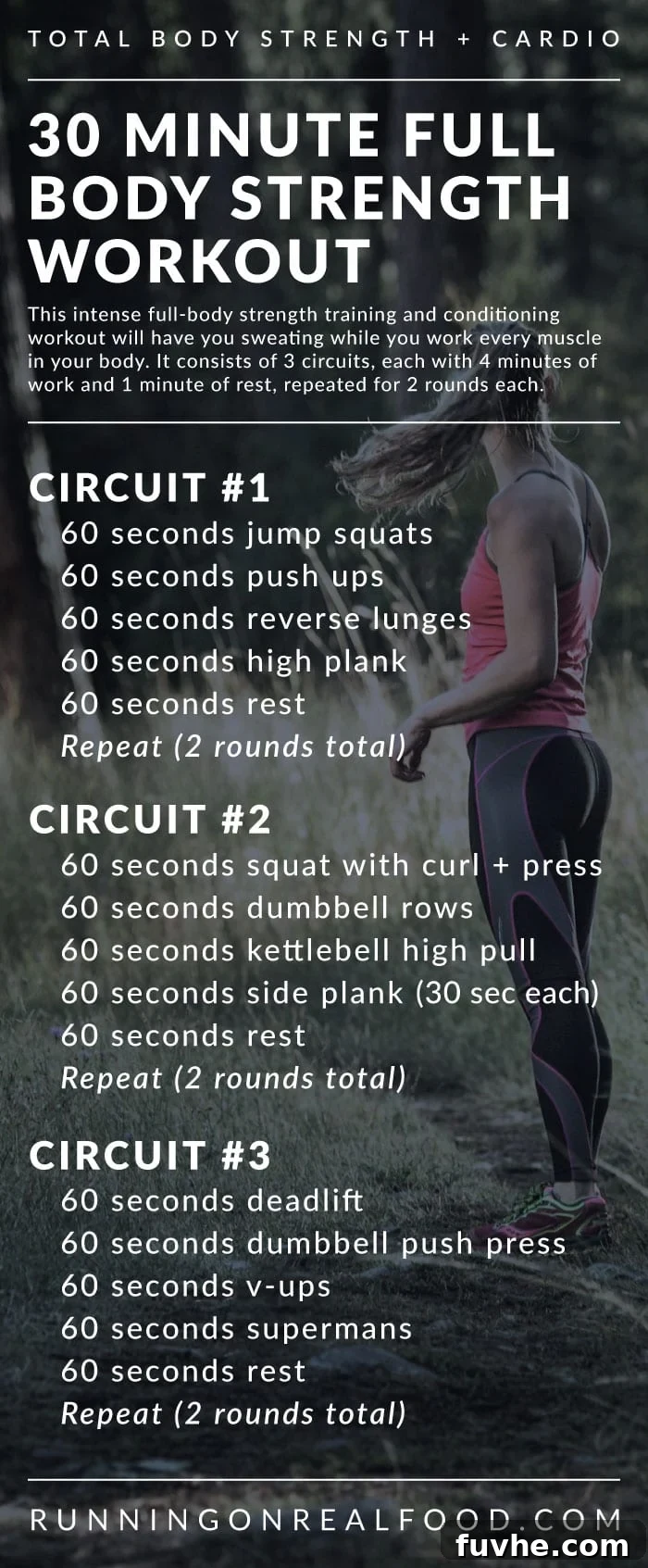
This dynamic workout is structured around three challenging circuits, each crafted to maximize your effort and minimize your rest. Each circuit demands 4 minutes of continuous work, followed by a well-deserved 1-minute rest period. To amplify the intensity and results, you will repeat each circuit for two exhilarating rounds. The entire session culminates in a total workout time of 30 minutes, making it incredibly effective and time-efficient. To complete this powerful routine, you’ll need a reliable set of dumbbells, a versatile kettlebell, and a timer to keep you on track and pushing through every second.
Why Choose Full-Body Workouts? Unlocking Your Fitness Potential
Full-body workouts are not just a trend; they are a cornerstone of effective fitness for countless reasons. Integrating multi-joint movements that engage several muscle groups simultaneously offers a myriad of benefits that specialized, single-muscle routines often miss. Firstly, they are incredibly time-efficient. By working your entire body in one session, you reduce the number of gym visits needed per week, making fitness accessible even for the busiest schedules. This translates to consistent progress and less time planning your routine.
Secondly, full-body training significantly boosts your calorie expenditure. Compound exercises recruit more muscle fibers, leading to a higher metabolic demand during and after your workout. This “afterburn effect,” or EPOC (Excess Post-exercise Oxygen Consumption), means you continue burning calories at an elevated rate long after you’ve finished your last rep, aiding significantly in fat loss and overall body composition improvement.
Moreover, these workouts foster functional strength. They mimic natural human movements, improving your ability to perform everyday tasks with greater ease, stability, and power. From lifting groceries to playing with children, the strength you gain is directly transferable to real-world scenarios. This holistic approach also promotes muscle symmetry and balance, reducing the risk of imbalances that can lead to injuries.
Finally, regular full-body sessions can dramatically improve your cardiovascular fitness. The continuous movement and elevated heart rate throughout the circuits act as a form of high-intensity interval training (HIIT), strengthening your heart and lungs. This dual benefit of strength and cardio makes full-body workouts an indispensable tool in any comprehensive fitness regimen, promoting overall health, longevity, and a powerful, resilient physique.
Essential Equipment for Your Ultimate Workout
To maximize the effectiveness of this 30-minute full-body strength and conditioning workout, having the right equipment is key. Don’t worry, you won’t need an entire gym; just a few versatile pieces will suffice. A good set of dumbbells is foundational. They are incredibly adaptable for various exercises targeting arms, shoulders, back, and legs. Choose a weight that challenges you but allows you to maintain proper form for the full 60 seconds of each interval. As you get stronger, you can gradually increase the weight for progressive overload.
Next, a kettlebell is an invaluable addition. Its unique design allows for dynamic, explosive movements like swings and high-pulls, which are excellent for building power, core strength, and cardiovascular endurance. If you don’t have a kettlebell, some exercises can be modified with a single dumbbell, but the kettlebell’s distinct benefits are worth considering. Lastly, a reliable timer is non-negotiable. Whether it’s a dedicated gym timer, an app on your smartphone, or a simple stopwatch, precise timing is crucial for adhering to the 60-second work and 60-second rest intervals, ensuring you get the most out of every circuit.
Pre-Workout Warm-up: Preparing Your Body for Peak Performance
Before diving into the intense circuits, a proper warm-up is paramount. Spending 5-10 minutes preparing your body will not only reduce the risk of injury but also enhance your performance. Start with light cardio, such as marching in place, jumping jacks, or a brisk walk, to gradually elevate your heart rate and increase blood flow to your muscles. Follow this with dynamic stretches that move your joints through their full range of motion. Examples include arm circles (forward and backward), leg swings (front-to-back and side-to-side), torso twists, and cat-cow stretches. Focus on movements that mimic the exercises you’re about to perform. A well-executed warm-up primes your muscles, mobilizes your joints, and mentally prepares you for the demanding workout ahead, ensuring you can give each circuit your absolute best.
Post-Workout Cool-down: Essential for Recovery and Flexibility
Just as important as the warm-up is the cool-down. After completing your intense 30-minute session, dedicate 5-10 minutes to bring your heart rate down gradually and improve your flexibility. Begin with a few minutes of light activity, like slow walking or light marching, to ease your body out of the high-intensity state. Then, transition into static stretches, holding each stretch for 20-30 seconds. Focus on the major muscle groups you worked: hamstrings, quads, glutes, chest, shoulders, and back. Examples include a quad stretch, hamstring stretch, glute stretch (figure-four), chest stretch in a doorway, triceps stretch, and a gentle back extension. A proper cool-down helps to reduce muscle soreness, promotes recovery, and improves your overall flexibility, setting you up for continued progress and injury prevention in your fitness journey.
Circuit 1: Power and Stability Foundation
The first circuit sets the tone for your workout, combining explosive power with foundational strength and core stability. Each exercise is performed for 60 seconds, followed by a 60-second rest period after the fourth exercise before repeating the circuit for a second round.
- 60 seconds Jump Squats: This explosive exercise targets your quadriceps, glutes, and hamstrings, while significantly boosting your cardiovascular endurance. To perform, start in a regular squat position, then powerfully explode upwards, lifting your feet off the ground. Land softly with bent knees, immediately flowing into the next squat. Focus on generating power from your hips and glutes, using your arms to assist the upward drive. Ensure your knees track over your toes and avoid landing stiff-legged to protect your joints.
- 60 seconds Push-ups: A classic compound movement, push-ups build strength in your chest, shoulders, triceps, and core. Begin in a high plank position with hands slightly wider than shoulder-width apart. Lower your chest towards the floor, keeping your body in a straight line from head to heels, engaging your core. Push back up to the starting position with controlled power. If traditional push-ups are too challenging, perform them on your knees or with your hands elevated on a bench or wall. For an advanced variation, slow down the eccentric (lowering) phase.
- 60 seconds Reverse Lunges: This exercise is excellent for unilateral leg strength, targeting your glutes, hamstrings, and quadriceps while improving balance. Step one leg back, lowering your hips until both knees are bent at approximately a 90-degree angle. Ensure your front knee stays directly over your ankle and your back knee hovers just above the ground. Push through your front heel to return to the starting position. Alternate legs with each repetition, focusing on control and stability rather than speed. You can hold dumbbells for added resistance.
- 60 seconds High Plank: A phenomenal core stabilizer, the high plank engages your entire body, particularly your abdominals, lower back, and shoulders. Assume a push-up position, but keep your arms extended and locked out. Maintain a straight line from your head to your heels, ensuring your hips don’t sag or rise too high. Engage your core by drawing your belly button towards your spine, and brace your entire body. Focus on deep, controlled breathing. This is not just a static hold; it’s an active exercise in total body tension.
- 60 seconds rest
Repeat for 2 total rounds.
Circuit 2: Compound Movements and Unilateral Strength
Circuit two introduces more complex compound movements and focuses on back and core strength, ensuring a well-rounded muscular development. Each exercise is performed for 60 seconds, followed by a 60-second rest period after the fourth exercise before repeating the circuit for a second round.
- 60 seconds Squat with Curl and Press: This fantastic triple-threat exercise combines a lower-body squat with an upper-body bicep curl and overhead press, working your legs, glutes, core, biceps, and shoulders. Hold dumbbells at your sides. Perform a squat, then as you stand up, immediately curl the dumbbells up to your shoulders. From there, press them overhead, fully extending your arms. Reverse the movement back down to the squat position. Focus on smooth transitions between each phase, maintaining control throughout the entire movement.
- 60 seconds Dumbbell Row: Targeting your lats, rhomboids, and biceps, the dumbbell row is crucial for building a strong, balanced back and improving posture. Hinge at your hips, keeping your back straight and nearly parallel to the floor. Let the dumbbell hang directly below your shoulder. Pull the dumbbell towards your hip, squeezing your shoulder blade at the top of the movement. Control the weight as you lower it back down. Perform 30 seconds on one side, then switch to the other side for the remaining 30 seconds, or alternate reps if comfortable.
- 60 seconds Kettlebell High-Pull: An explosive exercise that builds power in your hips, glutes, hamstrings, shoulders, and traps. Start with the kettlebell between your feet. Hinge at your hips with a slight bend in your knees, grasping the kettlebell with both hands. Drive through your heels, extending your hips and knees powerfully as you pull the kettlebell upwards towards your chin, leading with your elbows. The movement should be driven by your lower body, not just your arms. Control the kettlebell back down into the starting position.
- 60 seconds Side Plank (30 seconds per side): This exercise is a powerhouse for strengthening your obliques and improving core stability. Lie on your side, propped up on your forearm with your elbow directly under your shoulder. Stack your feet, or place your top foot in front of your bottom foot for more stability. Lift your hips off the ground, forming a straight line from your head to your heels. Engage your core and glutes. Hold for 30 seconds on one side, then carefully switch and hold for 30 seconds on the other side. Avoid letting your hips sag.
- 60 seconds rest
Repeat for 2 total rounds.
Circuit 3: Posterior Chain and Core Strength Finale
The final circuit focuses on developing powerful posterior chain muscles and robust core strength, ensuring you finish strong and comprehensively worked. Each exercise is performed for 60 seconds, followed by a 60-second rest period after the fourth exercise before repeating the circuit for a second round.
- 60 seconds Deadlift (Dumbbell or Kettlebell): The deadlift is arguably one of the most effective full-body exercises, primarily targeting your hamstrings, glutes, and lower back, while also engaging your core and grip strength. Stand with your feet hip-width apart, dumbbells or kettlebell in front of you. Hinge at your hips, keeping your back straight and chest proud, to grab the weight. Drive through your heels, extending your hips and knees to stand up, squeezing your glutes at the top. Lower the weight back down with control, maintaining a neutral spine. Focus on the hip hinge movement, not rounding your back.
- 60 seconds Push-Press: A fantastic exercise for building overhead strength and power, the push-press works your shoulders, triceps, and engages your legs and core. Hold dumbbells at shoulder height, palms facing each other. Dip your knees slightly, then explosively drive upwards with your legs, using that momentum to press the dumbbells overhead. Lock out your arms at the top, then control the weight back down to your shoulders. The leg drive allows you to lift heavier weight than a strict overhead press, developing explosive power.
- 60 seconds V-ups: This advanced core exercise targets your entire abdominal wall, including your rectus abdominis and obliques. Lie flat on your back with your arms extended overhead. Simultaneously lift your legs (keeping them straight) and your torso, reaching your hands towards your toes, forming a “V” shape with your body. Lower back down with control, avoiding a complete collapse onto the mat. If V-ups are too challenging, perform tuck-ups (bending your knees) or alternate leg raises.
- 60 seconds Supermans: A powerful exercise for strengthening your lower back, glutes, and hamstrings, improving spinal health and posture. Lie face down on the floor with your arms extended forward and legs straight. Simultaneously lift your arms, chest, and legs off the ground, squeezing your glutes and lower back muscles. Hold for a brief second at the top, feeling the contraction along your posterior chain, then slowly lower back down. Focus on controlled movement and avoid jerking.
- 60 seconds rest
Repeat for 2 total rounds.
Maximizing Your Workout: Tips for Sustained Progress
To truly reap the long-term benefits of this 30-minute full-body strength and conditioning workout, consistency and smart progression are key. Make this routine a regular part of your schedule, aiming for 2-3 times per week with adequate rest days in between. As you grow stronger, challenge yourself through progressive overload: gradually increase the weight of your dumbbells or kettlebell, or try to complete the exercises with perfect form and slightly faster transitions (without sacrificing technique). You might also explore variations of the exercises to keep things fresh and continually challenge your muscles in new ways.
Equally important is listening to your body. Some days you might feel stronger than others. On days you feel fatigued, it’s okay to reduce the intensity or take an extra rest day. Pushing too hard when your body needs recovery can lead to burnout or injury. Prioritize proper form over lifting heavy weights; good technique ensures you target the intended muscles and minimizes injury risk. Don’t forget the role of nutrition and hydration. Fueling your body with nutrient-dense foods and staying well-hydrated is crucial for muscle repair, energy levels, and overall performance.
Finally, embrace the mental aspect of fitness. Staying motivated can be tough, but remember your “why.” Celebrate small victories, track your progress, and visualize yourself becoming stronger and healthier. This 30-minute full-body blitz is more than just a workout; it’s an investment in your well-being, paving the way for a more energetic, capable, and confident you. Stick with it, and watch your body transform!
Discover More Full-Body Challenges
If you’ve loved the intensity and efficiency of this full-body strength and conditioning workout, there’s a whole world of similar challenges waiting for you. Dive deeper into full-body training with these complementary routines, designed to keep your fitness journey exciting and progressive:
45 Minute Full-Body EMOM Workout // 40 Minute Full-Body EMOM Workout // Full-Body 30 Minute EMOM Workout // 30 Minute Kettlebell HIIT Workout // 30 Minute HIIT Workout // Cardio and Strength Circuit Training Workout