
Are you ready to elevate your fitness routine and challenge every muscle in your body? This ultimate full-body kettlebell and barbell conditioning workout is meticulously designed to ignite your metabolism, build functional strength, and boost your cardiovascular endurance. By combining the dynamic power of kettlebells with the foundational strength-building capabilities of a barbell, this session promises a comprehensive challenge that will leave you feeling strong, accomplished, and completely invigorated. From explosive pushes to powerful pulls, you’ll engage your arms, core, legs, and back, simultaneously improving your heart and lung capacity. Get ready to sweat, grow, and transform your fitness!
Why This Workout? Unleashing Full-Body Power
This isn’t just another workout; it’s a strategically crafted conditioning session that leverages the unique benefits of two highly effective training tools: kettlebells and barbells. Together, they create a synergy that targets multiple fitness aspects:
- Comprehensive Full-Body Engagement: Unlike isolated exercises, this routine forces your entire body to work as a cohesive unit. From the ground up, you’ll activate major muscle groups in your legs, glutes, back, core, shoulders, and arms.
- Enhanced Cardiovascular Fitness: The high-intensity, compound movements, performed in a circuit format, rapidly elevate your heart rate, significantly improving your cardiovascular endurance and stamina.
- Functional Strength Development: Many of the exercises mimic real-world movements, translating into improved strength for daily activities, sports, and overall life quality.
- Increased Calorie Burn: The combination of strength training and conditioning, especially with compound exercises, leads to a higher caloric expenditure during and after your workout, contributing to fat loss.
- Improved Power and Explosiveness: Kettlebell swings and hang power cleans are prime examples of exercises that build explosive power, crucial for athletic performance and dynamic movement.
- Better Core Stability: Maintaining proper form through complex lifts like hang power cleans and shoulder-to-overhead requires immense core activation, leading to a stronger, more stable midsection.
Who Is This Workout For? Scaling For All Levels
This dynamic kettlebell and barbell workout is incredibly versatile, making it suitable for a wide range of fitness enthusiasts. Whether you’re an intermediate lifter looking for a challenging conditioning piece or an advanced athlete aiming to push your limits, this routine can be tailored to your specific needs.
- For Beginners: If you’re new to kettlebells or barbells, focus intensely on mastering proper form before increasing weight or speed. Consider using an empty barbell or lighter kettlebells. The substitutions section provides excellent alternatives if you’re not yet comfortable with certain movements. It’s highly recommended to consult a certified coach to learn the correct technique for complex lifts like hang power cleans.
- For Intermediate Lifters: This workout offers an excellent opportunity to improve your work capacity and strength. Focus on maintaining consistent pacing and striving for “unbroken” sets with challenging but manageable weights.
- For Advanced Athletes: Push your limits by increasing the weight, striving for faster transitions between exercises, or reducing rest times between rounds (though sticking to the prescribed rest is also a formidable challenge).
Preparation is Key: Your Essential Warm-Up Routine
Before diving into such an intense workout, a proper warm-up is non-negotiable. It prepares your muscles, joints, and cardiovascular system for the demands ahead, significantly reducing the risk of injury and enhancing performance. Aim for 5-10 minutes of light cardio followed by dynamic stretches.
- Light Cardio (3-5 minutes):
- Jumping Jacks
- High Knees
- Butt Kicks
- Light Jogging (in place or around a space)
- Dynamic Stretches (5-7 minutes):
- Arm Circles (forward and backward)
- Leg Swings (forward and sideways)
- Torso Twists
- Cat-Cow Stretches
- Glute Bridges
- Worlds Greatest Stretch (lunge with thoracic rotation)
- Light Kettlebell Deadlifts or Barbell Good Mornings with an empty bar
Equipment Needed: Gear Up for Success
To conquer this full-body conditioning challenge, you’ll need a few key pieces of equipment. Remember, safety and effectiveness hinge on using the right tools.
- 1 Barbell with Weight Plates: This is central to Part 2 of the workout. For those new to barbell training, starting with an empty bar is perfectly acceptable and recommended to master the form. Experienced lifters should select a weight that allows for consistent, unbroken sets without sacrificing technique.
- 1 Kettlebell: The star of Part 1, a single kettlebell will challenge your power, endurance, and grip strength. Choose a weight that you can move dynamically and safely for multiple repetitions.
- Barbell Substitution Option: If a barbell isn’t available, or if you prefer dumbbells or two kettlebells, you can substitute the barbell portion. Perform bent-over rows, hang power cleans, and shoulder-to-overhead movements using two kettlebells or dumbbells. This offers similar benefits while maintaining the workout’s intensity.
- Kettlebell Substitution Option: If you don’t have a kettlebell, don’t worry! You can adapt the exercises using a barbell. For kettlebell deadlift high-pulls and Russian kettlebell swings, perform sumo deadlift high-pulls and conventional deadlifts with a barbell, respectively. Focus on the hip hinge and explosive drive to mimic the kettlebell movements.
- Optional but Recommended: A workout mat for push-ups, a water bottle to stay hydrated, and comfortable athletic shoes for stability and support.
Understanding the Workout Structure: Rounds and Intensity
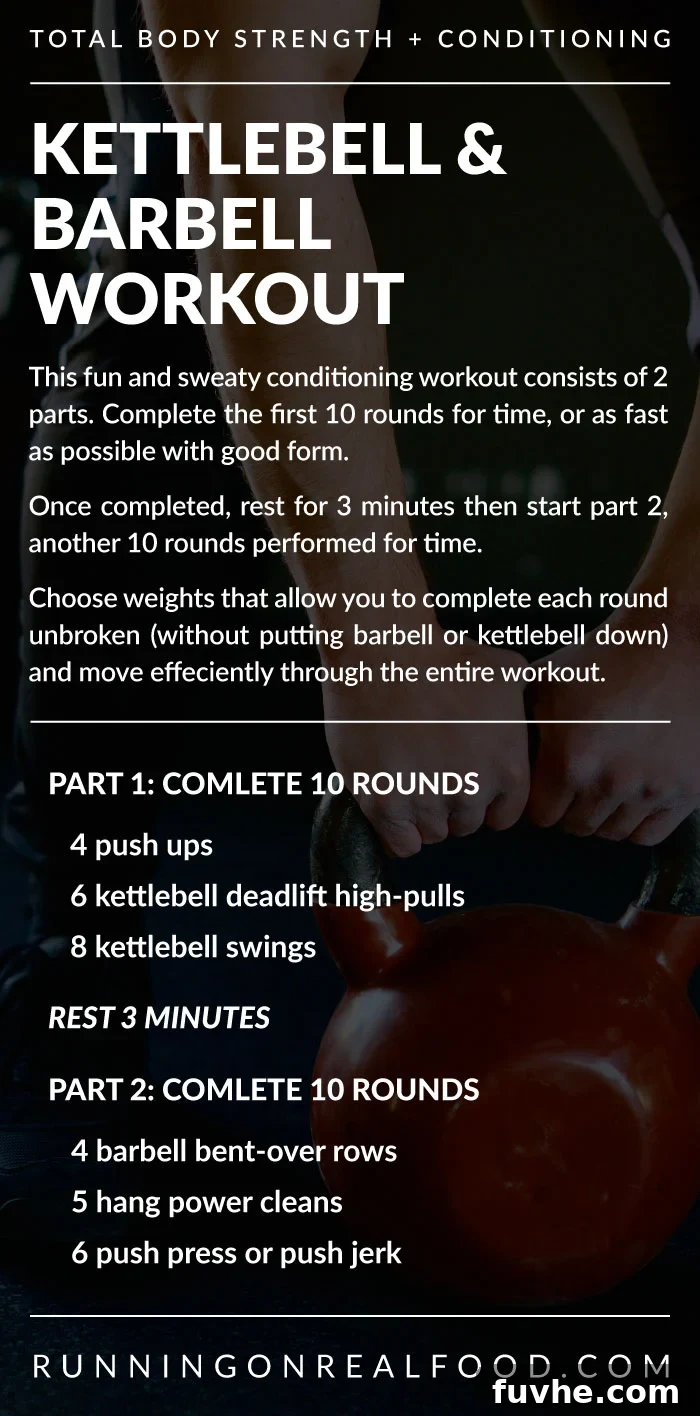
This workout is divided into two distinct parts, each designed to be completed for a specific number of rounds, with a crucial rest period in between. The goal for both sections is to complete each round “unbroken,” meaning you perform all repetitions of an exercise sequence without putting down the weight or taking an extended break. This approach maximizes the conditioning aspect and builds mental toughness.
View this workout on Instagram for a visual guide.
Workout Details: Part 1 – Explosive Kettlebell Power
Complete 10 Rounds of the following sequence, focusing on speed and controlled power:
- 4 Push-Ups:
- Description: A fundamental bodyweight exercise targeting the chest, shoulders, and triceps, with significant core engagement.
- Form Tip: Keep your body in a straight line from head to heels, core tight. Lower your chest towards the floor until your elbows are at about a 90-degree angle, then push back up powerfully.
- Scaling: For an easier modification, perform push-ups on your knees or against an elevated surface (like a bench). For a greater challenge, try decline push-ups or add a pause at the bottom.
- Muscles Targeted: Pectorals, deltoids, triceps, serratus anterior, abdominals.
- 6 Kettlebell Deadlift High-Pulls:
- Description: An explosive hip-hinge movement that transitions into an upright row, building power from the ground up.
- Form Tip: Start with the kettlebell between your feet. Hinge at your hips, keeping your back straight. Drive through your heels to stand up explosively, pulling the kettlebell vertically towards your chin, leading with your elbows. Control the descent.
- Scaling: Use a lighter kettlebell or focus on the deadlift portion without the high-pull if the movement is new. To increase intensity, focus on a faster, more powerful pull.
- Muscles Targeted: Glutes, hamstrings, lower back, lats, traps, deltoids.
- 8 Russian Kettlebell Swings:
- Description: A powerful, full-body ballistic exercise that strengthens the posterior chain and improves cardiovascular endurance.
- Form Tip: Stand with feet shoulder-width apart, kettlebell slightly in front. Hinge at the hips, swinging the kettlebell back between your legs. Drive your hips forward explosively, squeezing your glutes, to swing the kettlebell to chest height. The power comes from the hips, not the arms.
- Scaling: Use a lighter kettlebell or reduce the range of motion. For more advanced athletes, consider American kettlebell swings (overhead) or a heavier bell.
- Muscles Targeted: Glutes, hamstrings, lower back, core, shoulders, forearms.
After completing all 10 rounds of Part 1, rest for a full 3 minutes. This allows for partial recovery before moving to the barbell complex.
Workout Details: Part 2 – Barbell Strength and Power Complex
Complete 10 Rounds of the following barbell complex, striving for smooth, unbroken transitions:
- 4 Barbell Bent-Over Rows:
- Description: A foundational strength exercise that builds a strong, muscular back, essential for posture and pulling power.
- Form Tip: Hinge at your hips, keeping your back straight and nearly parallel to the floor. Let the barbell hang directly below your shoulders. Pull the barbell towards your lower chest/upper abdomen, squeezing your shoulder blades together. Control the eccentric (lowering) phase.
- Scaling: Use a lighter weight or perform seated cable rows as a modification. Increase intensity with heavier weight or a pause at the top of the pull.
- Muscles Targeted: Lats, rhomboids, trapezius, posterior deltoids, biceps, forearms.
- 5 Hang Power Cleans:
- Description: An explosive, full-body Olympic lifting movement that develops power, coordination, and strength.
- Form Tip: Start with the barbell hanging at mid-thigh (the “hang” position). Drive your hips and knees explosively, shrugging your shoulders and pulling the bar upwards. As the bar reaches peak height, rapidly drop under it into a quarter squat, catching the bar in the front rack position (elbows high). Stand up fully.
- Scaling: Use a very light barbell or an empty bar to practice the movement. Break down the movement into stages (deadlift to hang, hang shrugs, muscle cleans). Advanced lifters can increase weight.
- Muscles Targeted: Glutes, hamstrings, quads, calves, traps, deltoids, biceps, core.
- 6 Shoulder to Overhead (Push Press or Jerk):
- Description: This exercise involves moving the barbell from the front rack position to an overhead lockout, building shoulder and core strength. You can choose between a Push Press or a Jerk.
- Push Press (simpler): Dip slightly by bending knees, then explosively drive the bar overhead using leg power, finishing with arms locked out.
- Jerk (more advanced): Involves a double dip – an initial dip and drive to get the bar moving, followed by a second dip to catch the bar in a split or squat stance, then standing up.
- Form Tip: Maintain a strong core throughout. Drive through your heels. Ensure the bar travels directly overhead, finishing with locked elbows and the bar aligned over your mid-foot.
- Scaling: Start with an empty bar or dumbbells. Practice strict presses before attempting push presses. Advanced athletes should focus on jerks for maximal weight and power.
- Muscles Targeted: Deltoids, triceps, core, quads, glutes.
Recommended Weights: Finding Your Sweet Spot
Selecting the appropriate weight is paramount for both safety and effectiveness. The goal is to choose a weight that allows you to complete each set and round smoothly, maintaining excellent form, and ideally, without needing to put the weight down (“unbroken”).
- For the Kettlebell (Part 1):
- Aim for a weight you can move quickly and explosively, allowing you to complete all 6 high-pulls and 8 swings without needing to stop.
- Recommended range for most individuals is 16-24 kg. However, scale this strictly according to your current fitness level, experience, and technique. Beginners might start with 8-12 kg, while advanced users might challenge themselves with 28 kg or more. It’s better to go lighter and maintain perfect form than to go too heavy and risk injury or poor technique.
- For the Barbell (Part 2):
- Choose a weight that allows you to complete all 4 bent-over rows, 5 hang power cleans, and 6 shoulder-to-overhead repetitions “unbroken” within each round. This means you should be able to perform the entire complex without resting the bar on the floor.
- A general recommended range is 55-95 lbs (25-43 kg). I personally used 75 lbs (approximately 34 kg) for this workout. Adjust this range based on your strength and technical proficiency with Olympic lifts. Beginners should always start with an empty barbell (45 lbs/20 kg) or even a PVC pipe to master the complex movements before adding any weight. The hang power clean is a technical lift, and proper form is crucial.
Listen to your body. If your form starts to break down, reduce the weight. The consistency and quality of movement are more important than the amount of weight lifted, especially in a conditioning workout.
Safety First: Essential Tips for a Successful Workout
While challenging, this workout should always be performed with safety as your top priority. Adhering to these guidelines will help prevent injury and ensure a productive session:
- Prioritize Form Over Weight: Never sacrifice proper technique for heavier weight or faster reps. If your form deteriorates, lighten the load or slow down.
- Listen to Your Body: Pay attention to any sharp pain. “Good pain” (muscle burn, fatigue) is normal; “bad pain” (joint pain, sharp aches) is a signal to stop.
- Stay Hydrated: Drink water before, during, and after your workout.
- Control the Movement: Even on the descent, maintain control over the weight. Avoid letting gravity do all the work.
- Use a Spotter (Optional): For heavier barbell lifts, especially if you’re pushing your limits, having a spotter can provide an extra layer of safety.
- Proper Footwear: Wear stable, athletic shoes that provide good support for lifting and dynamic movements.
- Know Your Limits: It’s okay to scale down. Consistency and injury prevention are key to long-term progress.
Post-Workout Recovery: Your Cool-Down Routine
Just as important as your warm-up, a proper cool-down helps your body transition from an intense state back to rest. It promotes flexibility, reduces muscle soreness, and aids in recovery. Dedicate 5-10 minutes to static stretching.
- Static Stretches (hold each for 20-30 seconds):
- Quad Stretch
- Hamstring Stretch (seated or standing)
- Calf Stretch
- Chest Stretch (doorway stretch)
- Triceps Stretch
- Shoulder Stretch
- Child’s Pose
- Pigeon Pose (for hips and glutes)
Progressing with Your Workout: Continuous Growth
To continue seeing results, it’s essential to implement progressive overload. Here’s how you can make this workout more challenging over time:
- Increase Weight: Gradually lift heavier kettlebells or barbells while maintaining perfect form.
- Increase Reps or Rounds: Add an extra repetition to each exercise or an additional round to Part 1 or Part 2.
- Decrease Rest: If you’re feeling strong, slightly reduce the 3-minute rest period between parts.
- Improve Speed and Efficiency: Focus on making your transitions between exercises smoother and faster, reducing the time it takes to complete each round without sacrificing form.
- Reduce Workout Time: Aim to complete the entire workout in a shorter amount of time while keeping the same volume.
Conclusion: Embrace the Challenge
This kettlebell and barbell conditioning workout is more than just a series of exercises; it’s a test of your strength, endurance, and mental grit. It’s an opportunity to build a more powerful, resilient, and conditioned body. By combining the best of both worlds – the ballistic power of kettlebells and the foundational strength of barbells – you’re setting yourself up for incredible fitness gains. Remember to prioritize form, listen to your body, and celebrate every round you complete. Are you ready to take on this challenge and unleash your full potential? Grab your gear, warm up, and let the gains begin!
More Workouts to Fuel Your Fitness Journey
Looking for more intense and effective workouts to add to your routine? Explore these other challenging sessions designed to push your limits and help you achieve your fitness goals:
- 30-Minute Barbell and Burpee Workout
- Barbell and Burpee 30 Minute EMOM
- 25-Minute Burpee and Kettlebell EMOM
- Running, Burpee and Thruster Workout
- 40-Minute Kettlebell and Rowing Workout