
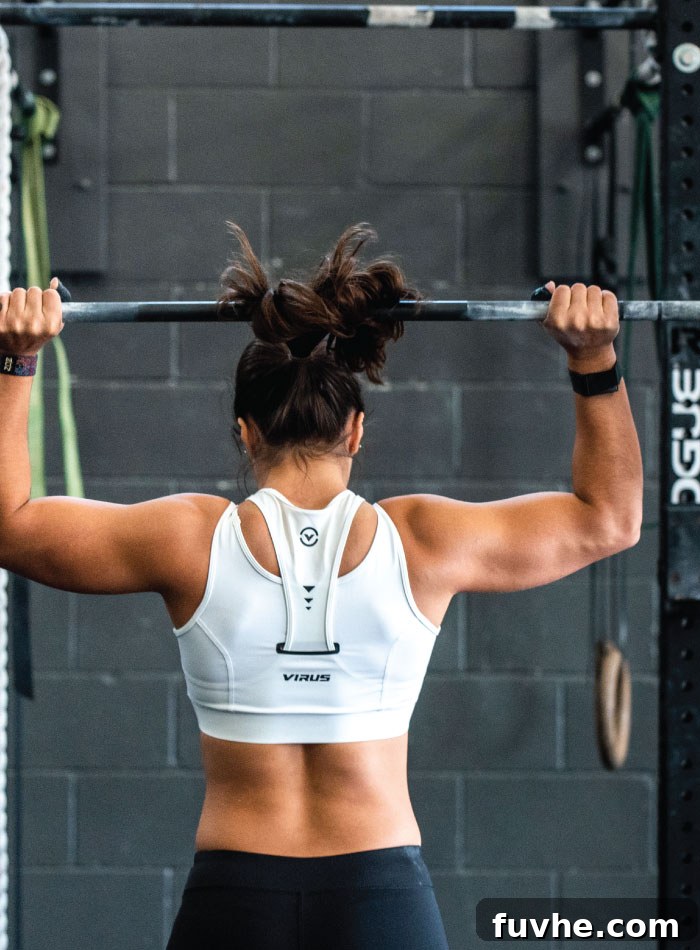
Unleash your full potential with this dynamic 35-minute treadmill and barbell workout, expertly designed to sculpt your physique, boost your endurance, and challenge your mental fortitude. This comprehensive program seamlessly blends high-intensity cardiovascular bursts with targeted full-body strength training, making it an ideal choice for anyone looking to maximize their fitness in a limited amount of time. You’ll navigate through 5 exhilarating rounds, each commencing with a rapid 400-meter run, immediately followed by a powerful sequence of barbell exercises targeting both your upper and lower body. Prepare to engage your muscles and ignite your metabolism with barbell step-ups, push presses, reverse lunges, and bent-over rows, all within a unique “every seven minutes” structure that keeps the intensity high and the rest strategic. This workout isn’t just about moving; it’s about pushing your limits and experiencing a transformative fitness journey.
Understanding the 35-Minute Strength & Barbell Workout Structure
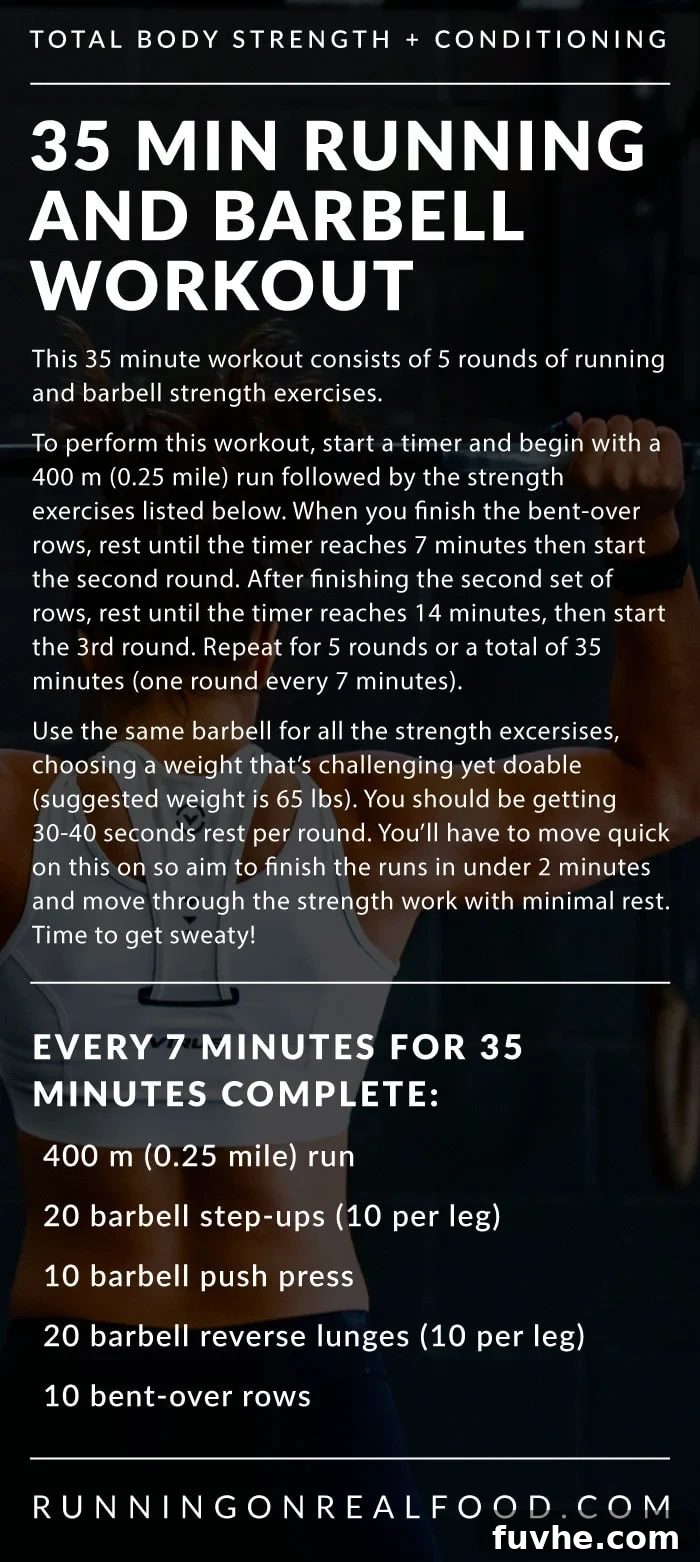
The core of this challenging full-body workout routine lies in its unique time-based structure: “Every 7 minutes for 35 minutes.” This might sound a little different from your typical gym session, but think of it as a variation of an EMOM (Every Minute On the Minute) workout, extended to a longer interval to accommodate a series of exercises. Essentially, you’ll complete a full circuit of running and barbell movements, then rest for the remainder of the 7-minute block, before kicking off the next round precisely when the clock hits another 7-minute mark. This structure ensures consistent effort and minimizes downtime, making every second of your 35 minutes count.
Here’s a detailed breakdown of each round, designed for optimal muscle engagement and cardiovascular benefit:
- 400m Treadmill Run: As soon as the clock begins, jump onto the treadmill or head outside to cover 400 meters (approximately 0.25 miles). The goal here is speed and efficiency; aim to complete this segment in 2 minutes or less. This initial sprint serves as a powerful cardio burst, elevating your heart rate and preparing your muscles for the strength work ahead.
- 20 Barbell Step-Ups (10 per leg): Immediately after your run, grab your barbell and place it across your upper back, resting comfortably on your shoulders. Find a sturdy box or bench and perform 20 step-ups, alternating legs for 10 repetitions on each side. Focus on driving through your heel, maintaining an upright posture, and controlling the descent. This exercise is phenomenal for building lower body strength, targeting your glutes, hamstrings, and quads, while also improving balance and stability.
- 10 Barbell Push Presses: Without much pause, transition into 10 barbell push presses. Start with the barbell at your shoulders, hands just outside shoulder-width. Dip slightly at the knees, then powerfully drive through your legs to press the barbell overhead, locking out your elbows at the top. Control the bar back down to your shoulders. The push press is a dynamic compound movement that builds explosive power in your shoulders, triceps, and legs.
- 20 Barbell Reverse Lunges (10 per leg): With the barbell still on your back from the step-ups, step backward with one leg into a lunge, lowering your hips until both knees are bent at approximately a 90-degree angle. Push off your back foot to return to the starting position, then repeat on the other side. Complete 20 total reverse lunges (10 per leg). This exercise is excellent for developing unilateral leg strength, improving balance, and isolating the glutes and hamstrings more effectively than traditional squats.
- 10 Barbell Bent-Over Rows: Finally, complete the strength circuit with 10 barbell bent-over rows. Hinge at your hips, keeping your back straight and core engaged, allowing the barbell to hang directly below your shoulders. Pull the barbell up towards your lower chest/upper abdomen, squeezing your shoulder blades together at the top, then slowly lower it back down. This movement is crucial for developing a strong, resilient back, improving posture, and strengthening the muscles that support your spine.
Once you’ve powered through all these exercises, note the time. The remaining seconds until the 7-minute mark are your designated rest period. When the clock hits 7:00, it’s time to hit the treadmill again for Round 2. You’ll repeat this entire sequence for 5 total rounds, concluding your intense 35-minute workout when the clock reaches 35:00.
Optimizing Your Performance and Maximizing Gains
This hybrid cardio and strength training workout is designed to be demanding, leaving you with minimal recovery time within each round. Expect to feel the burn and push your cardiovascular and muscular endurance to its limits. Here are some essential tips to help you navigate this challenging routine effectively and safely:
- Pace Your Run Strategically: While the goal is to finish the 400m run in under 2 minutes, don’t sprint so hard that you compromise your ability to perform the barbell exercises with good form. Find a pace that is challenging but sustainable across all five rounds. A consistent, strong pace is better than burning out in the first round.
- Seamless Transitions: The clock is always ticking. Practice quick transitions between the treadmill and the barbell, and between each barbell exercise. Every second saved here translates into more valuable rest time before the next round begins. Set up your equipment efficiently beforehand to avoid fumbling.
- Prioritize Form Over Speed (within reason): In the heat of the moment, it’s easy to let form slip to move faster. However, poor form increases the risk of injury and diminishes the effectiveness of the exercise. Focus on controlled movements, especially during the barbell exercises. If your form is breaking down, consider scaling the weight or reps.
- Embrace Minimal Rest: You might find yourself with as little as 30-40 seconds of rest per round, or even less, depending on your speed. Learn to embrace these short recovery windows. Use them to catch your breath, take a quick sip of water, and mentally prepare for the next round. This limited rest is key to building cardiovascular endurance and muscular stamina.
- The “No-Drop Bar” Challenge (Optional): The original design of this workout presented the challenge of performing all barbell exercises—step-ups, push presses, lunges, and rows—without ever putting the barbell down. This demands immense grip strength, muscular endurance, and mental toughness. While incredibly rewarding if achieved, it’s perfectly acceptable, and often advisable, to take short pauses between exercises to reset your grip, adjust your position, or simply catch your breath. Don’t feel pressured to keep the bar in hand if it compromises your form or safety.
- Listen to Your Body: Pay close attention to how your body feels. Fatigue is expected, but sharp pain is a warning sign. If something feels off, adjust immediately.
- Hydration is Key: Keep a water bottle within arm’s reach and take sips during your brief rest periods to stay adequately hydrated throughout the workout.
Modifications and Scaling for Every Fitness Level
This intensity-packed barbell and running circuit is highly adaptable, allowing individuals of all fitness levels to participate and benefit. The key to successful scaling is to choose modifications that challenge you without compromising proper form or leading to excessive fatigue that hinders subsequent rounds. The goal is to achieve at least 30-45 seconds of rest within each 7-minute window; if you find yourself getting less than 15-20 seconds, it’s a clear sign you need to adjust the difficulty.
Here’s how you can effectively scale this workout:
- Adjust Barbell Weight: This is the most straightforward way to scale. If you’re struggling to complete the barbell exercises with good form, or if you’re finding your rest periods are too short, reduce the weight on your barbell. Conversely, if you’re consistently finishing with plenty of time to spare and feel you could push harder, consider increasing the weight slightly in subsequent rounds or workouts.
- Bodyweight Alternatives: For beginners or days when your body needs less load, consider performing some or all of the lower body exercises (step-ups and reverse lunges) with just your bodyweight. This still provides an excellent challenge, builds muscular endurance, and focuses on movement mechanics. For the push presses and bent-over rows, you might use lighter dumbbells or a PVC pipe to practice form.
- Reduce Repetitions: If the prescribed 20 step-ups and lunges, or 10 presses and rows, are proving too much within the time limit, reduce the number of repetitions for one or more exercises. For example, try 10 step-ups (5 per leg) or 7 push presses. The aim is to complete the strength portion efficiently.
- Modify the Run: If 400 meters in under 2 minutes is too intense, you can shorten the running distance (e.g., 200m or 0.15 miles) or reduce the intensity by power walking or jogging at a comfortable pace. Alternatively, if outdoor running isn’t an option, you can substitute the run with another cardio exercise like rowing, cycling, or jumping jacks for a set duration (e.g., 90 seconds).
- Increase Rest (by reducing work): While the “every 7 minutes” structure dictates the start of each round, you can effectively “increase” your rest by reducing the total work you do within that 7-minute window (lighter weights, fewer reps, shorter run). This allows you to recover more fully and maintain intensity across all 5 rounds.
- Use Alternative Equipment: If you don’t have access to a barbell, dumbbells or kettlebells are excellent substitutes. For step-ups and lunges, hold a dumbbell in each hand or a kettlebell in the goblet position. For push presses, use dumbbells overhead. For bent-over rows, perform dumbbell rows with one or two dumbbells.
The goal is to find a modification that challenges you and encourages progression, ensuring you get the most out of every intense strength and cardio session.
Essential Equipment for Your Barbell & Running Circuit
To successfully execute this powerful full-body fitness routine, you’ll need access to a few key pieces of equipment. While variations are possible, having the right tools on hand will ensure the most effective and efficient workout experience.
- Treadmill or Outdoor 400m (0.25 mile) Running Route:
- Treadmill: This is often the most convenient option, allowing you to precisely track your distance and maintain a consistent pace regardless of weather conditions. Aim to set your treadmill to a challenging but sustainable speed that allows you to complete the 400m in under 2 minutes.
- Outdoor Route: If you prefer fresh air, a pre-measured 400-meter route (like a track or a marked path) is ideal. If not, you can use a GPS-enabled running app on your phone or watch to accurately measure the distance. Be mindful of traffic, pedestrians, and uneven terrain if running outdoors.
- Barbell plus Weight Plates:
- A standard Olympic barbell (typically 45 lbs/20 kg) is recommended, but a lighter women’s barbell or even a fixed-weight barbell can work if appropriate for your strength level.
- Weight Plates: You’ll need a selection of plates to adjust the total weight for each exercise. For this workout, the same barbell weight will be used for step-ups, push presses, lunges, and rows.
- Weight Guidance:
- Beginner: Start with an empty barbell (if 45 lbs) or add minimal weight, aiming for 25-55 lbs total. Focus heavily on mastering form before increasing load.
- Intermediate: A total weight of 55-85 lbs is often a good starting point, allowing for challenging reps while maintaining form.
- Advanced: If you’re highly experienced, you might use 85 lbs or more, pushing your limits while ensuring safety and proper technique.
- Alternatives: If a barbell isn’t available, two dumbbells of appropriate weight or a heavy kettlebell can be used for most exercises. For step-ups and lunges, hold a dumbbell in each hand or a kettlebell in the goblet position. For push presses, use dumbbells. For bent-over rows, perform single-arm or dual-dumbbell rows.
- Box or Bench:
- You’ll need one sturdy box or bench for the barbell step-ups. A standard plyometric box (like a 20-inch box) is ideal, offering a good height for a challenging step-up.
- Key Considerations: Ensure the box or bench is stable and won’t tip over during the exercise. It should be able to support your body weight plus the barbell weight.
- Alternatives: A sturdy park bench, a low wall, or even a robust set of stairs can serve as a suitable substitute if you don’t have access to a dedicated gym box. Always test its stability before loading it with weight.
Benefits of Incorporating This Dynamic Workout into Your Routine
This 35-minute barbell and treadmill workout isn’t just about moving; it’s a strategically designed program offering a multitude of benefits that contribute to overall health and fitness. By combining strength and cardio in a demanding, time-efficient format, you’ll experience noticeable improvements across several key areas:
- Enhanced Cardiovascular Endurance: The repeated 400m runs, especially when performed quickly, significantly challenge your cardiovascular system. This improves your heart and lung efficiency, allowing you to sustain higher intensity for longer periods, both in workouts and daily life.
- Increased Muscular Strength and Power: The barbell exercises (step-ups, push presses, lunges, rows) are compound movements that engage multiple muscle groups simultaneously. This leads to substantial gains in overall muscular strength, particularly in the legs, glutes, shoulders, and back. The push press, in particular, builds explosive power.
- Improved Full-Body Conditioning: This workout targets nearly every major muscle group while simultaneously pushing your cardio limits. This comprehensive approach builds well-rounded fitness, improving your body’s ability to perform various physical tasks with greater ease and efficiency.
- Effective Fat Burning and Metabolism Boost: The high-intensity nature of combining strength and cardio, coupled with minimal rest, creates an “afterburn” effect known as EPOC (Excess Post-exercise Oxygen Consumption). This means your body continues to burn calories at an elevated rate even after your workout is finished, aiding in fat loss and boosting your metabolism.
- Time Efficiency: In just 35 minutes, you get a powerful, full-body workout that addresses both strength and cardio needs. This makes it an ideal option for busy individuals who want to maximize their fitness results without spending hours in the gym.
- Mental Toughness and Discipline: Pushing through the discomfort of limited rest and maintaining focus on form during intense rounds builds significant mental resilience. This workout teaches you to persevere, manage fatigue, and stay disciplined, skills that extend beyond the gym.
- Versatility and Adaptability: As demonstrated in the scaling section, this workout can be easily modified to suit various fitness levels and equipment availability. This makes it a sustainable option that you can continue to challenge yourself with as you get stronger.
Integrating this dynamic workout into your weekly routine can be a game-changer for anyone looking for a comprehensive, challenging, and highly effective fitness solution.
Safety First: Important Considerations for Your Workout
While this challenging barbell and cardio circuit is incredibly effective, prioritizing safety is paramount to prevent injury and ensure a sustainable fitness journey. Taking a few precautionary steps can make all the difference:
- Thorough Warm-Up: Never skip your warm-up! Before diving into the first round, dedicate 5-10 minutes to light cardio (jogging, cycling) and dynamic stretches (arm circles, leg swings, torso twists). This prepares your muscles, increases blood flow, and improves joint mobility, significantly reducing the risk of strains or pulls.
- Prioritize Form Over Weight: This cannot be stressed enough. Using a weight that is too heavy and sacrificing proper form is a common cause of injury. If you find your technique breaking down, reduce the weight immediately. It’s far better to lift lighter with perfect form than heavier with sloppy movements.
- Listen to Your Body: Distinguish between muscle fatigue (the good burn) and sharp, sudden pain (the bad kind). If you experience any discomfort beyond typical muscle exertion, stop the exercise and assess. Pushing through pain can lead to serious injury.
- Stay Hydrated: Intense workouts like this lead to significant fluid loss. Ensure you are well-hydrated before, during, and after your session. Keep a water bottle within reach and take sips during your brief rest periods.
- Cool-Down and Stretch: After completing your 35 minutes, dedicate another 5-10 minutes to cooling down. This should include light cardio (walking) followed by static stretches, holding each stretch for 20-30 seconds. Stretching improves flexibility and aids in muscle recovery, reducing post-workout soreness.
- Proper Footwear: Wear appropriate athletic shoes that provide good support and stability, especially for running and lifting.
- Clear Your Space: Ensure your workout area is free of obstructions to prevent tripping or bumping into objects, particularly when transitioning quickly between exercises.
- Consult a Professional: If you are new to exercise, have any pre-existing medical conditions, or are unsure about proper technique, consult with a doctor or a certified fitness professional before starting this or any new workout program. They can provide personalized guidance and ensure the routine is suitable for your individual needs.
By keeping these safety considerations in mind, you can confidently undertake this demanding workout, pushing your limits while protecting your body.
Expand Your Fitness Journey: More Workouts to Explore
If you’ve enjoyed the challenge and effectiveness of this treadmill and barbell workout, you’ll be thrilled to discover a wider array of routines designed to push your limits and diversify your fitness regimen. Whether you’re seeking more hybrid strength and cardio, high-intensity interval training, or specific bodyweight challenges, these additional workouts offer unique ways to keep your body guessing and your motivation high. Explore these options to continue building strength, boosting endurance, and achieving your fitness goals.
- 30-Minute Barbell and Burpee Workout
- 30 Minute Rolling Hills Treadmill Workout
- 3-Part CrossFit AMRAP Workout
- Bodyweight and Running Workout For Time
- Killer Full-Body HIIT Workout