
Embark on a journey to elevate your cardiovascular fitness and build resilient aerobic endurance with this meticulously crafted steady-pace conditioning workout. Designed as a challenging yet incredibly rewarding pyramid structure, this session will test your stamina and consistency. You’ll dive straight into action with a dynamic 500-meter row, transitioning seamlessly into a circuit of burpees, powerful kettlebell swings, and fundamental air squats. The intensity builds towards a longer 1-kilometer row at the apex, before you strategically descend the other side of the pyramid, repeating the movements in reverse order. This workout isn’t just about moving fast; it’s about moving smart, maintaining a consistent effort that pushes your boundaries without burning you out prematurely. It’s a profound test of mental grit and physical staying power, promising significant gains in your overall aerobic capacity and full-body conditioning.
Mastering the Steady Pace: Understanding Your Workout Details
At its core, this workout is deceivingly simple: complete the prescribed movements “for time.” While this phrase often implies an all-out sprint to the finish, for this specific conditioning piece, “for time” carries a nuanced meaning. Your ultimate objective is to finish as quickly as possible, yes, but crucially, this must be achieved while maintaining excellent form and a consistent, steady pace throughout. Given the longer duration and the high volume of repetitions involved, adopting a strategy of relentless acceleration from the start is counterproductive and will likely lead to early fatigue and a significant drop in performance.
The true challenge lies in pacing. This is not a sprint, but a sustained effort designed to build your aerobic engine. Approach each movement with a deliberate, maintainable rhythm. Imagine a pace that feels “uncomfortable” but not “impossible” – a state where you are certainly working hard, breathing heavily, and feeling the burn, but you know, deep down, that you can sustain this effort for the entirety of the workout. A good rule of thumb for this steady-state effort is the “talk test”: you should be able to utter a few words or short phrases, but definitely not hold a full-blown conversation. If you can chat comfortably, you’re not pushing hard enough. If you’re completely unable to speak, you’re likely going too hard and risking early burnout. Finding this sweet spot is key to maximizing the aerobic benefits of this session.
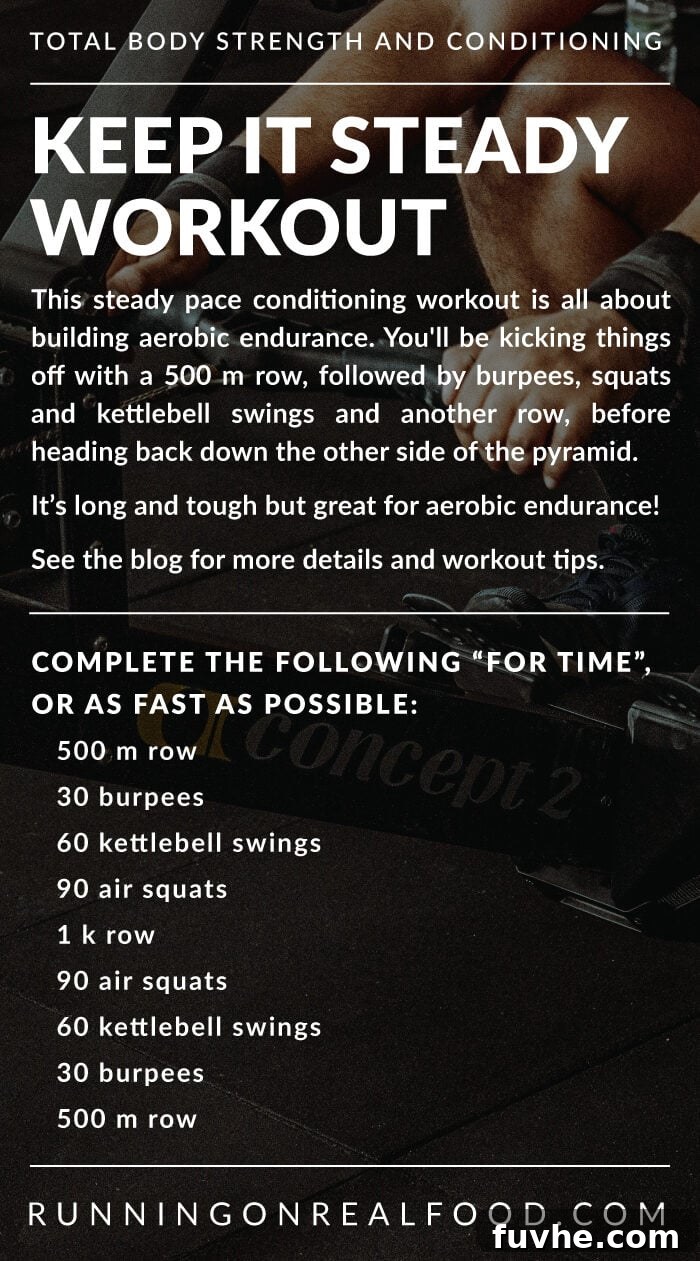
Here is the full workout structure to be completed “for time,” prioritizing a consistent, unwavering effort:
- 500 m row
- 30 burpees
- 60 kettlebell swings
- 90 air squats
- 1 k row
- 90 air squats
- 60 kettlebell swings
- 30 burpees
- 500 m row
Optimizing Your Performance: Essential Workout Tips
To truly conquer this conditioning workout and unlock its full potential for building aerobic fitness, strategic execution and mindful movement are paramount. Here are detailed tips for each component, designed to help you maintain that crucial steady pace and achieve your best performance:
Rowing: The Cardiovascular Foundation
The rowing segments—starting and ending with a 500m row, with a challenging 1k in the middle—are the backbone of your aerobic effort. For the 500m rows, an excellent goal for intermediate athletes is to complete each in 2 minutes or less. For the longer 1k row, aim for 4 minutes or less. Beginners, prioritize consistent effort over speed; target around 2:30 for the 500m rows and 5 minutes for the 1k row. Remember the “talk test” here: you should be able to get out a couple of words if absolutely necessary, but not full sentences. Focus on efficient technique: the powerful drive should come from your legs, followed by a slight lean back and then arm pull, reversing the movement smoothly on the recovery. Maintain a consistent stroke rate and power output; avoid sprinting the first few strokes only to fade significantly. Imagine yourself as a well-oiled machine, steadily propelling yourself through the water.
Burpees: Full-Body Conditioning at Pace
The 30 burpees in each half of the pyramid are potent full-body conditioners that demand significant cardiovascular and muscular endurance. The key to tackling 30 reps at a steady pace is to avoid explosive, maximum-effort burpees that will quickly drain your energy. Instead, focus on a controlled, fluid motion. Ensure your chest makes contact with the floor, and you jump with hands overhead at the top of each rep. For consistency, consider a slight modification if needed, such as stepping back into the plank rather than jumping, or eliminating the chest-to-floor component by performing “up-downs.” The goal is to keep moving without long breaks. Find a rhythm – perhaps one burpee every 3-5 seconds – and stick to it, allowing your breathing to dictate your pace rather than chasing a fleeting burst of speed.
Kettlebell Swings: Power and Posterior Chain Strength
Kettlebell swings are a powerful hip-hinge exercise, not a squat. The primary focus should be on driving with your hips and glutes, creating momentum for the kettlebell to swing to eye height. Keep your spine neutral throughout the movement; avoid rounding your back or leaning too far forward. For safety and consistency in this workout, focus on eye-height swings only, rather than overhead. Regarding weight selection, ladies can aim for a 16 kg kettlebell, while men can challenge themselves with a 24 kg kettlebell. If these weights feel too heavy to maintain form, opt for a lighter bell. For advanced athletes, aiming for two sets of 30 reps with minimal rest is an ambitious but achievable target. Beginners might find more success by breaking the 60 reps into four sets of 15, taking quick, controlled breaths between sets. The critical aspect is to minimize rest and maintain powerful, controlled swings.
Air Squats: Endurance in Lower Body Strength
With 90 air squats in the middle of this workout, maintaining a consistent, steady pace is paramount to completing them efficiently. Focus on proper form: descend until your hips are below your knees (achieving full depth), keep your chest up, and ensure your knees track over your toes. The challenge with high-volume squats lies in the muscular endurance of your legs and core. While it might be tempting to rush, a controlled, steady tempo will prevent your legs from burning out too quickly. If needed, brief, standing breaks of just a few seconds are acceptable to reset your breathing and shake out your legs. Avoid resting in the bottom of the squat, as this puts undue stress on your joints. Imagine a consistent up-and-down rhythm, breathing deeply with each repetition.
No Rowing Machine? Effective Alternatives
If you don’t have access to a rowing machine, don’t let that deter you from tackling this fantastic workout. You can easily substitute the rowing segments with running, either on a treadmill or outdoors. For a 500m row, a comparable effort can be achieved with a 400-meter run. For the 1-kilometer row, aim for an 800-meter run. On a treadmill, set a challenging but maintainable pace. If running outdoors, try to find a flat, consistent path. The key remains the same: maintain a steady, uncomfortable but sustainable pace, mirroring the aerobic effort you would exert on the rower. Adjust your pace to ensure it aligns with the “talk test” described earlier.
By focusing on these detailed tips and maintaining a disciplined approach to pacing, you will not only complete this challenging pyramid workout but also significantly enhance your aerobic capacity, muscular endurance, and mental fortitude. Every rep, every stroke, and every step contributes to building a stronger, more resilient you.
Continue Your Fitness Journey: More Workouts to Explore
Feeling invigorated and ready for additional challenges after mastering this steady-pace conditioning workout? Consistency is key to long-term fitness, and we’ve got a host of other effective routines to keep your training varied and engaging. Dive into these workouts to further expand your strength, endurance, and overall athletic capability. Each one offers a unique challenge, designed to push you further and help you discover new levels of fitness.
- 100-20-100 Reps for Time Workout
- 40-Minute Kettlebell and Rowing Workout
- Bodyweight and Running For Time Workout
- 30-Minute Aerobic Conditioning Workout