

Unleash your inner athlete with this dynamic no-equipment bodyweight and running workout. Designed for maximum efficiency and effectiveness, this routine perfectly blends cardiovascular endurance with functional strength training. By alternating high-intensity running intervals with powerful bodyweight exercises like burpees, sit-ups, air squats, and walking lunges, you’ll engage every major muscle group, elevate your heart rate, and boost your overall fitness.
The beauty of this workout lies in its incredible versatility and accessibility. Whether you’re at home, traveling, or simply don’t have access to a gym, all you need is a treadmill or a clear 400-meter (0.25-mile) outdoor route. This isn’t just a workout; it’s a challenge crafted to be completed “for time,” meaning your goal is to push your limits and finish as rapidly as possible while maintaining impeccable form. Get ready to experience a complete fitness transformation, anytime, anywhere.
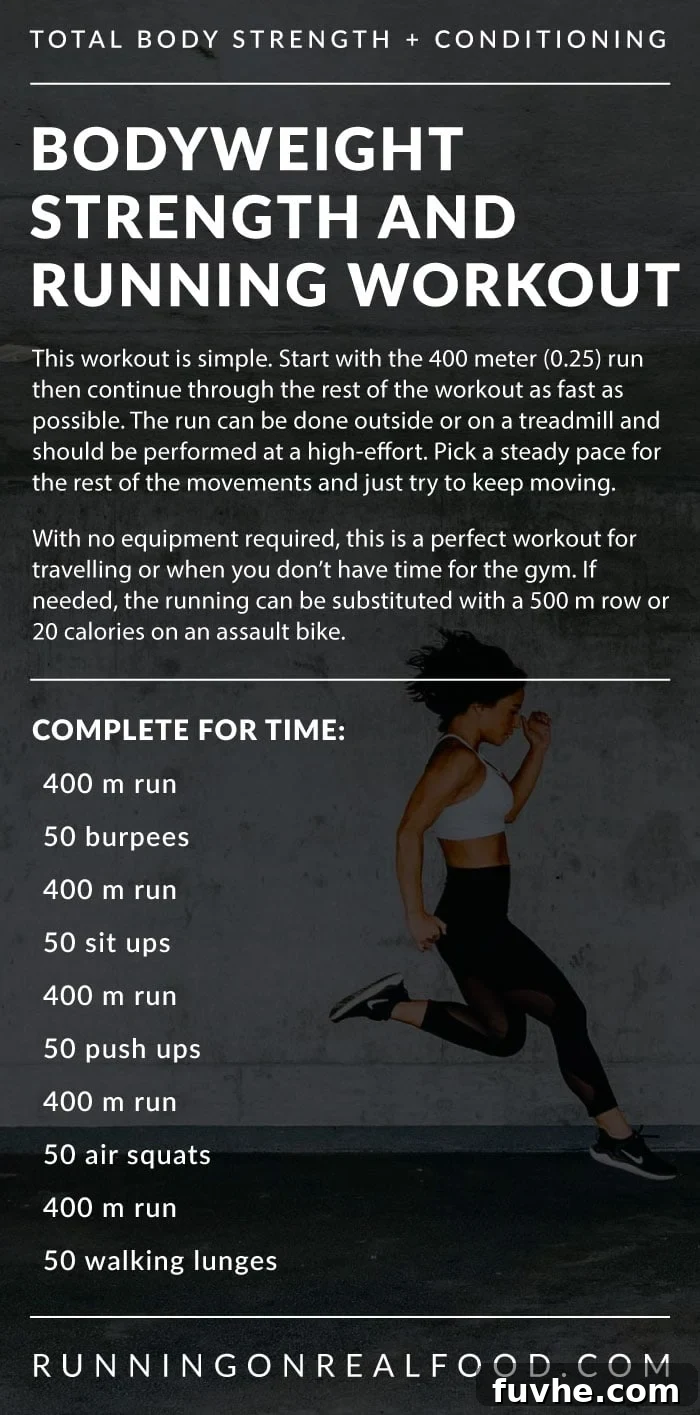
Your Comprehensive Bodyweight and Running Challenge: The “For Time” Protocol
This “for time” workout is a straightforward yet incredibly demanding circuit designed to test your endurance, strength, and mental grit. The objective is clear: complete all prescribed rounds and repetitions as quickly as you can. You’ll kick things off with a vigorous 400-meter run, setting the pace for the entire session. From there, transition seamlessly into the bodyweight exercises, striving to move continuously with minimal rest between movements. The clock starts at your first step and doesn’t stop until your final lunge, pushing you to discover your true capabilities.
Setting Up Your Performance Zone: Indoors or Outdoors
Flexibility is at the core of this workout’s design. The running segments can be performed either on a treadmill, allowing for precise distance and pace control, or outdoors, where you can embrace the elements and enjoy a change of scenery. Regardless of your chosen environment, aim for a high-effort pace during your runs. The goal is to challenge your cardiovascular system, not just to jog. For the bodyweight exercises, find a rhythm that allows you to maintain consistent movement without sacrificing proper technique. Remember, quality over quantity, but speed is still a factor.
No Treadmill? No Problem! Adaptable Cardio Substitutions
Life on the go often means limitations, but this workout is built to adapt. If a treadmill or a 400-meter outdoor route isn’t available, don’t let that stop you. Creative substitutions ensure you can still achieve a similar cardiovascular intensity. Consider these effective alternatives:
- Rower or Ski Erg: A 500-meter row or ski erg provides a fantastic full-body cardio blast, mimicking the endurance demands of running.
- Assault Bike: Push yourself through 20 calories on an assault bike. This challenging machine engages both your upper and lower body, delivering a powerful high-intensity interval.
- Other Cardio Equipment: Dedicate 2 minutes of high-effort on any cardio machine of your choice – be it an elliptical, StairMaster, or stationary bike. The key is to maintain a high level of intensity throughout the duration.
These substitutions ensure that the cardiovascular component remains robust, no matter your equipment availability.
The Full Circuit: Your Roadmap to Fitness
Here’s the complete breakdown of this challenging circuit. Perform each segment in the order listed, striving for speed and precision.
400 m Run
50 Burpees
400 m Run
50 Sit-ups
400 m Run
50 Push-ups
400 m Run
50 Air Squats
400 m Run
50 Walking Lunges (25 per leg)
Form First: Mastering Each Movement for Maximum Benefit
To maximize the effectiveness of this workout and prevent injury, proper form is paramount. Pay close attention to these cues for each exercise:
Burpees: The Ultimate Full-Body Blaster
The burpee is a cornerstone of functional fitness. Start standing, drop into a squat, kick your feet back into a plank, perform a push-up (optional but recommended), quickly bring your feet back to the squat position, and explode upwards into a jump with a clap overhead. Focus on fluidity and a strong core throughout. Avoid letting your hips sag in the plank or arching your back excessively during the jump.
Sit-ups: Engaging Your Core Effectively
Lie on your back with knees bent and feet flat on the floor, hands lightly behind your head or crossed over your chest. Engage your core to lift your shoulders and upper back off the ground, aiming to bring your chest towards your knees. Lower back down with control. The emphasis should be on core contraction, not pulling with your neck or using momentum. A common mistake is straining the neck; ensure your gaze remains forward or slightly upward.
Push-ups: Building Upper Body and Core Strength
Begin in a high plank position, hands slightly wider than shoulder-width apart, fingers pointing forward. Keep your body in a straight line from head to heels. Lower your chest towards the floor, keeping your elbows tucked in at a 45-degree angle to your body. Push back up to the starting plank position. If a full push-up is challenging, modify by performing them on your knees or against an elevated surface (like a bench or wall).
Air Squats: Foundation of Lower Body Power
Stand with feet shoulder-width apart, toes slightly out. Keep your chest up, shoulders back, and core engaged. Initiate the movement by pushing your hips back as if sitting in a chair, lowering until your thighs are parallel to the floor (or deeper if comfortable and form allows). Ensure your knees track in line with your toes. Drive through your heels to return to the standing position, squeezing your glutes at the top. Avoid letting your knees collapse inward.
Walking Lunges: Developing Leg Strength and Balance
Start standing tall. Step forward with one leg, lowering your hips until both knees are bent at approximately a 90-degree angle. Your front knee should be directly over your ankle, and your back knee should hover just above the ground. Push off your back foot to bring it forward, stepping into the next lunge with the opposite leg. Maintain an upright torso and stable core throughout. Focus on controlled movements and avoid losing balance.
Elevate Your Core Strength: The Optional 5-Minute Plank Finisher
Once you’ve conquered the main circuit, why not solidify your core strength with an incredibly effective finisher? This optional segment is designed to challenge your abdominal muscles, lower back, and entire core for sustained periods. Your mission: accumulate a total of 5 minutes in various plank positions. That’s right, 5 minutes of continuous core engagement, switching between plank variations as needed, with no rest! This isn’t just about holding a position; it’s about building incredible isometric strength and mental fortitude. You are stronger than you think, and you can definitely achieve this!
How to approach the 5-minute plank:
Alternate between high plank (on hands), low plank (on forearms), and side planks (on one forearm). Feel free to transition as many times as necessary to reach the 5-minute mark. Focus on keeping your body in a straight line, engaging your glutes and abs, and avoiding hip sagging or excessive arching of the back. This finisher is a fantastic way to conclude an already intense workout, leaving your core feeling powerfully worked.
Tailor Your Challenge: Scaling Options for Every Fitness Level
This workout is designed to be challenging, but it’s also highly adaptable. To ensure it matches your current fitness level and provides an effective yet manageable experience, you have two primary options for scaling:
- Reduce Bodyweight Exercise Repetitions: If 50 repetitions per exercise feels too daunting, reduce the count to 25. This allows you to maintain good form and intensity throughout the circuit without risking burnout or injury. As your strength improves, you can gradually increase the reps back towards 50.
- Shorten Running Distances: For those new to running or high-intensity cardio, consider reducing the length of each run to 200 meters, or 0.125 miles. This modification still provides a cardiovascular stimulus but makes the intervals more approachable, allowing you to focus on consistent effort. Over time, challenge yourself to increase the distance back to 400 meters.
Remember, the goal is to complete the workout with integrity and at a high effort. Don’t be afraid to scale down; it’s a smart way to build a strong foundation and ensure long-term progress.
Amp Up the Intensity: How to Make This Workout More Challenging
For seasoned athletes or those looking to push their limits further, there are several effective ways to increase the difficulty of this bodyweight and running workout. Progressive overload is key to continued growth:
- Increase Running Distances: Instead of 400-meter runs, extend each running segment to 800 meters. This doubles your cardiovascular output and significantly increases the endurance demand of the workout, making each bodyweight set feel even more challenging.
- Add External Weight to Bodyweight Exercises: Elevate the intensity of the air squats and walking lunges by incorporating external resistance.
- Goblet Squats and Lunges: Hold a single dumbbell or kettlebell against your chest during squats and lunges. This adds resistance while keeping the weight centered.
- Holding Two Dumbbells: For a more significant challenge, hold a dumbbell in each hand during your walking lunges and air squats.
- Weighted Vest: Wearing a weighted vest throughout the entire workout will increase the resistance on all bodyweight movements and add an extra layer of challenge to your runs.
- Barbell on Your Back: For advanced users, carefully place a barbell across your upper back for weighted squats and lunges (ensure proper safety precautions and form).
- Reduce Rest Intervals: While the workout is “for time” and naturally encourages minimal rest, consciously try to transition even faster between the run and bodyweight exercises, or between sets of exercises.
- Increase Reps or Rounds: For the truly ambitious, consider increasing the bodyweight reps to 75 or even 100 per exercise, or adding another full round to the entire circuit.
These methods ensure that as your strength and endurance grow, your workout can evolve with you, consistently providing a fresh challenge.
Prepare and Recover for Optimal Performance
To get the most out of this demanding workout and support your body’s recovery, always prioritize proper warm-up and cool-down routines.
The Importance of a Dynamic Warm-Up
Before diving into the intensity, spend 5-10 minutes on a dynamic warm-up. This prepares your muscles and joints for the strenuous activity ahead, increasing blood flow and reducing the risk of injury. Light cardio like jumping jacks, high knees, butt kicks, arm circles, leg swings, and torso twists are excellent choices to get your body ready.
Cool-Down and Stretching for Recovery
After completing the workout and the optional plank finisher, dedicate another 5-10 minutes to cooling down. This should include light cardio (like a slow walk) followed by static stretches, holding each stretch for 20-30 seconds. Focus on major muscle groups worked: hamstrings, quads, glutes, chest, shoulders, and core. Stretching aids in muscle recovery, improves flexibility, and helps prevent post-workout soreness.
Unlock Your Potential: Ready to Conquer?
This no-equipment bodyweight and running workout is more than just a series of exercises; it’s a testament to what you can achieve with consistency, effort, and a smart approach to fitness. Whether you’re a seasoned athlete or just starting your journey, this adaptable routine offers a fantastic way to build strength, boost endurance, and improve your overall health.
Embrace the challenge, focus on your form, and push for that “for time” record. You’ll be amazed at how quickly your body adapts and strengthens. Don’t forget to stay hydrated and nourish your body with wholesome foods to support your recovery and performance. Now, grab your running shoes, find your space, and get ready to sweat!
Discover More High-Intensity Workouts
Loved the challenge of this workout? We have plenty more to fuel your fitness journey and keep you engaged. Explore these other fantastic routines to continue building strength, endurance, and cardiovascular fitness:
Run Intervals Strength and Conditioning Workout • Strength and Conditioning EMOM Workout • HIIT Strength and Conditioning Workout