
Are you ready to challenge your strength, boost your core stability, and build functional muscle with just one piece of equipment? This comprehensive guide unveils a dynamic and **challenging single-arm dumbbell workout** designed to push your limits. Whether you have a single dumbbell, kettlebell, or even a barbell, this routine offers incredible versatility and effectiveness. Get ready to sculpt a more balanced physique, enhance your athletic performance, and ignite your metabolism. This isn’t just a workout; it’s a full-body journey that promises to leave you sweaty, strong, and deeply satisfied. It’s time to discover the immense power of unilateral training and transform your fitness routine!
Prepare Your Body: The Essential Warm-Up
Before diving into any intense training session, a proper warm-up is crucial. It prepares your muscles for action, increases blood flow, improves flexibility, and significantly reduces the risk of injury. Think of it as waking up your body and getting it ready for peak performance. Set a timer and perform 2 rounds of the following dynamic movements to elevate your heart rate and prime your major muscle groups:
- 30 seconds Jog in Place: A light cardio starter to gently raise your heart rate.
- 30 seconds High Knees: Engages your core and hip flexors, increasing agility.
- 30 seconds Jumping Jacks: A classic full-body warm-up, improving coordination and cardiovascular readiness.
- 30 seconds Butt Kickers: Activates your hamstrings and glutes, enhancing mobility.
- 30 seconds Fast Feet: Improves quickness and neurological activation.
- 30 seconds Bodyweight Squats: Activates your leg and glute muscles through a fundamental movement pattern.
Immediately follow this cardio circuit with 1 round of these mobility and active stretching movements to further prepare your joints and muscles for the demanding workout ahead:
- 10 Reverse Lunge with Stretch Overhead: Opens up your hips and chest while engaging your core. Perform 5 per leg.
- 20 Plank Shoulder Taps: Builds core stability and shoulder girdle strength, essential for single-arm movements.
- 10 World’s Greatest Stretch per Side: A comprehensive stretch that targets the hips, hamstrings, back, and chest, enhancing overall mobility.
This thorough warm-up ensures your body is primed and ready to tackle the main workout with optimal performance and safety.
The Ultimate Single-Arm Dumbbell Workout: Details & Execution
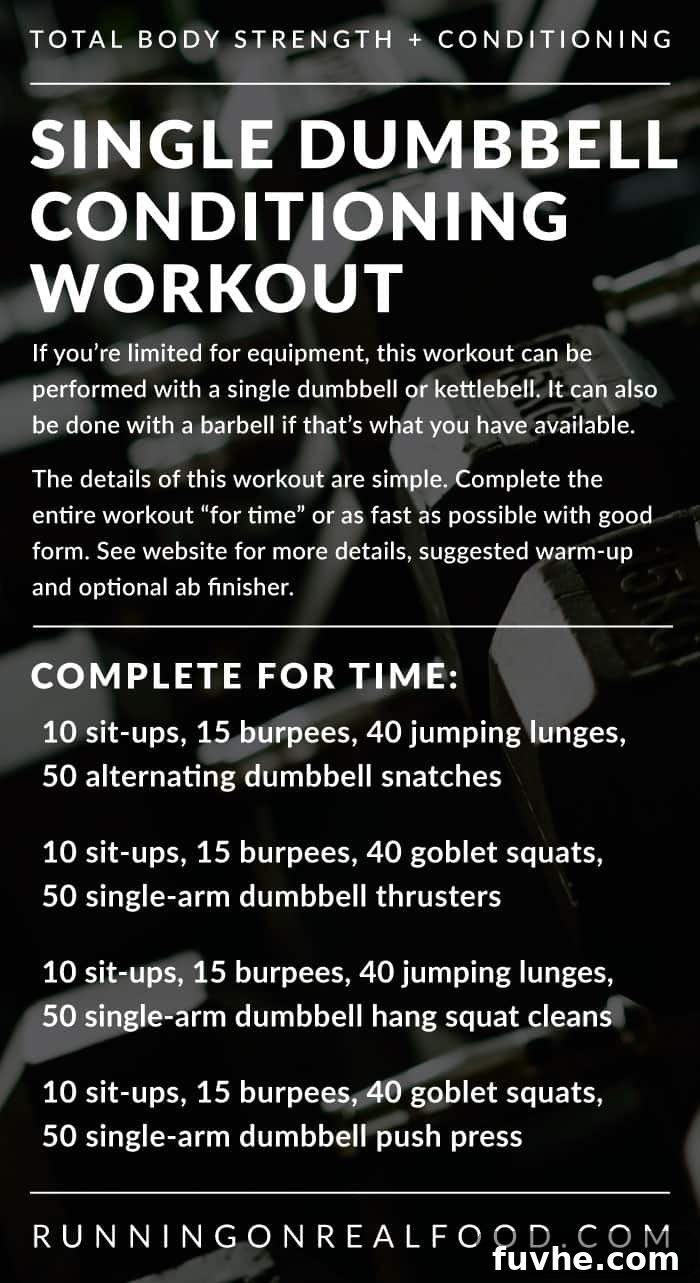
This high-intensity workout is structured into 4 challenging rounds, each designed to test your endurance, strength, and mental fortitude. The goal is to complete the entire workout “for time,” meaning you should aim to finish it as quickly as possible while maintaining excellent form. There is no programmed rest between movements or rounds; the intensity comes from the continuous effort. Focus on controlled movements and purposeful transitions to maximize efficiency and maintain an elevated heart rate throughout.
- Round 1: Power & Agility Focus
- 10 Sit-Ups: Engage your core directly. Focus on controlled movement, keeping your lower back pressed to the ground as you initiate the movement.
- 15 Burpees: A full-body explosive exercise that builds stamina and power. Ensure a full chest-to-ground descent and an explosive jump at the top.
- 40 Jumping Lunges: A dynamic leg exercise that builds explosive power and cardiovascular endurance. Maintain balance and soft landings.
- 50 Alternating Dumbbell Snatches (25 per arm): This unilateral powerhouse develops explosive full-body strength, coordination, and core stability. Drive through your heels, keep the dumbbell close to your body, and finish with a strong lockout overhead.
- Round 2: Strength & Stability Focus
- 10 Sit-Ups: Re-engage that core after the explosive movements.
- 15 Burpees: Keep pushing through this calorie-burner.
- 40 Goblet Squats: A fantastic exercise for building lower body strength and reinforcing proper squat mechanics while engaging the core. Keep your chest up and squat deep.
- 50 Single-Arm Dumbbell Thrusters (25 per arm): Combines a front squat with an overhead press, demanding incredible full-body power and coordination. Drive from your legs into the press.
- Round 3: Explosive Power & Coordination Focus
- 10 Sit-Ups: Maintain core integrity.
- 15 Burpees: Don’t let your form slip here!
- 40 Jumping Lunges: Reinforce power and stamina in the lower body.
- 50 Single-Arm Dumbbell Hang Squat Clean (25 per arm): A complex, technical lift that builds explosive power, core strength, and coordination. Focus on a strong hip drive and a quick catch into the squat.
- Round 4: Endurance & Overhead Strength Focus
- 10 Sit-Ups: The final core challenge.
- 15 Burpees: The last set of this full-body endurance test. Push through!
- 40 Goblet Squats: Finish strong with powerful legs and a stable core.
- 50 Single-Arm Push Press (25 per arm): Utilizes a slight leg drive to assist an overhead press, building shoulder strength and power. Use your legs for momentum, but focus on strong shoulder lockout.
Remember, while speed is a factor, maintaining proper form throughout each repetition is paramount to prevent injury and ensure maximum effectiveness. Listen to your body and adjust as needed, but strive for continuous movement to achieve the full metabolic benefits of this “for time” structure.
Core Crusher: Abs Finisher
After such a demanding full-body workout, an additional focus on your core can further enhance stability, strength, and definition. This abs finisher is designed to completely fatigue your abdominal muscles, leaving you with that satisfying burn. It’s a quick, intense circuit to cap off your training.
Complete 3 Rounds:
- 30 Flutter Kicks: Targets the lower abs and improves hip flexor endurance. Keep your lower back pressed to the ground.
- 30 Alternating Toe Touches: Works the upper abs and obliques. Reach for the opposite foot with each repetition.
- 30 seconds Right Side Plank: Builds oblique strength and full-body stabilization. Maintain a straight line from head to heels.
- 30 seconds Left Side Plank: Ensures balanced core development.
Post-Workout Cool-Down: Recovery is Key
Just as important as your warm-up, a proper cool-down helps your body transition from intense exercise back to a resting state. It aids in muscle recovery, reduces soreness, and improves flexibility. Dedicate 5-10 minutes to gentle stretching after your workout and abs finisher.
- Child’s Pose: Releases tension in the back and hips.
- Hamstring Stretch: Targets the back of your thighs.
- Quad Stretch: Relieves tightness in the front of your thighs.
- Pigeon Pose (per side): Excellent for hip flexibility.
- Overhead Triceps Stretch (per arm): Stretches the shoulders and triceps.
Hold each stretch for 20-30 seconds, breathing deeply and relaxing into the movement. This small investment in recovery will pay dividends in how you feel and perform in your next workout.
Frequently Asked Questions: Single-Arm Dumbbell Workout
What weight should I use for this single-arm workout?
Choosing the right weight is critical for both effectiveness and safety. The goal is to select a dumbbell that allows you to complete the movements with good form, but is challenging enough to make the final reps difficult. A good guideline is to pick a weight with which you could theoretically perform at least 30 reps of the single-arm dumbbell movements “unbroken” (without setting the dumbbell down) if you absolutely had to. This provides a baseline for sustained effort. As a starting point, many individuals find a 35 lb dumbbell for ladies and a 50 lb dumbbell for males to be a suitable challenge. However, listen to your body and don’t hesitate to adjust. If those weights feel too heavy, a 20-25 lb dumbbell can still provide an excellent workout for both men and women. The key is to challenge yourself while maintaining strict form, especially with the high rep count and “for time” structure.
I only have very light dumbbells… what can I do?
Having only light dumbbells (e.g., 5-15 lbs) doesn’t mean you can’t get an effective workout. You simply need to increase the intensity through other variables. Here are several strategies:
- Increase Reps: Instead of 50 snatches, perform 100 (50 per arm). This increases time under tension and cardiovascular demand.
- Double Up: If you have two light dumbbells, perform double dumbbell versions of the movements. For example, a double dumbbell thruster, double dumbbell hang squat clean, or double dumbbell push press. This increases the overall load.
- Slow Down Tempo: Control the eccentric (lowering) phase of each movement for 3-5 seconds. This increases time under tension and muscle fatigue.
- Minimize Rest: Strive to perform all movements unbroken without any rest. Transition immediately from one exercise to the next, and between arms.
- Focus on Form & Mind-Muscle Connection: With lighter weights, you can truly perfect your technique and intensely focus on squeezing the working muscle throughout the entire range of motion.
Remember, effort and consistency are more important than the absolute weight when building a solid fitness foundation.
Can I use a kettlebell instead of a dumbbell?
Absolutely! Kettlebells are fantastic tools for this workout. While there are slight differences in grip and weight distribution, the movements translate almost perfectly. The ballistic nature of kettlebell training might even add an extra layer of challenge and functional benefit to exercises like snatches and cleans. So, if a kettlebell is what you have, proceed with confidence – the workout will be just as effective.
Can I use a barbell instead of a dumbbell?
Yes, you can certainly adapt this workout to a barbell, which will introduce a different stimulus, often allowing for heavier loads and challenging bilateral coordination. For barbell adaptations, consider using weights around 65-85 lbs for ladies and 95-115 lbs for men as a starting point. However, scale this according to your individual strength and experience. Aim for a weight with which you could perform at least 20 reps of each movement unbroken if necessary. For single-arm movements, you would obviously need to switch to bilateral barbell equivalents (e.g., barbell snatches instead of single-arm dumbbell snatches). This will still be a highly effective and challenging workout.
Can I do this workout without equipment?
No equipment? No problem! This workout can be easily modified to be completed entirely with just your bodyweight, maintaining the intensity and full-body benefits. Here is a robust modified version you can do anywhere:
- Round 1 – 10 Sit-Ups, 15 Burpees, 40 Jumping Lunges, 50 Push-Ups (focus on a full range of motion, chest to ground)
- Round 2 – 10 Sit-Ups, 15 Burpees, 40 Bodyweight Squats (emphasize deep squats with controlled movement), 50 Mountain Climbers (maintain a plank position and drive knees to chest)
- Round 3 – 10 Sit-Ups, 15 Burpees, 40 Lunges (focus on smooth, alternating lunges), 50 Tricep Dips (use a sturdy chair, bench, couch, or stool to perform, focusing on triceps engagement)
- Round 4 – 10 Sit-Ups, 15 Burpees, 40 Bodyweight Squats, 50 Bodyweight RDLs (Airplanes) (focus on hinging at the hips, keeping your back straight, and feeling the stretch in your hamstrings and glutes)
This bodyweight alternative provides an excellent cardiovascular and strength challenge, proving that you don’t need fancy equipment to get an incredible workout.
How can I scale this workout for my fitness level?
This workout is highly adaptable to various fitness levels. If the prescribed movements or rep counts are too challenging, you can easily scale it down without losing effectiveness. Here are several ways to adjust the workout:
- Modified Burpees: Instead of a full burpee, step back into a plank, then step forward and stand up without the jump or push-up.
- Reverse Lunges: Scale the jumping lunges to reverse lunges, stepping back into each lunge without the explosive jump, focusing on control and balance.
- Bodyweight Squats: Replace goblet squats with standard bodyweight squats if holding a weight becomes too much.
- Lighter Weight: Use a lighter dumbbell or kettlebell. Even a few pounds can make a significant difference in perceived effort over many reps.
- Reduce Reps: Decrease the number of repetitions for each exercise. For example, instead of 50 single-arm movements, try 30 (15 per arm), or 20 (10 per arm) to build up your endurance.
- Add Short Rests: While the workout is designed for no rest, if you are struggling, allow yourself very short, controlled breaks (e.g., 5-10 seconds) between movements or arms to catch your breath.
Always prioritize good form over speed or weight. As you get stronger, you can progressively increase the challenge.
The Power of Unilateral Training: Benefits of Single-Arm Workouts
This single-arm dumbbell workout is more than just a challenging routine; it’s a strategic approach to building a more resilient and functional body. Unilateral (single-limb) training offers unique benefits that bilateral (two-limb) training often misses:
- Addresses Muscle Imbalances: Most people have a dominant side. Single-arm training forces each side to work independently, revealing and correcting imbalances that can lead to injury and limit performance.
- Enhances Core Stability: Holding a weight on one side creates an inherent challenge to your core. Your abdominal and oblique muscles must work harder to prevent rotation and maintain an upright posture, leading to a stronger, more stable trunk.
- Improves Functional Strength: Many daily activities and sports movements (throwing, carrying groceries, swinging a golf club) are unilateral. Training in this manner directly translates to better real-world strength and athletic performance.
- Increases Grip Strength: Holding a single dumbbell for extended periods, especially during high-rep movements, provides an excellent forearm and grip strength workout.
- Boosts Mind-Muscle Connection: Focusing on one limb allows for a deeper connection with the working muscles, improving control, awareness, and recruitment efficiency.
- Greater Calorie Burn: The increased demand on stabilization and the continuous nature of single-arm movements often lead to a higher metabolic cost and greater calorie expenditure.
Incorporating single-arm movements like those in this workout is a powerful way to elevate your overall fitness, prevent injury, and unlock new levels of strength and athleticism.
Tips for Maximizing Your Workout Success
To get the most out of this challenging single-arm dumbbell workout and ensure sustainable progress, consider these essential tips:
- Prioritize Form Over Speed: While this is a “for time” workout, never sacrifice proper technique for a faster finish. Poor form increases injury risk and reduces effectiveness. If your form starts to break down, take a brief pause or reduce the weight/reps.
- Controlled Breathing: Focus on your breath. Exhale during the exertion phase and inhale during the recovery phase. Proper breathing helps with energy regulation and muscle oxygenation.
- Stay Hydrated: Drink plenty of water before, during, and after your workout. This high-intensity routine will make you sweat, and hydration is key for performance and recovery.
- Fuel Your Body: Support your efforts with a balanced diet rich in whole foods, lean protein, complex carbohydrates, and healthy fats. Proper nutrition is the foundation of strength and recovery.
- Listen to Your Body: Pay attention to any pain signals. Push through discomfort, but never work through sharp pain. Take rest days when needed to allow for muscle repair and growth.
- Track Your Progress: Note down your completion time, the weights you used, and any modifications. This allows you to see your improvements, stay motivated, and set new goals.
- Consistency is Key: Incorporate this workout or similar challenging routines into your fitness regimen regularly. Consistent effort yields the best results over time.
Embrace the challenge, stay disciplined, and enjoy the incredible results that come with this powerful single-arm dumbbell workout!
Ready to Transform Your Fitness? Conclusion
This single-arm dumbbell workout is a testament to the power of functional, high-intensity training with minimal equipment. It’s designed not just to make you sweat, but to build balanced strength, explosive power, and unwavering core stability. By challenging each side of your body independently, you’re forging a more resilient, capable physique that translates directly to improved performance in all aspects of life. Embrace the intensity, maintain impeccable form, and push your limits. The results—a stronger, more balanced, and incredibly fit you—will be well worth every drop of sweat. Grab your dumbbell and get started on your journey to peak performance today!
More Workouts to Ignite Your Routine
- 30-Minute Dumbbell EMOM
- 30-Minute Bodyweight EMOM
- No-Equipment Strength Training Workout
- 45-Minute No-Equipment HIIT Workout