
Are you searching for an incredibly effective, full-body workout that requires absolutely no equipment and can be done almost anywhere? Look no further! This comprehensive bodyweight strength and conditioning routine is a game-changer for anyone short on time, traveling, or simply preferring to train without gym equipment. Its simplicity belies its power, delivering a potent punch of muscle engagement and cardiovascular challenge in a remarkably efficient package.
Imagine fitting a complete workout into your lunch break, or getting a sweat session in while on the road, all without needing a single piece of gear. That’s the beauty of this routine. I’ve personally experienced the effectiveness and convenience, often completing it in under 30 minutes – a true testament to workout efficiency and smart time management!
Embrace the Power of Bodyweight Training: Your Ultimate Fitness Solution
Bodyweight training isn’t just a convenient alternative; it’s a foundational approach to fitness that empowers you to build strength, endurance, and agility using your most readily available resource – your own body. This method offers a myriad of compelling benefits that make it an ideal choice for individuals of all fitness levels and diverse lifestyles:
- Unmatched Versatility & Freedom: Free yourself from the confines of a gym. This workout can be performed seamlessly in your living room, a local park, a hotel room, or even a small office space. All that’s required is a bit of clear ground, making it perfect for spontaneous sessions or when you’re on the go.
- Completely Cost-Effective: Eliminate the need for expensive gym memberships, personal trainers, or bulky home equipment. Bodyweight training is entirely free, democratizing access to effective fitness for everyone, regardless of budget.
- Builds Superior Functional Strength: Bodyweight exercises frequently mimic natural human movements like pushing, pulling, squatting, and bending. This focus cultivates practical strength, improves balance, enhances coordination, and boosts flexibility in ways that directly translate to improved performance in daily activities and other sports. You’re not just moving weight; you’re mastering control over your own physical being.
- Enhances Core Stability & Posture: A significant advantage of bodyweight movements is their inherent demand for core engagement. Nearly every exercise in this routine will challenge your abdominal and lower back muscles, leading to a stronger, more stable core. This translates to better posture, reduced risk of back pain, and a more robust foundation for all physical endeavors.
- Reduced Risk of Injury: By emphasizing proper form and natural movement patterns, bodyweight exercises can help strengthen crucial stabilizing muscles and connective tissues around your joints. This holistic strengthening approach can potentially lower your risk of injury compared to training with heavy external loads, especially for beginners.
- Boosts Cardiovascular Health & Endurance: When performed with intensity and minimal rest, bodyweight circuits transform into potent conditioning tools. The continuous movement keeps your heart rate elevated, improving your cardiovascular health, stamina, and overall endurance. It’s a fantastic way to get your cardio in without traditional running or cycling.
- Perfect for Travel & Outdoor Workouts: Maintaining a fitness routine while traveling can be a significant hurdle. This no-equipment workout eliminates the need to seek out a gym or pack resistance bands, allowing you to stay active and healthy wherever your adventures take you. Enjoy the fresh air and invigorating change of scenery that outdoor workouts provide!
Workout Details: Your Blueprint for a Full-Body Transformation
This meticulously designed workout targets all major muscle groups – your core, upper body, lower body – while simultaneously challenging your cardiovascular system. The primary objective is to complete the main workout circuit as rapidly as possible, minimizing rest between exercises and rounds. While speed is a goal, never compromise on form. Listen to your body, work at a challenging but sustainable pace, and always strive for proper execution over sheer velocity. Push yourself, but understand your limits to ensure safety and effectiveness.
Phase 1: Dynamic Warm-Up – Preparing Your Body for Peak Performance
Never, under any circumstances, skip your warm-up! This crucial preliminary phase prepares your muscles and cardiovascular system for the upcoming intensity, significantly helping to prevent injuries and optimize your performance throughout the workout. The goal is to feel warm, slightly out of breath, and perhaps breaking a light sweat by the end of it. If you prefer your own warm-up routine, feel free to use it, but ensure it includes dynamic movements that elevate your heart rate and prepare your entire body.
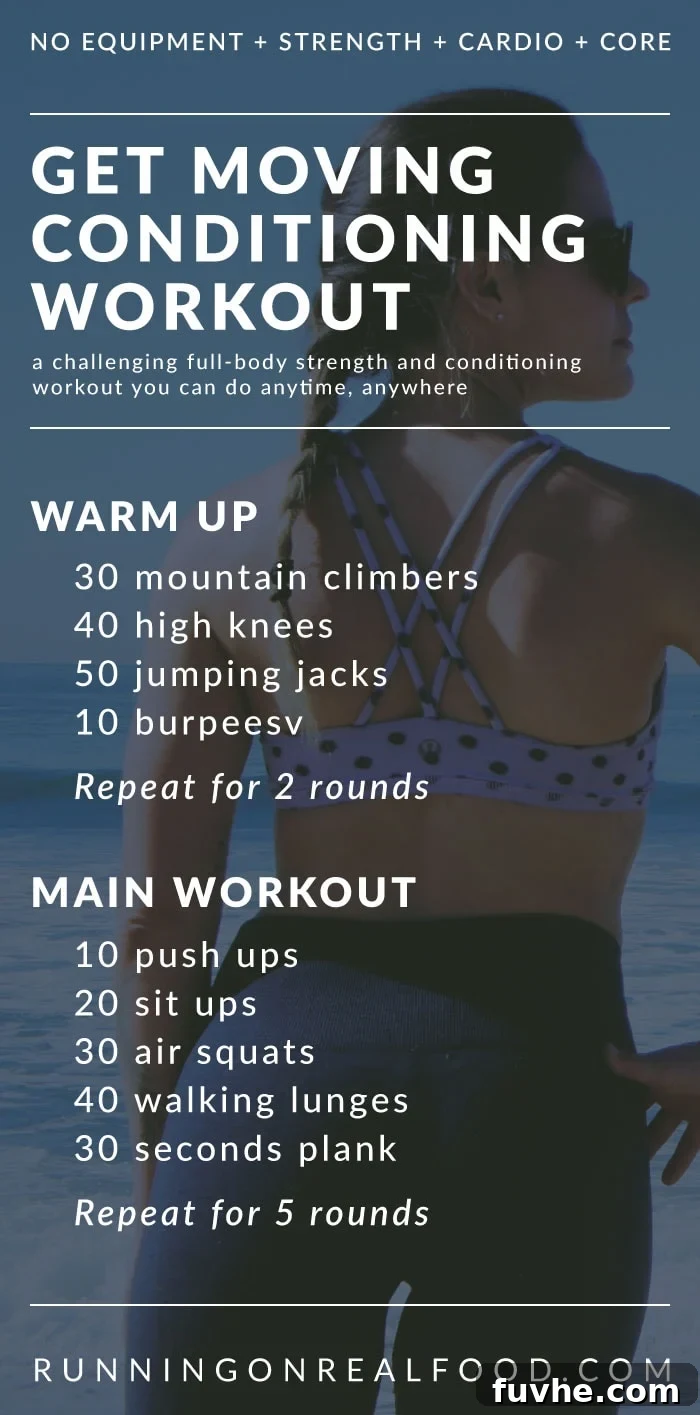
Recommended Warm-Up Routine:
- 30 Mountain Climbers: A phenomenal full-body exercise that engages your core, shoulders, and legs while rapidly elevating your heart rate. Focus on maintaining a plank-like position, keeping your hips low, and bringing your knees towards your chest with controlled, alternating movements.
- 40 High Knees: Excellent for robust cardiovascular conditioning and actively activating your hip flexors, quadriceps, and glutes. Drive your knees up towards your chest as high as possible, pumping your arms vigorously in sync with your legs.
- 50 Jumping Jacks: A classic for a reason! Jumping jacks are a superbly effective way to quickly increase heart rate, warm up your entire body’s major muscle groups, and improve overall coordination.
- 10 Burpees: The ultimate full-body conditioning exercise. Burpees are a demanding, multi-joint movement that challenges your strength, endurance, and coordination, serving as an ideal precursor to the main workout’s intensity.
Repeat this entire warm-up circuit for 2 rounds. Take minimal rest between individual exercises and between the two rounds to maintain an elevated heart rate and keep your body primed.
Phase 2: Main Workout – The Core of Your Strength & Conditioning Transformation
This is where the real work begins, demanding your focus and determination. The main workout consists of a challenging circuit of five fundamental bodyweight exercises, each designed to push your limits. You will repeat this entire circuit for a total of 5 rounds. The aim is to complete each round with unwavering focus and strong execution, always prioritizing proper form over raw speed. As you progress, you’ll find yourself able to move faster while maintaining excellent technique.
Main Workout Circuit:
- 10 Push-Ups: A cornerstone exercise for developing formidable upper body strength, primarily targeting your chest (pectorals), shoulders (deltoids), and triceps, with substantial engagement from your core stabilizers.
- 20 Sit-Ups: An exceptionally effective exercise for strengthening your rectus abdominis (the “six-pack” muscle) and improving overall core endurance and flexibility.
- 30 Air Squats: A fundamental and highly functional lower body exercise that comprehensively works your quadriceps, hamstrings, glutes, and core, while simultaneously improving critical hip and ankle mobility.
- 40 Walking Lunges (20 per leg): An outstanding exercise for developing unilateral leg strength, enhancing balance, and improving hip flexibility, effectively targeting your quadriceps, glutes, and hamstrings on each leg independently.
- 30 seconds Plank: A supremely powerful isometric exercise that builds incredible core strength, stability, and endurance across your entire midsection, including your rectus abdominis, obliques, and transverse abdominis.
How to Perform: Begin in a strong plank position, ensuring your hands are slightly wider than shoulder-width apart with fingers pointing forward. Keeping your body in a rigid, straight line from the crown of your head to your heels, lower your chest towards the floor by bending your elbows. Once your chest is just above the ground, powerfully push back up to the starting plank position.
Scaling (Easier): If full push-ups are too challenging, perform them on your knees, or against an elevated surface such as a counter, bench, or wall to reduce the load.
Scaling (Harder): To increase difficulty, try placing your feet on an elevated surface (decline push-ups) or narrowing your hand position (diamond push-ups).
How to Perform: Lie on your back with your knees bent and feet flat on the floor, positioned about hip-width apart. You can place your hands gently behind your head (without pulling on your neck) or crossed over your chest. Engage your core muscles to lift your upper body towards your knees, ensuring your lower back remains pressed into the floor as you initiate the movement. Slowly and with control, lower your torso back down to the starting position.
Scaling (Easier): To make sit-ups less challenging, use your arms to generate a slight momentum forward.
Scaling (Harder): To increase the difficulty, hold a light weight (e.g., a small dumbbell or medicine ball) to your chest, or extend your arms overhead.
How to Perform: Stand tall with your feet positioned roughly shoulder-width apart, with your toes pointing slightly outwards. Keep your chest lifted high and your core actively engaged. Initiate the movement by pushing your hips back as if you are sitting down into an imaginary chair, bending your knees. Descend until your thighs are parallel to the floor (or as deep as your comfort and mobility allow), always ensuring your knees track directly in line with your toes and do not collapse inward. Drive powerfully through your heels to return to the upright standing position.
Scaling (Easier): For beginners, focus on not going as deep into the squat, or use a chair to tap your glutes before standing up.
Scaling (Harder): For advanced practitioners, incorporate a jump at the top of the squat (jump squats) for explosive power, or introduce a pause at the bottom of the movement to increase time under tension.
How to Perform: Begin standing tall with your feet hip-width apart. Take a purposeful step forward with one leg, then lower your hips straight down until both knees are bent at approximately a 90-degree angle. Crucially, ensure your front knee is positioned directly above your ankle and your back knee hovers just above the ground. Push off your back foot to bring it forward, stepping immediately into the next lunge with the opposite leg. Maintain an upright torso and engaged core throughout the entire movement.
Scaling (Easier): If walking lunges prove too difficult, perform stationary lunges (lunge on one leg for all reps, then switch) to focus on stability.
Scaling (Harder): To dramatically increase intensity, perform jumping lunges, exploding upwards and switching legs in mid-air.
How to Perform: Start in a standard push-up position, then lower down onto your forearms, ensuring your elbows are directly beneath your shoulders. Your body must form a perfectly straight line from the crown of your head to your heels. Actively engage your core, glutes, and quadriceps to prevent your hips from sagging towards the floor or lifting too high towards the ceiling. Hold this rigid position for the prescribed duration, focusing on deep, controlled breathing.
Scaling (Easier): If a full plank on your forearms is too challenging initially, drop down to your knees while maintaining the straight line from head to knees.
Scaling (Harder): To significantly increase difficulty, try a single-arm plank or a single-leg plank, or elevate your feet.
Repeat this entire main workout circuit for 5 challenging rounds. Aim for minimal rest between exercises within a round and between the rounds themselves. Consider timing your entire workout from start to finish to track your progress and encourage future improvements!
Phase 3: Cool-Down – The Essential Concluding Phase for Recovery
After pushing your body through such a challenging and invigorating workout, a proper cool-down is absolutely vital for promoting effective recovery. This critical phase helps to gradually lower your heart rate, reduce muscle soreness (DOMS – Delayed Onset Muscle Soreness), and improve overall flexibility. Dedicate a focused 5-10 minutes to static stretching, holding each stretch for 20-30 seconds. Concentrate on the major muscle groups that were actively worked during the routine: your chest, triceps, shoulders, abdominals, quadriceps, hamstrings, and glutes.
Making This Workout Your Own: Strategies for Progression and Sustained Consistency
The inherent beauty of bodyweight training lies in its incredible adaptability and scalability. As you consistently perform this routine and grow stronger, you’ll naturally want to challenge yourself further to continue seeing measurable results and avoiding plateaus. Here are several effective ways to progressively advance this dynamic workout:
- Increase the Number of Rounds: Once completing 5 rounds feels consistently comfortable and less challenging, try incrementally adding a 6th, 7th, or even an 8th round to extend your workout duration and volume.
- Reduce Rest Intervals: Systematically decrease the amount of rest time you take between individual exercises within a round and between the completion of each round. This will significantly elevate the cardiovascular demand and intensify the metabolic challenge.
- Refine Your Form: Continuously strive to perfect your technique for every single exercise. Focus on achieving a deeper range of motion (where appropriate) and executing stricter, more controlled movements. Perfect form not only prevents injury but also maximizes muscle activation.
- Increase Repetitions or Duration: For exercises like push-ups, sit-ups, and squats, gradually increase the number of repetitions you perform within each round. For the plank, extend your hold time beyond 30 seconds, aiming for 45, 60, or even 90 seconds.
- Introduce Advanced Variations: As highlighted in the individual exercise descriptions, actively explore more challenging variations. Examples include explosive jump squats, dynamic jump lunges, single-leg planks for enhanced core stability, or narrow-grip diamond push-ups for greater tricep isolation.
- Incorporate a Weighted Vest: If you truly desire to escalate the challenge without introducing traditional external equipment, a quality weighted vest can drastically increase the resistance for all these bodyweight movements, pushing your strength and endurance to new levels.
Remember, consistency is the undisputed king in fitness. Aim to perform this full-body bodyweight workout 2-4 times per week, ensuring you allow for adequate rest days in between sessions to facilitate optimal muscle recovery and growth. Combine this dedicated physical effort with a balanced, nutrient-rich diet and sufficient hydration, and you will be incredibly well on your way to achieving, and even surpassing, your fitness goals.
Discover More Workouts to Keep You Engaged and Progressing
If you’ve enjoyed the intensity, efficiency, and full-body benefits of this no-equipment bodyweight routine, we invite you to explore some of our other challenging and diverse workouts. These routines are thoughtfully designed to push your limits, introduce new stimuli, and help you diversify your overall fitness regimen:
- Running, Thruster and Burpee Workout
- Leg Strength Cardio Workout
- 30 Minute EMOM Conditioning Workout
Now that you possess all the essential tools, comprehensive knowledge, and motivational insights, there is truly no excuse. Go get after it with passion, embrace the transformative challenge of bodyweight training, and revel in the incredible physical and mental benefits that await you!