
This core and glutes bodyweight workout challenges the abs and lower body – no equipment needed!
Sculpt Your Core & Glutes: The Ultimate No-Equipment Bodyweight Workout
Welcome to your go-to guide for building powerful core and glute strength, all from the comfort of your home and without a single piece of equipment. This comprehensive bodyweight workout is meticulously designed to challenge your abdominal muscles, strengthen your glutes, and enhance overall lower body power, making it perfect for anyone looking to improve their fitness, boost athletic performance, or simply feel stronger in their daily life.
Bodyweight training is incredibly effective and accessible, allowing you to build functional strength by using your own body as resistance. It emphasizes proper form, muscle control, and core stability, which are crucial for injury prevention and efficient movement. Get ready to activate every major muscle group in your core and glutes with this challenging yet rewarding routine!
Why a Strong Core and Glutes Matter
Often overlooked, the core and glutes are the powerhouses of your body, playing a pivotal role in almost every movement you make. A strong core (which includes your abs, obliques, and lower back) provides stability for your spine, improves posture, and enhances balance. It’s essential for everything from lifting groceries to running and jumping, acting as the foundation for all limb movements.
Similarly, strong glutes (buttocks muscles) are vital for lower body power, stability, and preventing injuries. They support your pelvis, help with hip extension, rotation, and abduction, and are crucial for activities like walking, climbing stairs, and squatting. Weak glutes can contribute to knee pain, lower back issues, and poor posture. By focusing on these two muscle groups, you’ll not only look and feel better but also move more efficiently and reduce your risk of common aches and pains.
Prepare Your Body: Essential Warm-Up Routine
Before diving into any workout, a proper warm-up is non-negotiable. It’s crucial for increasing blood flow to your muscles, elevating your heart rate gradually, improving joint mobility, and preparing your nervous system for the demands of exercise. Skipping the warm-up can increase your risk of injury and diminish your performance. This quick, dynamic warm-up will ensure your body is primed and ready to perform at its best.
Warm-Up: Complete 2 Rounds
- 20 Jumping Jacks: A classic full-body movement that quickly raises your heart rate and gets your blood flowing. Focus on controlled movements.
- 30 Hops in Place: Light bouncing helps to wake up the calves and ankles, improving proprioception and preparing your joints for impact.
- 30 Lateral Hops: Moving side-to-side helps to activate different leg muscles and improve lateral agility, essential for many daily movements.
- 20 High Knees: Marching or running with high knees increases heart rate and warms up the hip flexors and quads, improving running mechanics.
- 10 Reverse Lunges with Overhead Reach (per side): This combines lower body mobility with upper body flexibility, opening up the hips and shoulders while warming up the legs.
- 20 Skater Jumps: Lateral power jumps that warm up your glutes, quads, and inner thighs, enhancing agility and stability.
Dynamic Mobility & Activation Drills: Complete the Following
- 20-seconds Plank: Activates the entire core, building foundational strength and stability. Keep your body in a straight line from head to heels.
- 20-seconds Side Plank (left): Targets the obliques and improves lateral core stability, crucial for preventing rotational injuries.
- 20-seconds Side Plank (right): Balances strength on both sides of your core.
- 10 World’s Greatest Stretch (per side): An incredibly effective full-body stretch that opens up the hips, hamstrings, T-spine, and shoulders, improving overall mobility.
- 10 Single-Leg Glute Bridges (per side): Isolates and activates the glutes, preparing them for the heavier lifting in the main workout and improving hip extension.
The Core & Glutes Bodyweight Workout: Details & Execution
This main workout focuses on compound movements that engage multiple muscle groups simultaneously, ensuring an efficient and effective session. The goal is not just to complete the reps but to perform each movement with intention, focusing on muscle engagement and proper form. Remember to breathe deeply throughout and maintain a steady, controlled pace.
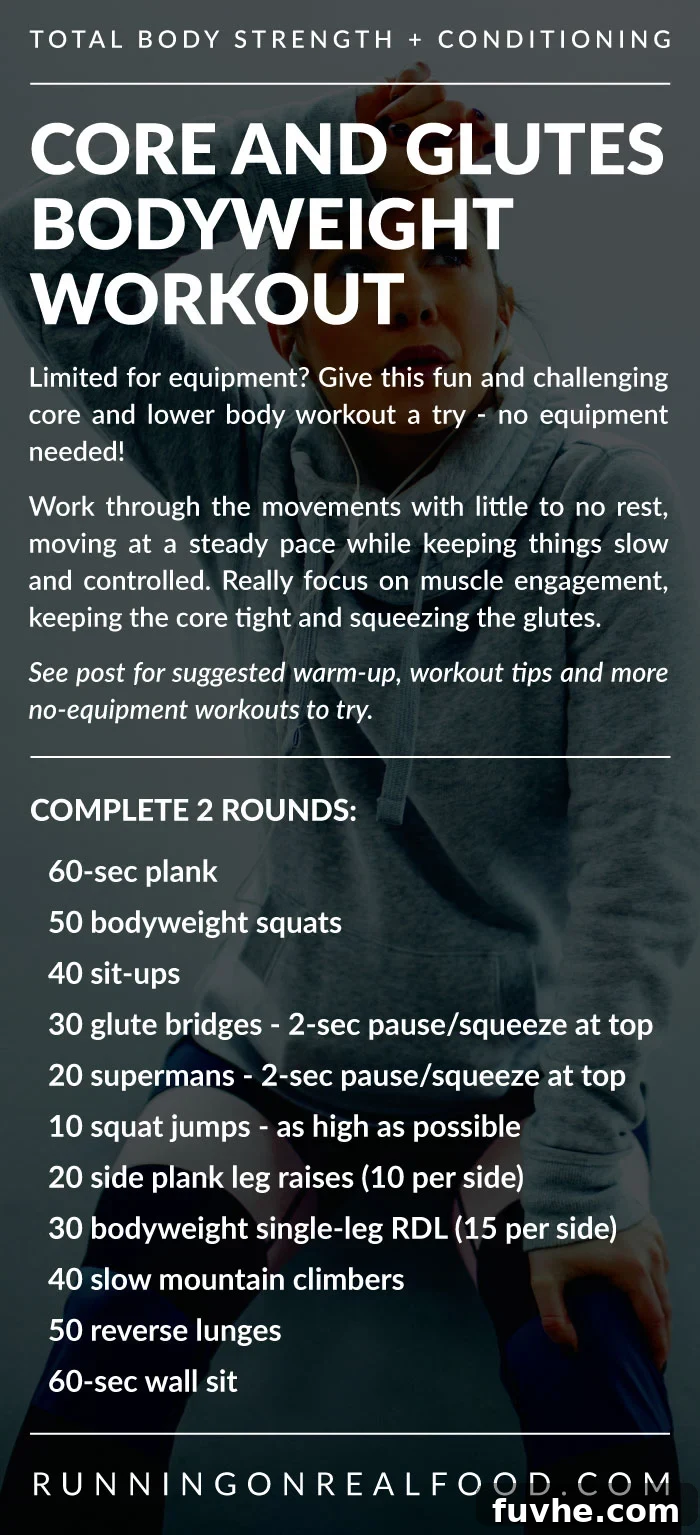
Workout Structure: Complete 2 Rounds
Perform each exercise for the specified duration or repetitions, then move directly to the next. Once you complete all exercises, rest for 60-90 seconds before starting your second round. Aim for minimal rest between exercises within a round to keep your heart rate up and maximize the calorie burn.
- 60-second Plank: Engage your core by drawing your belly button towards your spine. Maintain a straight line from your head to your heels, avoiding any sag in your hips or arch in your back.
- 50 Bodyweight Squats: Stand with feet shoulder-width apart. Lower your hips as if sitting in a chair, keeping your chest up and core engaged. Ensure your knees track over your toes, not past them.
- 40 Sit-Ups: Lie on your back with knees bent and feet flat on the floor. Engage your core to lift your upper body towards your knees, keeping your neck relaxed. Focus on controlled movement rather than speed.
- 30 Glute Bridges – 2-second pause/squeeze at top: Lie on your back, knees bent, feet flat. Drive through your heels to lift your hips towards the ceiling, squeezing your glutes powerfully at the top for a two-second hold. Lower slowly.
- 20 Supermans – 2-second pause/squeeze at top: Lie face down, arms extended forward. Simultaneously lift your arms, chest, and legs off the ground, squeezing your glutes and lower back muscles. Hold for two seconds, then lower with control.
- 10 Squat Jumps – as high as possible: Perform a regular squat, then explosively jump upwards, extending your entire body. Land softly back into a squat position to absorb the impact. This builds explosive power in the glutes and legs.
- 20 Side Plank Leg Raises (10 per side): Start in a side plank, elbow directly under your shoulder. While maintaining your side plank, lift your top leg towards the ceiling. This targets the outer glutes and deep core stabilizers.
- 30 Bodyweight Single-Leg RDL (15 per side): Stand on one leg with a slight bend in the knee. Hinge at your hips, extending the other leg straight back for balance, keeping your back flat. Lower your torso until it’s parallel to the floor, feeling the stretch in your hamstring and glute. Return to start using your glute.
- 40 Slow Mountain Climbers: Start in a plank position. Slowly draw one knee towards your chest, then return it. Alternate legs, keeping your core tight and hips stable. The emphasis is on control, not speed, to maximize core engagement.
- 50 Reverse Lunges: Step back with one foot, lowering your hips until both knees are bent at approximately 90-degree angles. Push off your back foot to return to the starting position. Alternate legs.
- 60-second Wall Sit: Find a wall, slide down until your knees are bent at a 90-degree angle, as if sitting in an invisible chair. Keep your back flat against the wall and hold. This is a fantastic isometric exercise for quad and glute endurance.
Optimize Your Performance: Essential Workout Tips
To get the most out of this bodyweight core and glutes workout, keep these critical tips in mind. They are designed to enhance your results, prevent injury, and ensure a fulfilling fitness experience.
- Maintain a Steady, Controlled Pace: While it’s natural to want to finish quickly, this workout isn’t about speed. Focus on maintaining a steady, consistent rhythm that allows you to move through each exercise without needing excessive rest. A controlled pace helps you maintain proper form and ensures continuous muscle engagement, leading to better results and endurance.
- Prioritize Slow, Deliberate Movements: Every repetition should be executed with precision. Avoid momentum and really concentrate on the muscles working. For example, during glute bridges, actively squeeze your glutes at the top. For squats, feel your quads and glutes engage through the full range of motion. This mind-muscle connection is paramount for maximizing effectiveness and building true strength.
- Engage Your Core Consistently: Your core is the foundation for all movements. Throughout the entire workout, actively draw your belly button towards your spine and brace your core as if preparing for a gentle punch. This will protect your lower back, improve stability, and enhance the effectiveness of every exercise, whether it’s a plank or a lunge.
- Listen to Your Body: Pay close attention to how your body feels. If you experience sharp pain, stop immediately. It’s okay to modify exercises, take extra rest if needed, or reduce repetitions. As you get stronger, you’ll be able to push harder, but always respect your body’s limits.
- For an Extra Challenge (Progressive Overload): Once you find this routine becoming easier, there are several ways to increase the intensity:
- Add Weight: Hold a dumbbell, kettlebell, or even a heavy book for exercises like reverse lunges, single-leg RDLs, glute bridges, and bodyweight squats. For sit-ups, hold a small plate or medicine ball to your chest.
- Increase Reps or Duration: Gradually increase the number of repetitions or the holding time for isometric exercises like planks and wall sits.
- Shorten Rest Times: Reduce the rest period between rounds to keep your heart rate elevated and challenge your cardiovascular endurance.
- Add an Extra Round: If two rounds feel too easy, try completing three rounds.
- Focus on Breath: Conscious breathing can significantly impact your performance. Inhale during the eccentric (lowering) phase of an exercise and exhale during the concentric (lifting or effort) phase. This helps to stabilize your core and provide oxygen to your working muscles.
Cool-Down & Stretching: Essential for Recovery
Just as important as your warm-up is your cool-down. A proper cool-down helps to gradually bring your heart rate down, reduce muscle soreness, and improve flexibility. Dedicate 5-10 minutes post-workout to static stretching, holding each stretch for 20-30 seconds without bouncing. Focus on the muscles you’ve just worked.
Suggested Cool-Down Stretches:
- Quad Stretch: Stand tall, grab your ankle, and pull your heel towards your glute.
- Hamstring Stretch: Sit or stand, extend one leg forward, and reach for your toes, keeping your back straight.
- Glute Stretch (Figure-Four): Lie on your back, cross one ankle over the opposite knee, and gently pull the knee towards your chest.
- Hip Flexor Stretch: Kneel on one knee, push your hips forward, and feel the stretch in the front of your hip.
- Child’s Pose: Kneel on the floor, sit back on your heels, and extend your arms forward, resting your forehead on the ground.
Continue Your Fitness Journey: More Workouts to Try
Consistency is key to achieving your fitness goals. Keep exploring new challenges and incorporating variety into your routine. Here are a few more bodyweight and conditioning workouts from our archives to keep you motivated and strong:
- 42 Minute No-Equipment EMOM
- Full Body Conditioning Workout
- 30-Minute Bodyweight EMOM
Remember, every workout is a step forward in your fitness journey. Embrace the challenge, celebrate your progress, and enjoy the benefits of a strong, healthy body!