

Conquer the Incline: Your Ultimate 20-Minute Rolling Hills Treadmill Workout
Are you ready to elevate your running game and experience a powerful, efficient workout that fits into even the busiest schedule? This 20-minute rolling hills treadmill workout is a masterclass in deceptive difficulty. While short in duration, it packs a serious punch, challenging your cardiovascular system and engaging key muscle groups in ways flat-ground running simply can’t. You’ll be running on the treadmill on a progressively increasing incline for the entire 20 minutes, pushing your limits up to an impressive 8%. This isn’t just a run; it’s a dynamic journey designed to boost your endurance, strength, and mental fortitude.
The beauty of this workout lies in its efficiency and accessibility. Just 20 minutes, and you’re done – but those minutes will be incredibly effective. The varying inclines simulate the undulating terrain of outdoor running, providing a full-body challenge that torches calories and builds lean muscle. Choose a speed that pushes you out of your comfort zone but is sustainable for the entire duration. Remember, you can achieve remarkable things in just 20 minutes. So, put on your favorite motivational playlist, commit to the challenge, and let’s get started on transforming your run!
Why Rolling Hills Treadmill Workouts Are Game-Changers
Incorporating rolling hills into your treadmill routine offers a multitude of benefits that extend far beyond simply burning calories. This dynamic approach to running provides a comprehensive workout that targets various aspects of your physical fitness and running performance.
- Enhanced Cardiovascular Health: Running on an incline significantly increases your heart rate and strengthens your cardiovascular system more efficiently than flat running. This translates to improved endurance and a healthier heart.
- Superior Muscle Engagement: Hill training actively recruits more muscle fibers, especially in your glutes, hamstrings, quadriceps, and calves. This builds lower body strength, which is crucial for overall running economy and preventing injuries. Think of it as strength training disguised as cardio.
- Increased Calorie Burn: The elevated effort required for incline running means you’ll burn more calories in less time. This makes rolling hills workouts an excellent choice for weight management and metabolic boosting.
- Improved Running Form and Efficiency: Running uphill encourages a shorter, quicker stride, promotes a stronger knee drive, and teaches you to lean slightly into the hill from your ankles, not your waist. These form improvements can carry over to your outdoor runs, making you a more efficient runner.
- Mental Toughness and Resilience: Tackling varying inclines challenges your mental stamina. Pushing through the tougher segments builds mental resilience, a critical trait for any runner facing long distances or challenging races.
- Reduced Impact: While challenging, running on an incline on a treadmill can actually be less impactful on your joints compared to running at high speeds on flat ground, as it naturally encourages a forefoot strike.
By mimicking natural terrain, rolling hills workouts provide a versatile and highly effective training method that makes every minute count, preparing your body and mind for any running challenge.
The 20-Minute Challenge: Short, Sharp, and Effective
In today’s fast-paced world, finding time for extensive workouts can be a real struggle. That’s precisely why this 20-minute rolling hills treadmill workout is an ideal solution. Its brevity doesn’t compromise its effectiveness; instead, it forces you to maximize every second, delivering a high-intensity, full-body cardiovascular workout that rivals longer, less structured sessions.
This concentrated burst of activity is perfect for kickstarting your metabolism, improving your anaerobic threshold, and building muscular endurance without consuming hours of your day. It’s an excellent option for busy professionals, parents, or anyone looking to fit a powerful fitness session into their lunch break or before starting their day. The key to its success lies in the continuous incline progression, which ensures your body is constantly adapting and working harder. Don’t underestimate its intensity just because it’s short; this workout is designed to leave you feeling accomplished and invigorated.
When selecting your speed, aim for a pace that feels challenging but not impossible. You should be able to maintain your chosen speed throughout the entire 20 minutes, even as the incline increases. For many, a brisk jogging pace to a moderate running speed works well. If you’re new to incline training, start with a speed where you can comfortably walk briskly or jog lightly, then gradually increase it as your fitness improves. The goal is to sustain effort while maintaining good form, making those 20 minutes count towards significant fitness gains.
Your 20-Minute Rolling Hills Workout Plan
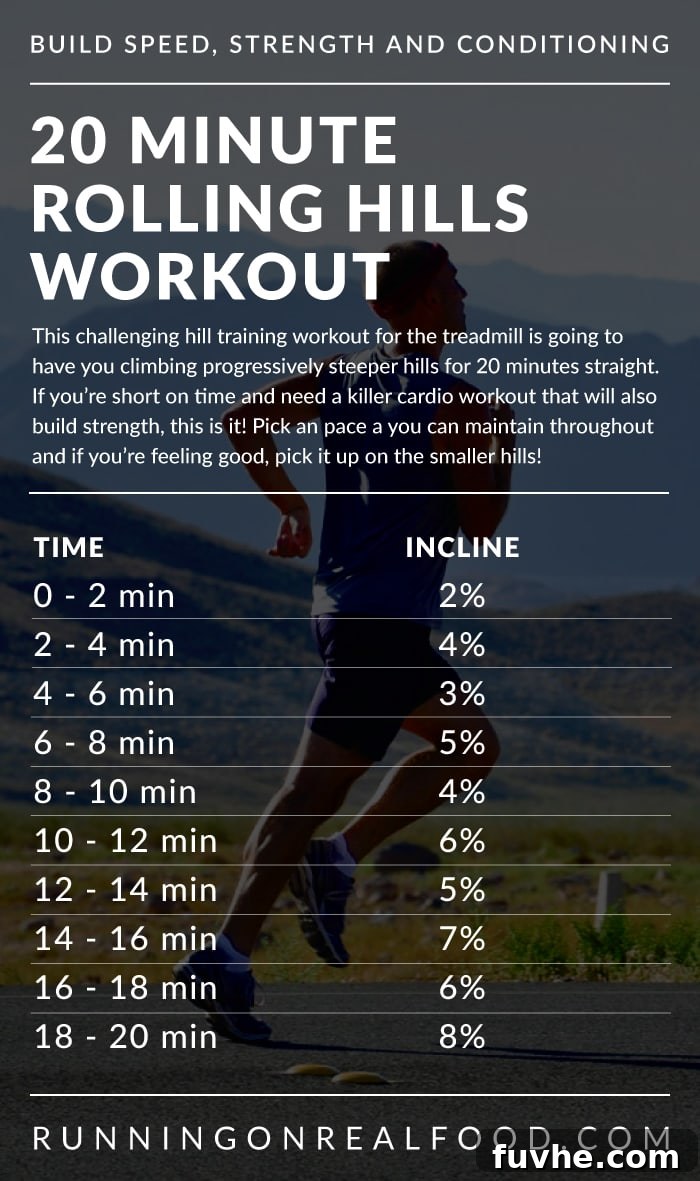
This structured workout is designed to progressively challenge you, mimicking the effort required to ascend and descend real hills. The inclines are carefully sequenced to provide both intense climbs and active recovery periods, ensuring a dynamic and engaging experience. Prepare to feel the burn and the exhilaration!
I distinctly remember tackling this exact routine at 7.0 mph, and let me tell you, there were moments I definitely wanted to hit that big, red stop button more than a few times! But pushing through those challenging moments is where the real growth happens. This workout isn’t just about physical exertion; it’s a test of mental fortitude. Find your challenging pace and hold onto it. I’d love to hear how you conquer it!
- 0-2 min – 2% Incline: Begin with a gentle warm-up. This incline allows your muscles to activate and your heart rate to gradually rise. Focus on light, easy strides and controlled breathing.
- 2-4 min – 4% Incline: The first climb begins. Increase your effort slightly. Engage your glutes and hamstrings more actively. Maintain good posture, looking straight ahead, not down at your feet.
- 4-6 min – 3% Incline: A slight decrease in incline provides an active recovery period. Don’t slow down too much; use this as a chance to regroup and prepare for the next, steeper climb. Maintain your pace and focus on consistent rhythm.
- 6-8 min – 5% Incline: Another significant climb. You should feel your quads and calves working hard. Keep your core engaged and your arm swing strong to help propel you forward.
- 8-10 min – 4% Incline: A welcome respite. This moderate incline allows you to catch your breath while still working hard. This is the halfway point; acknowledge your progress and stay focused.
- 10-12 min – 6% Incline: We’re building towards the peak challenges now. This incline demands a strong, consistent effort. Focus on a powerful push-off from your mid-foot.
- 12-14 min – 5% Incline: A sustained effort here, offering a brief chance to find your rhythm before the final steep push. Maintain your speed and remind yourself of your strength.
- 14-16 min – 7% Incline: This is a challenging segment! Push through, maintaining your speed as best you can. Shorten your stride if necessary, but keep the turnover quick. This is where your mental toughness truly comes into play.
- 16-18 min – 6% Incline: You’re almost there! Hold strong through this demanding incline. This feels like a slight break after the 7%, but it’s still a powerful effort. Keep your form solid.
- 18-20 min – 8% Incline: The final push! This is your peak challenge. Dig deep, give it everything you’ve got for these last two minutes. Focus on strong, deliberate steps. As the final seconds tick away, gradually reduce your speed for a cool-down walk.
Tips for Adjusting:
- For Beginners: If the listed speeds or inclines feel too intense, reduce your starting speed or decrease each incline by 1-2%. Focus on completing the full 20 minutes at a challenging but manageable pace.
- For Advanced Runners: To intensify this workout, increase your initial speed or add an additional 0.5-1.0 mph throughout the intervals. You can also increase the peak incline to 9% or 10% during the final segments for an extreme challenge.
Mastering Your Form on the Incline
Proper running form becomes even more critical when tackling inclines. Maintaining good technique not only prevents injury but also ensures you’re maximizing the benefits of hill training. Here are key form tips to keep in mind throughout this workout:
- Lean from the Ankles, Not the Waist: Avoid hunching over from your hips. Instead, maintain a tall posture and a slight forward lean that originates from your ankles. This helps you work with gravity, not against it.
- Shorten Your Stride: Resist the urge to lengthen your stride on inclines. Shorter, quicker steps are more efficient and reduce strain on your hamstrings and calves. Focus on a higher cadence (steps per minute).
- Lift Your Knees: Engage your hip flexors to drive your knees up slightly higher than you would on flat ground. This provides the power needed to ascend the incline.
- Engage Your Core: A strong core is your foundation. Keep your abdominal muscles gently braced to stabilize your torso and maintain an upright posture. This also prevents excessive swaying or twisting.
- Use Your Arms: Your arms are crucial for momentum and balance. Pump them actively but relaxed, with your elbows bent at roughly a 90-degree angle. Let them swing naturally forward and back, not across your body.
- Look Forward: Keep your gaze directed about 10-20 feet in front of you on the treadmill, rather than looking down at your feet or the control panel. This helps maintain a natural head and neck alignment.
- Mid-Foot Strike: Aim for a mid-foot landing, directly under your hips, rather than landing heavily on your heels or exclusively on your toes. A powerful push-off from your mid-foot will propel you forward.
By focusing on these form cues, you’ll optimize your energy, minimize the risk of injury, and get the most out of every challenging incline.
Pre and Post-Workout Essentials
To fully maximize the benefits of your 20-minute rolling hills workout and ensure a safe, effective experience, it’s crucial to pay attention to what you do before and after your run.
Pre-Workout: Setting the Stage for Success
- Dynamic Warm-up (5 minutes): Don’t skip this! A proper warm-up prepares your body for the exertion ahead. Include light cardio like marching in place, arm circles, leg swings, hip circles, and dynamic stretches such as walking lunges. This increases blood flow to your muscles and improves joint mobility.
- Hydration: Ensure you’re adequately hydrated before you start. Sip water throughout the day, and have a glass about 30 minutes before your workout.
- Light Snack (Optional): If you’re running early in the morning or haven’t eaten for a while, a small, easily digestible snack like half a banana or a few dates can provide quick energy.
- Proper Footwear: Wear comfortable, supportive running shoes that are designed for your foot type.
Post-Workout: Aiding Recovery and Growth
- Cool-down (3-5 minutes): After your final incline, slowly reduce your speed to a walk for 3-5 minutes. This helps bring your heart rate down gradually and prevents blood pooling in your legs.
- Static Stretching (5-10 minutes): Once your heart rate has normalized, engage in static stretches, holding each stretch for 20-30 seconds. Focus on major muscle groups worked during the run: hamstrings, quads, calves, glutes, and hip flexors.
- Re-Hydration: Replenish fluids lost during your workout. Continue to drink water steadily.
- Nutrition: Within 30-60 minutes post-workout, consume a snack or meal that combines carbohydrates (to replenish glycogen stores) and protein (to aid muscle repair). A smoothie, Greek yogurt with berries, or a turkey sandwich are great options.
By incorporating these pre and post-workout rituals, you’ll enhance your performance, accelerate recovery, and reduce the risk of soreness or injury, making your rolling hills workout even more effective.
Making It Your Own: Adjusting the Workout for All Levels
The beauty of treadmill workouts is their adaptability. This 20-minute rolling hills routine is designed to be challenging, but it’s essential that you tailor it to your current fitness level. Listening to your body is paramount for safety and long-term progress.
For Beginners: Building a Foundation
If you’re new to running, incline training, or returning after a break, here’s how to modify the workout to make it accessible and effective:
- Lower the Speed: Start with a brisk walking pace or a very light jog that feels comfortable. Focus on maintaining good form rather than speed.
- Reduce Incline Increments: Instead of the prescribed inclines, you could reduce each incline by 1-2%. For example, instead of 2-4-3-5-etc., try 1-3-2-4-etc. The goal is to feel the challenge without feeling overwhelmed.
- Take Shorter “Hills”: If 2-minute segments are too long, you can break them down into 1-minute intervals (e.g., 1 min at 2%, 1 min at 4%, 1 min at 3%, etc., adjusting your overall time).
- Focus on Consistency: Prioritize completing the full 20 minutes, even if it means reducing the intensity. Consistency builds endurance.
For Advanced Runners: Elevating the Challenge
If you’re an experienced runner looking for an extra push, here are ways to intensify this already challenging workout:
- Increase Your Base Speed: Start with a higher base speed and try to maintain it throughout the entire workout, even as the incline increases.
- Boost Incline Percentages: Add 0.5-1% to each incline segment. For example, instead of 7%, push for 8% or even 9% during the peak intervals.
- Incorporate Hand Weights: For an added upper body and core challenge, carefully carry light hand weights (1-3 lbs) while maintaining proper arm swing and form. Only do this if you are confident in your balance and form.
- Add an Extended Sprint: During a “recovery” incline (like 3% or 4%), incorporate a 30-second burst of higher speed before returning to your base pace.
Remember, the best workout is the one you can perform safely and consistently. Always prioritize your body’s signals and adjust as needed. As your fitness improves, you’ll naturally find yourself able to increase the intensity.
The Mental Game of Hill Training
While the physical demands of a rolling hills workout are undeniable, the mental challenge is often just as significant. Those moments when the incline is steep, and your legs are burning can test your resolve. However, developing mental toughness during these sessions translates directly to stronger performances in races and everyday runs.
- Break It Down: Instead of focusing on the entire 20 minutes or the highest incline, break the workout into smaller, manageable chunks. Focus on completing just the current 2-minute interval, then the next.
- Positive Self-Talk: Replace negative thoughts with encouraging affirmations. “I am strong,” “I can do this,” “This is making me faster.” Your inner dialogue has a powerful impact on your performance.
- Visualize Success: Imagine yourself effortlessly cresting a hill on an outdoor run, or crossing a finish line feeling strong. Visualization can trick your brain into feeling less fatigued.
- Focus on Your Breath: Deep, controlled breathing can calm your nervous system and help you manage exertion. Find a rhythm – perhaps inhale for two steps, exhale for two steps.
- Distraction (The Good Kind): While focusing on form is important, sometimes a good song, an engaging podcast, or even thinking about your day can help divert your attention from the discomfort during the toughest segments.
- Celebrate Small Victories: Acknowledge each incline conquered. Each completed interval is a step closer to your goal and a testament to your effort.
By consciously training your mind alongside your body, you’ll not only endure these challenging workouts but actually thrive during them, building a mental resilience that will serve you well in all aspects of life.
Integrating Rolling Hills into Your Fitness Routine
This 20-minute rolling hills workout is a fantastic tool, but its true power comes from how you integrate it into your broader fitness regimen. It shouldn’t be a standalone effort but rather a strategic component of a well-rounded training plan.
- Frequency: For most individuals, incorporating this workout 1-2 times per week is ideal. This allows sufficient time for muscle recovery and adaptation.
- Complementary Training:
- Strength Training: Pair this workout with dedicated strength training sessions (2-3 times per week). Focusing on compound movements like squats, lunges, deadlifts, and core work will build the power needed to tackle inclines effectively and prevent injuries.
- Easy Runs: Balance high-intensity incline work with easy, conversational pace runs on flatter terrain. These help build your aerobic base and aid in recovery without overstressing your body.
- Long Runs: If you’re training for longer distances, consider adding a rolling hills workout as a mid-week challenge, complementing your longer weekend runs.
- Cross-Training: Incorporate activities like cycling, swimming, or yoga on your non-running days to enhance overall fitness, reduce impact, and improve flexibility.
- Listen to Your Body: Always pay attention to signs of overtraining or excessive fatigue. If you’re feeling unusually tired or experience persistent soreness, take an extra rest day or opt for a lighter workout. Rest and recovery are just as crucial as the training itself.
By strategically placing this rolling hills workout within a diverse training plan, you’ll create a powerful synergy that builds a stronger, faster, and more resilient runner, capable of tackling any terrain.
Explore More Treadmill Workouts
If you enjoyed the challenge and benefits of this rolling hills routine, you’ll be thrilled to discover other dynamic treadmill workouts designed to keep your training fresh and effective. Expand your repertoire and continue to push your boundaries with these fantastic options:
Elevate Your Run: Try Our 30-Minute Rolling Hills Treadmill Workout: Ready for a longer, even more comprehensive hill challenge? This 30-minute version builds on the principles you’ve just experienced, offering extended periods of incline work for deeper cardiovascular and muscular conditioning.
Conquer the Summit: A Challenging 30-Minute Treadmill Hill Climb Workout: For those who crave sustained climbing, this workout focuses on longer segments at higher inclines, mimicking a continuous ascent. It’s excellent for building raw leg strength and mental endurance for serious elevation gains.
Boost Your Performance: Strength and Conditioning Workouts
Running is a full-body sport, and supplementing your treadmill sessions with targeted strength and conditioning can dramatically improve your performance, prevent injuries, and enhance your overall athleticism. Dive into these powerful routines to become a stronger, more resilient runner:
Synergy for Speed: Run Intervals and Strength Training for Runners: This workout combines short bursts of running with bodyweight strength exercises, building explosive power and endurance concurrently – perfect for shaving time off your runs.
Efficient & Intense: Your 30-Minute EMOM Conditioning Challenge: EMOM (Every Minute On the Minute) workouts are incredibly effective for boosting conditioning and muscular endurance. This quick-paced routine keeps you moving and constantly challenged.
Dynamic Duo: 35-Minute Treadmill and Barbell Fusion Workout: For those with access to barbells, this workout brilliantly merges treadmill cardio with fundamental strength exercises, offering a comprehensive full-body session in under 40 minutes.
Endurance Builder: A 30-Minute Aerobic Conditioning Workout: Focus on building your aerobic base and overall stamina with this conditioning workout. It’s designed to improve your body’s ability to use oxygen efficiently, crucial for sustained running performance.
Final Thoughts: Embrace the Incline, Transform Your Run
You’ve just explored a powerful, time-efficient strategy to transform your treadmill workouts and significantly boost your running fitness. This 20-minute rolling hills workout is more than just a sequence of inclines; it’s a testament to what you can achieve with focus, determination, and a willingness to challenge yourself.
By regularly incorporating this dynamic routine, you’ll not only strengthen your legs and cardiovascular system but also build invaluable mental resilience that will serve you both on and off the treadmill. Remember the benefits: enhanced endurance, increased calorie burn, superior muscle engagement, and improved running form. Don’t let its short duration fool you; this workout delivers profound results.
So, the next time you step onto the treadmill, embrace the incline. Let the varying terrain push you, motivate you, and ultimately, make you a stronger, more capable runner. Turn up the music, commit to those 20 minutes, and feel the transformation in every stride. Happy running!