

In the bustling world of fitness, where time is often a precious commodity, finding workouts that deliver maximum impact in minimal time is key. This is precisely where EMOM workouts shine. Standing for “Every Minute On the Minute,” EMOMs are a dynamic and incredibly efficient training methodology that keeps you focused, challenged, and consistently moving towards your fitness goals. They transform your perception of time in the gym, turning every minute into a purposeful stride toward a stronger, more conditioned you.
I’ve found EMOMs to be one of the most effective ways to structure my own training. Their inherent design forces a balance between intense effort and crucial recovery, making them perfect for building both muscular endurance and cardiovascular fitness. Whether you’re a seasoned athlete or just starting your fitness journey, EMOMs offer a scalable and engaging way to boost your performance. This article will guide you through a comprehensive 30-minute EMOM conditioning workout designed to pack a serious punch, helping you achieve significant results in half an hour.
What Exactly is an EMOM Workout?
The concept behind EMOM (Every Minute On the Minute) workouts is ingeniously simple yet incredibly effective. At its core, an EMOM workout dictates that you perform a specific number of repetitions of an exercise (or a set of exercises) at the top of every minute. Once you complete the prescribed reps, the remaining time within that minute is your rest period, until the next minute begins and you start the next set.
Let’s illustrate with a simple example: Imagine a 10-minute EMOM consisting of 10 push-ups. You would start your timer, immediately perform 10 push-ups, and then rest for the remainder of that first minute. As soon as the timer hits the 1-minute mark, you perform another 10 push-ups, resting until the 2-minute mark. This pattern continues for the full 10 minutes. The faster you complete your reps, the longer your rest, but the key is to be ready to go again when the clock hits the next minute.
This structured approach offers a unique blend of intensity and recovery. It prevents you from taking excessively long breaks, ensuring a consistent level of effort throughout the workout. Conversely, it guarantees you a minimum amount of rest, allowing you to maintain better form and power than you might in a continuous, untimed session. This rhythmic ebb and flow makes EMOMs a powerful tool for developing both muscular stamina and cardiovascular fitness.
Why EMOM Workouts Are So Effective for Conditioning
EMOM workouts aren’t just a trend; they’re a highly effective training method backed by clear benefits that contribute significantly to overall conditioning. Here’s why incorporating EMOMs into your routine can yield remarkable results:
Unparalleled Time Efficiency
In our busy lives, maximizing workout time is crucial. EMOMs are designed for efficiency. By structuring work and rest within minute-long intervals, they ensure that every second of your workout is purposeful. You get a tremendous amount of work done in a concentrated period, making them perfect for those short on time but unwilling to compromise on results. A 30-minute EMOM can be as demanding and effective as a much longer, less structured session.
Enhanced Focus and Pacing
The ticking clock in an EMOM workout is a relentless motivator. It eliminates guesswork about when to start your next set, keeping your mind engaged and preventing distractions. This constant awareness of time helps you develop a better sense of pacing. You learn to balance speed with sustainability, realizing that too fast means less rest, and too slow means cutting into the next minute’s work. This mental discipline translates directly into improved workout performance.
Superior Cardiovascular and Muscular Conditioning
EMOMs are fantastic for building both aerobic and anaerobic capacity. The consistent work intervals elevate your heart rate and challenge your cardiovascular system, while the repeated muscular contractions build endurance and strength. Depending on the exercises chosen, an EMOM can target specific muscle groups for strength development or offer a full-body conditioning challenge, like the workout we’re outlining today.
Incredible Versatility and Scalability
One of the greatest strengths of EMOM workouts is their adaptability. They can be tailored to any fitness level, from absolute beginners to elite athletes. You can adjust the number of repetitions, modify the exercises, or even change the total workout duration. This scalability ensures that EMOMs remain challenging and beneficial no matter where you are on your fitness journey, making consistent progress achievable and sustainable.
Boosts Mental Toughness and Discipline
The continuous nature of EMOMs, especially as fatigue sets in during later rounds, demands mental fortitude. Pushing through each minute, maintaining form, and resisting the urge to quit builds significant mental toughness and discipline. This resilience cultivated in your workouts often translates positively into other areas of your life.
Understanding Your 30-Minute EMOM Conditioning Challenge
Today, we’re diving into a powerful 30-minute EMOM conditioning workout designed to hit your entire body, improve your stamina, and challenge your mental grit. This workout is structured to maximize your effort and recovery within specific time blocks, ensuring you get a comprehensive training session in just half an hour. The primary goal is to perform each exercise with excellent form, maintaining consistency throughout all rounds.
The workout consists of 6 distinct exercises, and you will complete 5 full rounds. This means each exercise will be performed once every six minutes. You will cycle through the list, performing one exercise per minute. For instance, in minute 1, you do exercise 1; minute 2, exercise 2; and so on, until minute 6, when you complete exercise 6. Then, as minute 7 begins, you’ll cycle back to exercise 1, starting your second round, and continue this pattern for a total of 30 minutes (5 rounds x 6 exercises per round).
Equipment You’ll Need
One of the beauties of this particular EMOM is its minimal equipment requirement. All you’ll need is a set of dumbbells. If you don’t have dumbbells, don’t worry! This workout is highly adaptable, and you can easily substitute with a kettlebell or even a barbell for many of the movements. The key is to select a weight that allows you to complete the prescribed repetitions with good form, leaving you with enough time (but not too much) to recover before the next minute begins.
How to Scale This EMOM for Your Fitness Level
EMOM workouts are incredibly versatile and can be easily adjusted to match your current fitness level, ensuring you get an effective and safe workout every time. Here’s how you can make this 30-minute EMOM work for you:
Adjusting Repetitions
- For Beginners: If you find yourself struggling to complete the reps within the minute, or if your form is deteriorating, simply reduce the number of repetitions for each exercise. For example, instead of 24 Dumbbell Reverse Lunges, try 16 or 20. The goal is to finish your reps with at least 15-20 seconds of rest before the next minute starts.
- For Advanced Athletes: If you find you’re finishing the reps too quickly and getting too much rest, consider increasing the number of repetitions slightly. However, always prioritize maintaining perfect form over adding more reps. The challenge comes from the consistent intensity and short rest periods, not just the sheer volume.
Modifying Exercises
Some exercises might be too challenging or not suitable for your body. Here are some common modifications:
- Push-Ups: If 12 standard push-ups are too difficult, perform knee push-ups or incline push-ups (hands on an elevated surface like a bench or box). If too easy, try decline push-ups (feet elevated).
- Renegade Rows: If balancing in a plank with dumbbells is too challenging, perform regular dumbbell rows bent over from a standing position, or perform plank rows without the dumbbells.
- Burpees: If full burpees are too intense, modify by stepping back into a plank instead of jumping, or eliminate the push-up portion (burpee without push-up).
- V-Ups: For those new to core work, try Tuck-Ups (bringing knees to chest while crunching up) or simple Crunches or Leg Raises.
Adjusting Rounds or Total Workout Time
Don’t have 30 minutes? No problem! EMOMs are perfectly flexible with time:
- Shorter Workout: Only have 12 minutes? That’s perfect for 2 full rounds (2 rounds x 6 exercises/round = 12 minutes). Need 18 minutes? Complete 3 rounds.
- Longer Workout: If you want to increase the duration, simply add more rounds. Remember to maintain good form and adjust reps if necessary to sustain the workout for a longer period.
Pacing Strategy
Finding your optimal pace is crucial. You want to complete your reps quickly enough to earn a brief rest, but not so fast that your form suffers or you burn out by the third round. Aim for a pace that allows you to finish your reps in roughly 30-40 seconds, leaving 20-30 seconds for active recovery (walking around, shaking out your limbs, preparing for the next minute). This sweet spot ensures consistent intensity without overdoing it.
The 30-Minute EMOM Conditioning Workout Breakdown
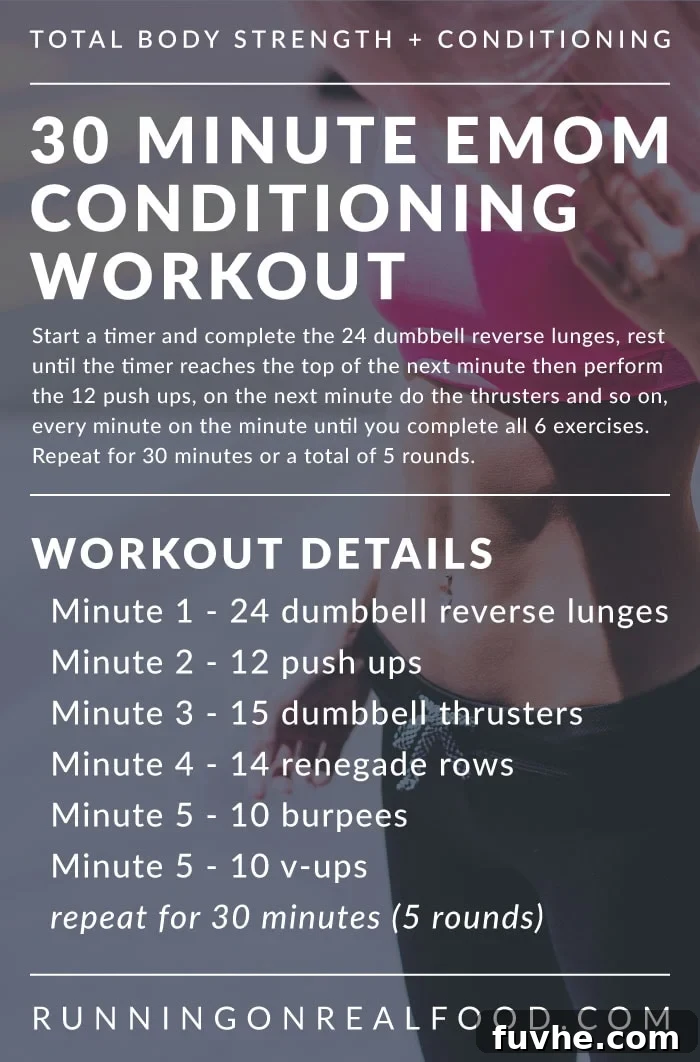
Here’s the full breakdown of your 30-minute EMOM. Remember to perform each exercise at the top of its designated minute, resting for the remainder of that minute, for a total of 5 rounds (30 minutes).
- Minute 1: 24 Dumbbell Reverse Lunges (12 per leg)
Execution: Hold a dumbbell in each hand by your sides. Step one leg straight back, lowering your hips until both knees are bent at approximately a 90-degree angle. Ensure your front knee is directly above your ankle and your back knee hovers just above the floor. Push through your front heel to return to the starting position. Alternate legs.
Form Tip: Keep your torso upright and core engaged throughout the movement. Focus on controlled descent and powerful ascent.
Target Muscles: Quadriceps, hamstrings, glutes.
Modification: Reduce reps to 16-20 total, or perform without dumbbells (bodyweight reverse lunges). - Minute 2: 12 Push Ups
Execution: Start in a high plank position, hands slightly wider than shoulder-width apart, fingers pointing forward. Lower your chest towards the floor by bending your elbows, keeping them tucked slightly towards your body. Push back up to the starting plank position.
Form Tip: Maintain a straight line from your head to your heels (no sagging hips or piking butt). Keep your core tight.
Target Muscles: Chest, shoulders, triceps, core.
Modification: Perform push-ups from your knees, or incline push-ups with hands on an elevated surface. - Minute 3: 15 Dumbbell Thrusters
Execution: Hold a dumbbell in each hand, resting on your shoulders with palms facing each other. Begin with a squat, lowering your hips below parallel. As you powerfully drive up from the squat, use the momentum to press the dumbbells overhead until your arms are fully extended. Lower the dumbbells back to your shoulders as you begin the next squat.
Form Tip: This is a fluid, explosive movement. Connect the squat and press seamlessly. Keep your chest up during the squat.
Target Muscles: Quads, glutes, shoulders, triceps, core.
Modification: Reduce reps, or use lighter dumbbells. If overhead pressing is an issue, perform dumbbell squats followed by a push press (using legs for momentum). - Minute 4: 14 Renegade Rows (7 per arm)
Execution: Start in a high plank position with a dumbbell in each hand, palms facing each other, wrists under shoulders. Keep your core tight and hips stable (minimize rocking). Row one dumbbell up towards your chest, pulling your elbow towards the ceiling. Lower with control and then repeat on the other side.
Form Tip: Maintain a strong, stable plank. Imagine balancing a cup of water on your lower back to prevent excessive hip rotation.
Target Muscles: Lats, biceps, shoulders, core (anti-rotation).
Modification: Perform dumbbell rows standing bent-over, or plank from your forearms and remove the rowing motion if stability is a major issue. - Minute 5: 10 Burpees
Execution: Begin standing. Squat down and place your hands on the floor. Kick your feet back into a high plank position. Perform a push-up (optional). Jump your feet back towards your hands, then explode upwards into a jump, reaching your hands overhead.
Form Tip: Focus on a controlled descent and a powerful, full-body explosion upwards. Keep your core engaged throughout.
Target Muscles: Full body (cardio, strength, power).
Modification: Step back into the plank instead of jumping, remove the push-up, or eliminate the jump at the end. - Minute 6: 10 V-Ups
Execution: Lie flat on your back with arms extended overhead and legs straight. Simultaneously lift your torso and legs, reaching your hands towards your toes, forming a ‘V’ shape with your body. Lower back down with control.
Form Tip: Keep your core tight and avoid yanking with your neck. Focus on using your abdominal muscles to lift your upper and lower body.
Target Muscles: Abdominals, hip flexors.
Modification: Perform Tuck-Ups (bringing knees to chest while crunching), or alternating single leg V-ups.
Pre-Workout Warm-up and Post-Workout Cool-down
To ensure a safe and effective workout and promote optimal recovery, never skip your warm-up and cool-down routines. These often-overlooked components are crucial for injury prevention and maximizing performance.
Pre-Workout Warm-up (5-10 minutes)
A proper warm-up prepares your body for the demands of the EMOM. It increases blood flow to your muscles, raises your core body temperature, and improves joint mobility. This primes your muscles for activity and reduces the risk of strains or injuries.
- Light Cardio (2-3 minutes): Start with something to get your heart rate up, like jumping jacks, high knees, butt kicks, or a light jog in place.
- Dynamic Stretches (3-7 minutes): Move through exercises that actively take your joints through their full range of motion. Examples include arm circles, leg swings (forward/backward and side-to-side), torso twists, cat-cow stretches, bird-dogs, and walking lunges with a twist. Focus on movements that mimic the exercises in your EMOM.
Post-Workout Cool-down (5-10 minutes)
The cool-down helps your body gradually return to its resting state, reduces muscle soreness, and improves flexibility. It’s a critical step in the recovery process.
- Light Cardio (1-2 minutes): A gentle walk or light cycling to bring your heart rate down.
- Static Stretches (4-8 minutes): Hold each stretch for 20-30 seconds, breathing deeply into the stretch. Focus on the major muscle groups worked during the EMOM, such as quads, hamstrings, glutes, chest, shoulders, triceps, and core. Examples include quad stretch, hamstring stretch (seated or standing), glute stretch (figure-four stretch), chest opener, triceps stretch, and cobra stretch for the abs.
- Foam Rolling (Optional): If you have a foam roller, spend a few minutes rolling out any tight areas for deeper myofascial release.
Tips for Maximizing Your EMOM Performance
To get the most out of this 30-minute EMOM conditioning workout and ensure your safety, keep these crucial tips in mind:
- Prioritize Form Over Speed: It’s tempting to rush through reps to gain more rest time, but sacrificing form significantly increases your risk of injury and reduces the effectiveness of the exercise. Focus on controlled, precise movements first, then build speed.
- Listen to Your Body: While EMOMs are designed to be challenging, pushing through sharp pain is never recommended. If an exercise causes discomfort, modify it or substitute it for another movement that targets similar muscle groups.
- Stay Hydrated: Intense workouts, especially conditioning-focused ones, lead to significant fluid loss. Drink water before, during, and after your workout to maintain performance and aid recovery.
- Breathe Properly: Focus on your breathing throughout the workout. Typically, exhale during the exertion phase of an exercise and inhale during the recovery or eccentric phase. Proper breathing helps oxygenate your muscles and manage fatigue.
- Track Your Progress: Keep a record of your workouts. Note the weights used, reps completed, and how you felt. This allows you to see your improvements, helps you scale the workout appropriately, and keeps you motivated.
- Know Your Limits: While challenging yourself is part of fitness, recognize when you need to slow down or take a brief extra rest. The goal is consistent effort, not burnout after the first round.
Ready for More EMOM Challenges?
If you loved the intensity and efficiency of this 30-minute EMOM, you’ll be thrilled to know there are many more challenges waiting for you. EMOM workouts offer endless variations, targeting different muscle groups, fitness goals, and durations. They are a fantastic way to keep your training fresh, exciting, and consistently challenging.
Explore these other great EMOM workouts to continue building your strength, endurance, and overall conditioning:
45 Minute Full-Body EMOM Workout // 40 Minute Full-Body EMOM Workout // Full-Body 30 Minute EMOM Workout // Strength and Conditioning EMOM Workout // 45 Minute E2MOM Workout
EMOM workouts are an excellent strategy for anyone looking to maximize their fitness gains in minimal time. This 30-minute conditioning challenge is just one example of how you can leverage the “Every Minute On the Minute” principle to push your limits, build a stronger body, and achieve impressive results. So, set your timer, commit to each minute, and embrace the power of EMOM training!