
Unlock your full potential with this ultimate full-body strength training workout designed to challenge every major muscle group in your body while simultaneously boosting your cardiovascular fitness. Whether you’re a seasoned lifter or looking to elevate your fitness routine, this comprehensive program will help you build strength, improve endurance, and enhance overall athletic performance. We’ll delve into a powerful circuit comprising compound movements and core-strengthening exercises, structured for maximum efficiency and results. Get ready to sculpt your physique, increase your power, and transform your fitness journey with a routine that targets your lower body, upper body, and core in a dynamic, integrated approach.
Why Full-Body Workouts Are Essential for Holistic Fitness
Full-body strength training offers a multitude of benefits that go beyond just building muscle. By engaging all major muscle groups in a single session, you optimize your body’s anabolic response, leading to more efficient muscle growth and fat loss. These workouts are incredibly time-efficient, making them perfect for busy individuals who want to maximize their results without spending hours in the gym. They promote balanced muscle development, reduce the risk of imbalances and injuries, and significantly improve overall functional strength applicable to daily life. Furthermore, integrating compound movements often elevates your heart rate, providing a valuable cardiovascular benefit that enhances endurance and stamina. This particular workout is crafted to deliver all these advantages, ensuring a comprehensive and rewarding fitness experience.
Workout Details: Your Path to Strength and Endurance
This full-body strength workout is designed to be straightforward yet incredibly effective. You won’t need a complex timer or adhere to strict EMOM (Every Minute On the Minute) or AMRAP (As Many Rounds As Possible) protocols. Instead, the focus is on performing each exercise with control and precision, moving at a steady, sustainable pace. The goal is to challenge yourself, not to rush. Take short, necessary rests between sets and exercises to maintain good form, but keep them brief to keep your heart rate up and maximize the cardiovascular benefits. This structure allows you to concentrate on muscle engagement and proper technique, ensuring you get the most out of every repetition.
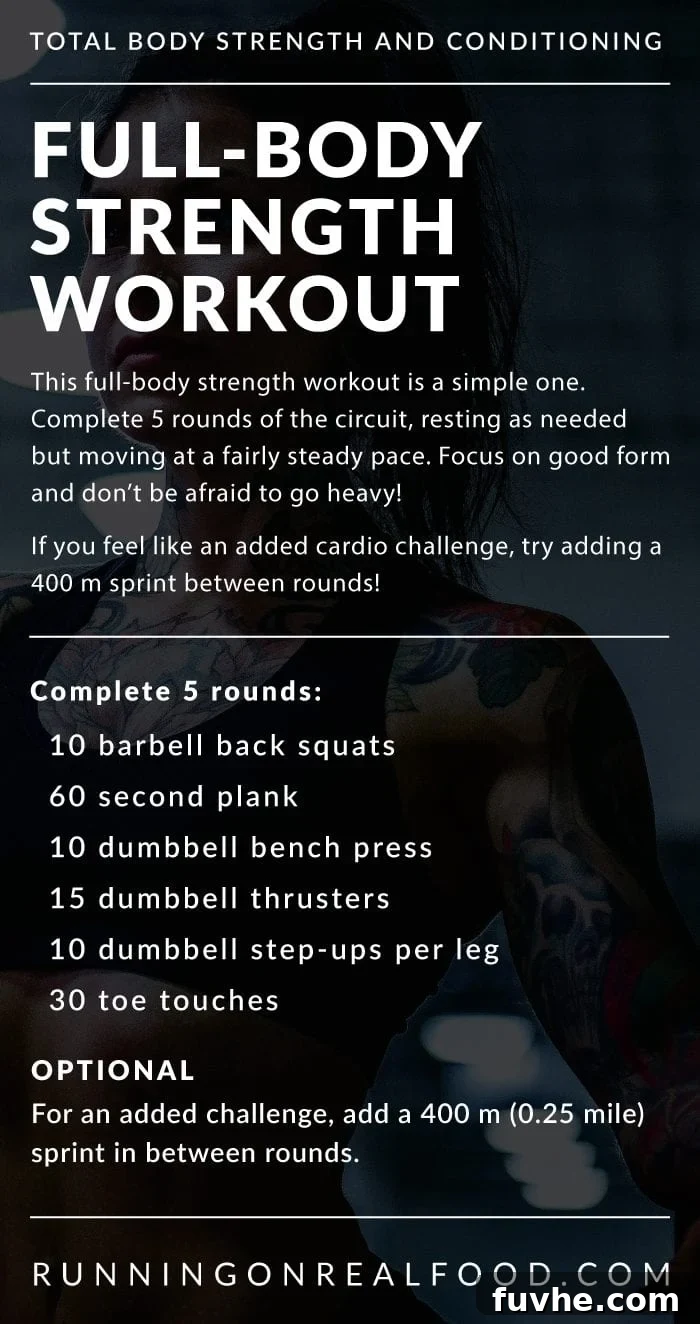
This demanding workout consists of 5 complete rounds of the following exercises. Focus on quality over speed, pushing your limits responsibly:
- Barbell Back Squat x 10 repetitions: A foundational exercise for lower body strength.
- 60-second Plank: An essential core stabilizer.
- Dumbbell Bench Press (or Floor Press) x 10 repetitions: Targets the chest, shoulders, and triceps.
- Dumbbell Thruster x 15 repetitions: A dynamic full-body movement combining a squat and an overhead press.
- Dumbbell Step-Up x 10 repetitions per leg: Excellent for glute and leg strength, unilateral stability.
- Toe Touches x 30 repetitions: Focuses on core and abdominal strength.
Weight Selection for Maximum Impact
Choosing the right weight is critical for maximizing results and ensuring progression. For the Barbell Back Squats and Dumbbell Bench Press, aim for a challenging weight. This should be a load that feels “scary” but manageable for 5 sets of 10 repetitions. The final two repetitions of each set should be extremely difficult, pushing your muscles to their limit while still allowing you to maintain proper form. This intensity is key for stimulating muscle growth and strength adaptation.
For the Dumbbell Thrusters, opt for a slightly lighter, more manageable weight. The thruster is a dynamic, explosive movement, and you’ll want to move quickly and fluidly through all 15 repetitions. Focus on a smooth transition from the squat to the overhead press. When it comes to Dumbbell Step-Ups, choose a weight that allows you to maintain perfect form. The emphasis here is on driving through the heel and engaging the glutes. Complete all 10 repetitions on one leg before switching to the other to ensure balanced development and maximize unilateral strength. Always prioritize form over lifting heavy, especially with exercises that require balance and coordination.
Detailed Exercise Breakdown and Form Tips
1. Barbell Back Squat x 10
The barbell back squat is often called the “king of all exercises” for good reason. It’s a powerful compound movement that primarily targets your quadriceps, hamstrings, and glutes, while also engaging your core and lower back for stabilization. Proper form is paramount to prevent injury and maximize benefits. Begin by positioning the barbell across your upper back, resting on your traps, not directly on your neck. Keep your chest up, shoulders back, and core tight. Descend by pushing your hips back and bending your knees, as if sitting into a chair. Aim to go at least to parallel (thighs parallel to the floor) or deeper if your mobility allows. Drive back up through your heels, squeezing your glutes at the top. Remember to keep your knees tracking in line with your toes throughout the movement. If you don’t have a barbell, consider goblet squats with a heavy dumbbell or kettlebell, holding it close to your chest.
2. 60-second Plank
The plank is a cornerstone exercise for building a strong, stable core. It engages your rectus abdominis, obliques, and transverse abdominis, crucial for posture, spinal health, and overall athletic performance. To perform a perfect plank, position your body in a straight line from head to heels, supported on your forearms and toes. Ensure your elbows are directly beneath your shoulders. Actively squeeze your glutes and brace your core as if preparing for a punch. Avoid letting your hips sag or pushing them too high; maintain that rigid, straight line. Breathe deeply and consistently throughout the 60 seconds. If a full plank is too challenging, drop to your knees, ensuring you still maintain a straight line from head to knees.
3. Dumbbell Bench Press (or Floor Press) x 10
This exercise effectively targets your chest (pectorals), shoulders (anterior deltoids), and triceps. If you have access to a bench, lie flat with your feet firmly on the floor. Hold a dumbbell in each hand, palms facing each other or forward, with your arms bent at 90 degrees, dumbbells at chest level. Press the dumbbells straight up towards the ceiling, fully extending your arms without locking your elbows. Slowly lower the dumbbells back to the starting position with control. If a bench isn’t available, the dumbbell floor press is an excellent alternative. Lie on the floor, follow the same pressing motion, and enjoy the added benefit of restricting range of motion which can be kinder to the shoulders. Keep your lower back pressed into the floor for stability.
4. Dumbbell Thruster x 15
The dumbbell thruster is a dynamic, full-body compound exercise that combines a front squat with an overhead press. It’s fantastic for building power, endurance, and coordination, engaging your legs, core, shoulders, and triceps all in one explosive movement. Start with dumbbells resting on your shoulders, elbows pointing forward. Perform a full squat. As you drive up from the squat, use the momentum to explosively press the dumbbells overhead, fully extending your arms. Control the descent back to the shoulders as you simultaneously lower into the next squat. This continuous flow makes it a great cardiovascular challenge. Focus on a fluid motion and generating power from your lower body.
5. Dumbbell Step-Up x 10 per leg
Step-ups are a fantastic unilateral exercise that isolates one leg at a time, improving balance, stability, and developing strong glutes and hamstrings. You’ll need a sturdy box, bench, or step for this exercise. Hold a dumbbell in each hand by your sides. Place one foot firmly on the step, ensuring your entire foot is on the surface. Drive through the heel of your elevated foot to push your body upwards, bringing your other leg up to meet it (or hovering it slightly). Step back down with control. Complete all 10 repetitions on one leg before switching to the other. Maintain an upright torso and avoid leaning forward excessively. Focus on controlled movements to maximize muscle engagement.
6. Toe Touches x 30
Toe touches are a classic abdominal exercise that targets the upper and lower abs, promoting core strength and flexibility. Lie on your back with your legs extended straight up towards the ceiling, perpendicular to the floor. Extend your arms towards your feet, keeping them straight. Engaging your core, lift your shoulder blades off the floor and reach your fingertips towards your toes. The goal is to contract your abdominal muscles to lift your upper body, not to swing your arms. Control the movement as you slowly lower your shoulders back down. If reaching your toes is too difficult, aim for your shins or knees, focusing on the abdominal crunch.
Elevate Your Workout: Add a Cardio Challenge
To further amplify the intensity and cardiovascular benefits of this full-body strength routine, consider integrating a cardio challenge between each round. A 400-meter (0.25 mile) sprint is an excellent option that will significantly elevate your heart rate, improve your anaerobic capacity, and add a dynamic, athletic component to your training. If sprinting isn’t feasible, you can substitute it with 2-3 minutes of high-intensity cardio such as jump rope, rowing, cycling, or performing burpees. This addition transforms the workout into a metabolic powerhouse, burning more calories and boosting your overall endurance. Remember to maintain a challenging pace during your cardio intervals to truly push your limits.
Essential Equipment for Your Workout
To perform this highly effective strength and conditioning workout, you will need a few key pieces of equipment. While variations can often be made for home workouts, having the right tools ensures you can execute the exercises with proper form and progressive overload.
- Barbell and Rack: For the Barbell Back Squats, you will ideally need a full-sized barbell with various weight plates and a sturdy squat rack or power cage. This setup provides safety and allows for heavy lifting, which is crucial for building significant lower body strength. If you do not have access to a barbell and rack, you can substitute with a heavy dumbbell or kettlebell for goblet squats, holding the weight against your chest. Alternatively, holding two dumbbells by your sides for a dumbbell squat can also work.
- Dumbbells: Dumbbells are versatile and essential for this routine. You will need at least one heavy set for the Dumbbell Bench Press to effectively challenge your chest and triceps. For the Dumbbell Thrusters and Step-Ups, you might opt for a slightly lighter set, or use the same heavy set if you’re confident in your ability to maintain form and control throughout the higher rep counts. Having a range of dumbbell weights allows for proper progressive overload and adaptation across different exercises.
- Sturdy Box or Bench: A secure and stable box or bench is required for the Dumbbell Step-Ups. Ensure it is robust enough to support your weight and resistant to tipping or sliding during the exercise to prevent injury.
Pre-Workout Preparation: The Importance of a Warm-Up
Before diving into this intense full-body workout, a proper warm-up is absolutely critical. A dynamic warm-up prepares your muscles, joints, and cardiovascular system for the demands of the upcoming exercises, significantly reducing the risk of injury and improving performance. Aim for 5-10 minutes of light cardio followed by dynamic stretches. Examples include:
- Light Cardio: 3-5 minutes of jogging, cycling, or rowing to gently raise your heart rate and increase blood flow to your muscles.
- Dynamic Stretches: Arm circles, leg swings, torso twists, cat-cow stretches, glute bridges, and bodyweight squats. These movements actively move your joints through their full range of motion, improving flexibility and activating key muscle groups that will be utilized in the main workout. Pay particular attention to hip and shoulder mobility as these areas are heavily involved in the squats, presses, and thrusters.
Post-Workout Recovery: The Benefits of a Cool-Down
Just as important as the warm-up, a cool-down is an often-overlooked but vital part of your training session. A proper cool-down helps your body gradually return to its resting state, reduces muscle soreness, and improves flexibility. Dedicate 5-10 minutes post-workout to static stretching, holding each stretch for 20-30 seconds. Focus on the major muscle groups you’ve just worked:
- Hamstring Stretch: Lie on your back and pull one leg towards your chest, or sit and reach for your toes.
- Quad Stretch: Stand and pull your heel towards your glutes, or lie on your stomach and pull one heel towards your glutes.
- Glute Stretch: Figure-four stretch or pigeon pose.
- Chest Stretch: Use a doorway or wall to stretch your pectorals.
- Shoulder Stretch: Cross-body arm stretch.
- Core Stretch: Gentle cobra stretch or child’s pose to relax the back and abs.
Deep breathing during your cool-down also helps to calm your nervous system and promotes relaxation.
Progression and Consistency: The Keys to Long-Term Results
To continually see results from this full-body workout, the principle of progressive overload is essential. This means gradually increasing the demands placed on your body over time. As you get stronger, you can implement various strategies:
- Increase Weight: Once you can comfortably complete all 5 rounds with good form, try increasing the weight slightly for the barbell squats, bench press, and dumbbell step-ups.
- Increase Reps/Sets: If adding weight isn’t an option, you could try adding an extra repetition or even an extra set to each round, though the current 5-round structure is already quite demanding.
- Reduce Rest Times: Shortening the rest periods between exercises or rounds can increase the cardiovascular intensity and muscular endurance challenge.
- Improve Form and Control: Sometimes, the best way to progress is to refine your technique, moving more slowly and deliberately through each repetition to maximize time under tension and muscle engagement.
Consistency is paramount. Aim to perform this workout 2-3 times per week, allowing a day of rest in between sessions for muscle recovery and growth. Listen to your body, and don’t be afraid to take an extra rest day if needed, especially when starting a new challenging routine.
More Workouts to Try: Expand Your Fitness Repertoire
If you’re loving the challenge and effectiveness of this full-body strength workout, there are many other routines you can explore to keep your training fresh and continuously challenge your body in new ways. Varying your workouts helps prevent plateaus and ensures holistic development. Consider incorporating some of these exciting and effective routines into your fitness journey:
- 40-Minute Full-Body EMOM
- Single-Arm Dumbbell Workout
- 30-Minute Full-Body Superset Workout
- 30-Minute Full-Body Strength Workout
- Core and Upper Body Circuit Workout
These workouts offer different structures and focuses, from timed circuits to specific muscle group emphasis, allowing you to continually diversify your training and achieve new levels of fitness. Happy lifting!