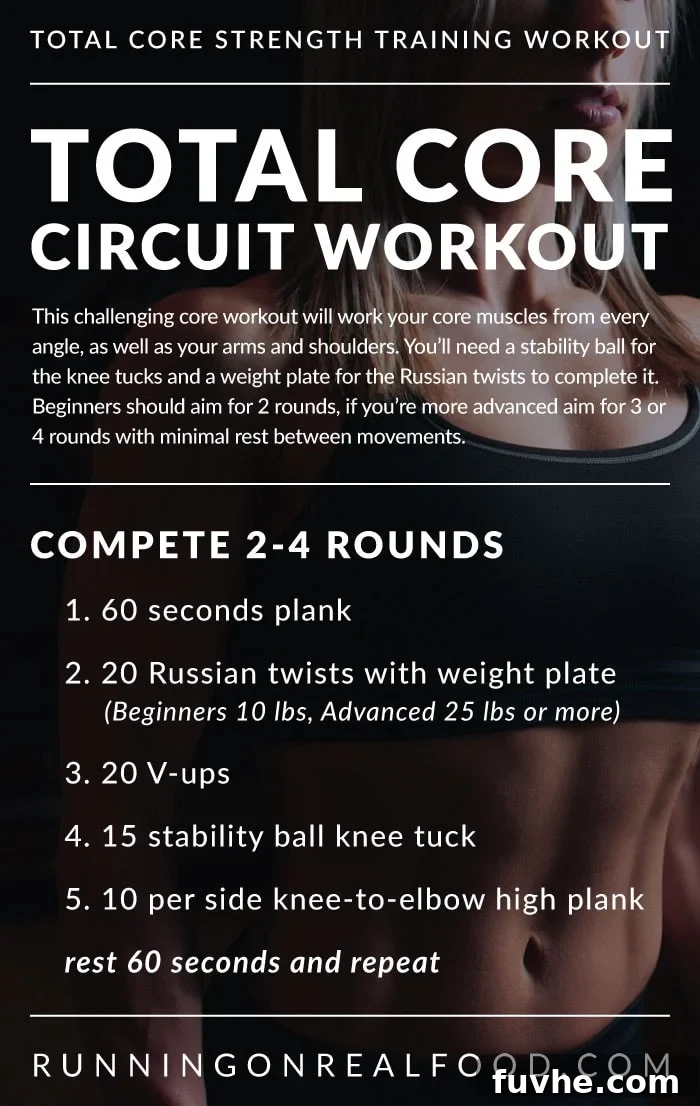
Unlock your core’s full potential with this dynamic stability ball circuit, designed to sculpt and strengthen your midsection from every angle. Far beyond just aesthetics, a robust core is the bedrock of overall fitness, enhancing balance, improving posture, preventing injuries, and boosting athletic performance. This comprehensive workout requires nothing more than a stability ball and your own determination, making it perfect for home or gym use. We’ll delve into the benefits of each exercise, ensuring proper form and providing modifications to suit all fitness levels.
Total Core Circuit Workout: Build Strength & Stability
A strong core is not just about a visible six-pack; it’s about building a powerful center that supports your entire body. From lifting groceries to running a marathon, a well-conditioned core impacts nearly every movement you make. This circuit specifically targets the abdominal and core muscles, including the obliques, lower back, and hip flexors. Additionally, key exercises like the plank and stability ball knee tuck will engage your shoulders, triceps, and chest, transforming this into a highly efficient, full-upper-body-supportive workout.
The Power of Circuit Training
Circuit training involves performing a series of exercises consecutively with minimal rest between them. This method not only keeps your heart rate elevated, boosting calorie burn and cardiovascular fitness, but it also maximizes muscle endurance. For core training, it means keeping your muscles under tension for longer periods, leading to greater strength and definition. This particular circuit is structured to challenge different core muscles sequentially, ensuring a comprehensive workout.
Why the Stability Ball is Your Core’s Best Friend
The stability ball, also known as an exercise ball or Swiss ball, is an incredibly versatile and effective tool for core training. Its inherent instability forces your body to engage deeper stabilizing muscles that might be overlooked in traditional floor exercises. This leads to enhanced proprioception, balance, and overall core strength. It also allows for a greater range of motion in many exercises, intensifying the muscle activation. When selecting a stability ball, ensure it’s the right size for your height – typically, when sitting on it, your knees should form a 90-degree angle with your feet flat on the floor.
Before You Begin: The Importance of a Warm-Up
Never skip your warm-up! A proper warm-up prepares your muscles and joints for the strenuous activity ahead, increasing blood flow and reducing the risk of injury. Aim for 5-10 minutes of light cardio and dynamic stretches before starting your circuit. Consider movements like arm circles, leg swings, torso twists, and light jogging in place to get your body ready.
Circuit Instructions: Maximize Your Effort
Work through each exercise in the circuit consecutively with minimal rest between them. Once you’ve completed all five exercises, take a 60-second rest period. Repeat the entire circuit 3 to 4 times for a complete and challenging core workout.
Repeat the following circuit 3 to 4 times.
-
60 Seconds Plank
How to Perform: Start in a push-up position, but instead of resting on your hands, lower down onto your forearms. Ensure your elbows are directly beneath your shoulders, and your body forms a straight line from your head to your heels. Keep your core tight, glutes squeezed, and avoid letting your hips sag or pike up. Your gaze should be focused on the floor a few inches in front of you to maintain a neutral neck.
Benefits: The plank is a foundational core exercise that strengthens not only your abdominals but also your back, shoulders, glutes, and hamstrings. It’s excellent for improving posture and reducing back pain by building isometric strength.
Modifications:
- Beginner: Perform the plank on your knees, maintaining a straight line from head to knees.
- Advanced: Elevate your feet on a stability ball for increased instability, or lift one leg or arm off the ground alternately to further challenge your balance and core stability.
-
20 Russian Twists with Weight Plate
How to Perform: Sit on the floor with your knees bent and feet flat. Lean back slightly, engaging your core, so your torso is at about a 45-degree angle to the floor. Lift your feet off the ground, balancing on your sit bones. Hold a weight plate (or a dumbbell, medicine ball, or even a heavy book) with both hands in front of your chest. Twist your torso from side to side, tapping the weight to the floor beside your hip on each side. Focus on rotating your entire torso, not just your arms.
Benefits: Russian twists are highly effective for targeting the obliques (side abdominal muscles), improving rotational core strength, and enhancing spinal mobility. The added weight increases the intensity, helping to build definition.
Weight Guidance: Beginners should start with a 10 lbs plate to master the form. Experienced individuals can challenge themselves with a 25 lbs plate or heavier.
Modifications:
- Beginner: Keep your feet on the floor for more stability, or perform without any weight.
- Advanced: Increase the weight, or perform on an unstable surface like a stability ball (if safe and experienced) for an extra challenge.
-
20 V-Ups
How to Perform: Lie flat on your back with your legs straight and arms extended overhead. Keeping your core engaged, simultaneously lift your legs (straight) and your upper body off the floor, reaching your hands towards your toes. Your body should form a ‘V’ shape at the top of the movement. Slowly and with control, lower back down to the starting position, ensuring your lower back remains pressed into the floor throughout the movement.
Benefits: V-ups are a fantastic full-abdominal exercise that works the upper and lower abs simultaneously, as well as the hip flexors. They improve core strength, flexibility, and coordination.
Modifications:
- Beginner: Perform tuck-ups instead, where you bring your knees towards your chest and your elbows towards your knees, or alternate single-leg and arm raises.
- Advanced: Hold a light dumbbell or medicine ball in your hands for added resistance.
-
15 Stability Ball Knee Tuck
How to Perform: Begin in a high plank position with your hands on the floor directly under your shoulders and your shins resting on top of a stability ball. Ensure your body forms a straight line from your head to your heels. Keeping your core tight and stable, slowly pull your knees towards your chest, allowing the ball to roll forward. Your hips will lift slightly. Pause briefly, then slowly extend your legs back to the starting plank position, controlling the ball’s movement.
Benefits: This exercise intensely targets the lower abs, hip flexors, and deep core stabilizers. The instability of the ball forces greater core engagement and challenges your balance, making it far more effective than traditional knee tucks.
Modifications:
- Beginner: Perform regular knee tucks on a stable surface without the ball, or start with fewer repetitions.
- Advanced: Perform stability ball pikes, lifting your hips towards the ceiling while keeping your legs straight, rolling the ball inwards.
-
10 per side Knee-to-Elbow High-Plank
How to Perform: Start in a high plank position with your hands directly under your shoulders and your body in a straight line from head to heels. Keeping your core tight and hips stable, bring your right knee towards your right elbow, crunching your side oblique muscles. Return your right leg to the starting plank position. Repeat on the left side, bringing your left knee towards your left elbow. Continue alternating sides, focusing on controlled movement rather than speed.
Benefits: This dynamic plank variation strengthens the entire core, with a particular emphasis on the obliques. It also challenges shoulder stability and hip flexor strength, improving coordination and full-body control.
Modifications:
- Beginner: Perform the movement more slowly, or place your hands on an elevated surface (like a sturdy bench) to decrease the intensity.
- Advanced: Add a mountain climber style pace after completing the controlled repetitions, or touch your knee to the opposite elbow for an added rotational challenge.
Post-Workout Protocol: The Cool-Down
After pushing your core to its limits, a proper cool-down is crucial for promoting flexibility, reducing muscle soreness, and signaling to your body that it’s time to recover. Spend 5-10 minutes performing static stretches, holding each stretch for 20-30 seconds. Focus on stretching your abs (e.g., cobra stretch), lower back (e.g., child’s pose), and hip flexors (e.g., kneeling hip flexor stretch).
Maximizing Your Core Training Results
To get the most out of this core circuit workout and see lasting results, consider these additional tips:
- Focus on Mind-Muscle Connection: Don’t just go through the motions. Actively think about squeezing and engaging your core muscles with each repetition.
- Breathe Properly: Exhale on the exertion phase of each exercise and inhale during the recovery phase. Proper breathing helps stabilize your core and supports your movements.
- Consistency is Key: Incorporate this core circuit into your routine 2-3 times per week, allowing for rest days in between to facilitate muscle recovery and growth.
- Progressive Overload: As you get stronger, challenge yourself. This could mean increasing the number of repetitions, adding more rounds, shortening rest times, or using heavier weights for exercises like Russian twists.
- Nutrition and Hydration: A healthy diet rich in protein, complex carbohydrates, and healthy fats, along with ample hydration, is essential for muscle repair, energy, and overall health.
- Listen to Your Body: If you feel sharp pain, stop immediately. It’s okay to modify exercises or take extra rest if needed. Form always takes precedence over speed or weight.
Who is This Workout For?
This stability ball core circuit is adaptable for a wide range of fitness levels. Beginners can focus on mastering the form with modifications, while advanced individuals can increase repetitions, reduce rest, or incorporate advanced variations. It’s an excellent addition to any fitness regimen, whether you’re aiming to improve athletic performance, alleviate back pain, or simply strengthen your body’s powerhouse.
Integrating Core Work into Your Routine
You can perform this core circuit as a standalone workout on its own days, integrate it into a full-body strength training session, or add it as a finisher after your cardio or weightlifting routine. The key is to make it a consistent part of your fitness journey.
More Core Workouts to Explore
Looking for more ways to challenge your core? Check out these related workouts to keep your routine fresh and effective:
- Dynamic Core and Cardio Circuit Workout
- Push, Pull, Legs, and Core Superset Workout
- Leg + Core Superset Workout for Enhanced Performance
- Intense Core and Cardio Circuit Workout
Pin This Workout for Later!
Save this challenging and effective stability ball core circuit so you can easily come back to it whenever you’re ready to strengthen your core and enhance your overall fitness.