

Are you pressed for time but still eager to get a powerful, effective workout in? Look no further! Today, we’re diving into a super fun and incredibly efficient shoulder and core strength circuit workout that’s perfect for fitting into even the busiest schedules. Whether you’re squeezing it into your lunch break or looking for a quick yet impactful start to your day, this routine will get you in and out of the gym – or even just your living room – in no time. Designed to build comprehensive core strength, challenge your shoulders, and engage your legs, this workout can be completed in approximately 15-20 minutes with nothing more than a set of dumbbells. Get ready to transform your strength and stability with minimal fuss and maximum results!
Why Core and Shoulder Strength Matters for Overall Fitness
Before we jump into the workout, let’s understand why focusing on your core and shoulders is paramount for overall health and athletic performance. A strong core, encompassing your abdominal muscles, obliques, lower back, and even parts of your glutes, acts as the powerhouse of your body. It provides stability for almost every movement you make, from standing and walking to lifting heavy objects. Enhancing your core strength can significantly reduce the risk of lower back pain, improve posture, and boost your performance in all other exercises and daily activities.
Similarly, strong and stable shoulders are crucial. They support a vast range of arm movements, prevent injuries in the delicate shoulder joint, and are essential for any upper body strength. Whether you’re reaching for something on a high shelf or performing complex lifts, healthy shoulders are non-negotiable. This circuit workout specifically targets these vital areas, creating a robust foundation for your entire body.
Your Efficient 15-Minute Workout Breakdown
This dynamic circuit workout is structured into two main segments, each designed to maximize your strength and endurance in a short amount of time. Remember, the key to circuit training is moving with purpose and minimal rest between exercises to keep your heart rate up and muscles engaged. We recommend a quick 5-minute dynamic warm-up before you begin, including arm circles, torso twists, and cat-cow stretches, to prepare your muscles and prevent injury. After the workout, a 5-minute cool-down with static stretches like child’s pose and shoulder stretches will aid in recovery and flexibility.
Circuit 1: The Ultimate Plank Challenge
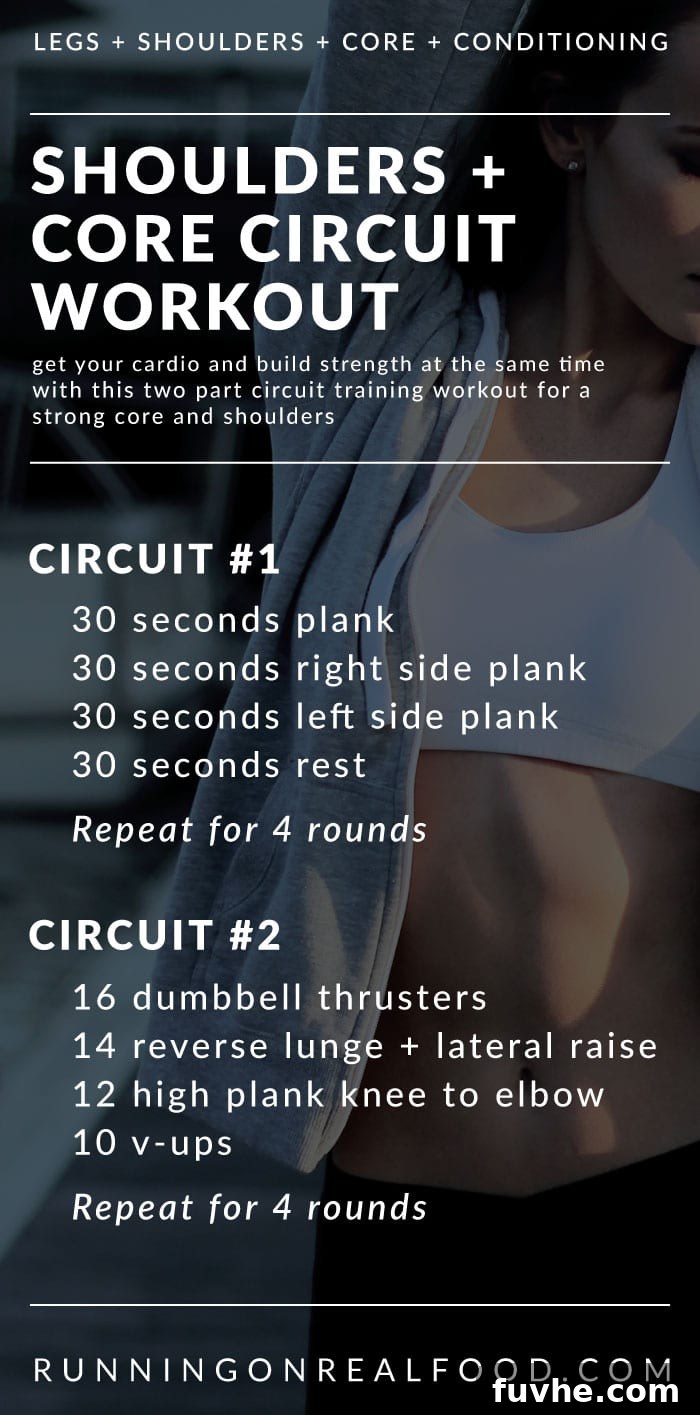
Circuit #1 is a continuous 6-minute plank series designed to ignite your entire core musculature, including your lower back, upper back, abs, and obliques. The goal is to move seamlessly from one plank variation to the next without resting until all three segments are completed. Planking is an incredible way to build a strong, healthy back and core, which are essential for preventing injury and alleviating lower back pain, ultimately enhancing all other areas of your fitness journey.
- 30 seconds Plank: Begin in a standard plank position. Ensure your body forms a straight line from head to heels, engaging your glutes and core. Avoid letting your hips sag or arch upwards. Keep your gaze directed towards the floor to maintain a neutral neck alignment.
- 30 seconds Left Side Plank: Transition immediately to a left side plank. Stack your feet one on top of the other, or place your top foot slightly in front of the bottom for added stability. Prop yourself up on your left forearm, keeping your elbow directly under your shoulder. Lift your hips high, forming a straight line from your head to your feet.
- 30 seconds Right Side Plank: Without delay, switch to the right side plank, mirroring the form from the left side. Focus on maintaining strong core engagement and a stable posture.
- 30 seconds Rest: After completing both side planks, take a brief 30-second rest to recover before repeating the entire Circuit 1. Aim to complete this circuit a total of two times.
Progression & Regression Tips for Circuit 1: If 30 seconds per plank variation feels too challenging, start with 15-20 seconds for each, or modify by performing the plank from your knees. For those finding it too easy, increase the hold time to 45 or even 60 seconds per variation, or try advanced versions like lifting one leg in a traditional plank or performing a star plank in the side plank position.
Circuit 2: Dynamic Strength & Core Power
Circuit #2 combines more intensive core work with two powerful shoulder and leg exercises, creating a full-body challenge that will elevate your heart rate and build functional strength. Perform each exercise consecutively with minimal rest between them, completing all reps before moving to the next. After completing one round of all four exercises, take a 60-90 second rest. Aim to complete Circuit 2 for a total of 3-4 rounds, depending on your fitness level and time availability.
- 16 Dumbbell Thrusters: This is a total body powerhouse exercise that not only challenges your strength but will also get your heart pumping.
- How to: Start standing with a dumbbell in each hand, resting on your shoulders, palms facing each other. Squat down, keeping your chest up and core engaged, as if sitting into a chair. Drive through your heels to stand up powerfully, simultaneously pressing the dumbbells overhead until your arms are fully extended. Lower the dumbbells back to your shoulders as you begin your next squat.
- Benefits: Engages quads, glutes, hamstrings, shoulders, triceps, and core. Excellent for building explosive power and cardiovascular endurance.
- 14 Dumbbell Reverse Lunge with Lateral Raise: This compound movement beautifully works your legs, shoulders, core, and balance.
- How to: Stand tall with a lighter dumbbell in each hand, arms by your sides. Step back with your right leg into a reverse lunge, lowering your hips until both knees are bent at approximately a 90-degree angle. As you lunge, simultaneously raise both dumbbells out to the sides, keeping a slight bend in your elbows, until your arms are parallel to the floor (lateral raise). Push off your back foot to return to the starting position, lowering the dumbbells as you stand. Alternate legs for 14 total reps (7 per leg).
- Benefits: Improves lower body strength, balance, and shoulder stability. Engages glutes, quads, hamstrings, and deltoids.
- 12 High Plank Knee to Elbow: This exercise targets your obliques and core stability with a dynamic twist.
- How to: Start in a high plank position, hands directly under your shoulders, body in a straight line from head to heels. Keeping your core tight and hips stable, bring your right knee towards your right elbow, engaging your right oblique. Return your right leg to the plank position. Alternate sides, bringing your left knee towards your left elbow. That’s one rep. Perform 12 total reps (6 per side).
- Benefits: Strengthens obliques, improves core stability, and enhances hip flexor mobility.
- 10 V-Ups: A fantastic exercise for challenging your entire rectus abdominis.
- How to: Lie flat on your back with your legs straight and arms extended overhead. Keeping your legs straight and core engaged, simultaneously lift your torso and legs off the ground, reaching your hands towards your toes to form a “V” shape with your body. Lower slowly and with control back to the starting position.
- Benefits: Intense abdominal workout, improves core strength and flexibility.
- Modification: If full V-ups are too difficult, try performing tuck-ups (bending your knees as you bring them towards your chest) or single-leg V-ups.
Essential Equipment: Choosing Your Dumbbells
To effectively complete this dynamic workout, you will need two sets of dumbbells: one heavier set for the powerful thrusters and a lighter set for the more controlled reverse lunge with lateral raise. Having two different weights allows you to challenge your muscles appropriately for each exercise, optimizing both strength and form. For instance, you might use 25 lb. dumbbells for the thrusters and 12 lb. dumbbells for the lateral raises, just as I did. However, the most important thing is to select weights that are challenging for *you* while allowing you to maintain perfect form throughout all repetitions.
A good rule of thumb for choosing your weights is that the last few reps of each set should feel quite difficult to complete, pushing your muscles close to fatigue. If you can easily complete all reps without much effort, it’s time to increase your weight. Conversely, if you’re sacrificing form to complete reps, it’s a sign to go lighter. Always prioritize proper technique over heavier weights to prevent injury and ensure you’re effectively targeting the intended muscles.
Pro Tips for Maximizing Your Workout Success
To get the most out of this incredibly effective shoulder and core circuit, keep these expert tips in mind:
- Focus on Form Over Speed: While this is a circuit workout and pace is important, never sacrifice proper form for speed. Performing exercises with incorrect technique not only reduces their effectiveness but also significantly increases your risk of injury. Take your time, especially when learning new movements.
- Engage Your Core Consistently: The core is your body’s stabilizer. Consciously engage your core muscles throughout every exercise, not just the designated core movements. This will protect your spine and enhance the overall effectiveness of each rep.
- Listen to Your Body: Pay attention to what your body tells you. If something feels like sharp pain, stop immediately. Distinguish between muscle fatigue and actual pain. Rest when you need to, and don’t be afraid to modify exercises if necessary.
- Stay Hydrated: Drink plenty of water before, during, and after your workout. Proper hydration is crucial for muscle function, energy levels, and recovery.
- Breathe Effectively: Don’t hold your breath! Exhale on the exertion phase of each movement (e.g., as you press overhead in a thruster, or lift your body in a V-up) and inhale during the recovery phase.
- Progressive Overload: As you get stronger, challenge yourself by gradually increasing the weight of your dumbbells, the number of reps or sets, or by decreasing rest times. This continuous challenge is how your muscles adapt and grow stronger.
- Consistency is Key: The real magic happens with consistency. Aim to incorporate this or similar workouts into your routine 2-3 times a week, allowing for rest days in between to help your muscles recover and rebuild.
More Workouts to Fuel Your Fitness Journey
Loved this quick and powerful circuit? If you’re looking for more ways to challenge your body and keep your fitness routine exciting, explore some of our other popular workouts. They’re designed with efficiency and effectiveness in mind, just like this one!
- Core and Cardio Circuit Workout
- Intense Core Circuit Workout
- Leg and Core Superset Power Workout
- 45 Minute Full-Body EMOM Challenge
- 40 Minute Full-Body EMOM Blast
This shoulder and core circuit workout proves that you don’t need hours in the gym to build significant strength and improve your overall fitness. With just a pair of dumbbells and a dedicated 15-20 minutes, you can achieve incredible results, enhance your stability, prevent injuries, and feel stronger in every aspect of your life. Give it a try, commit to the process, and witness the amazing transformation in your body!