

Unleash Your Full Potential: The Ultimate Run Intervals Strength and Conditioning Workout
Are you ready to redefine your fitness limits? This comprehensive Run Intervals Strength and Conditioning Workout is meticulously designed to push every fiber of your being, delivering unparalleled improvements in your overall fitness, strength, endurance, and cardiovascular health. It’s a challenging yet incredibly rewarding program that targets all major muscle groups, elevates your heart rate, and tests your mental fortitude, ensuring a well-rounded and highly effective training experience. If you’re seeking a workout that builds a resilient body and an unstoppable mindset, you’ve found it.
Workout Overview: Structure and Strategy
This dynamic workout blends high-intensity running intervals with powerful strength exercises, creating a metabolic challenge that will ignite your muscles and boost your stamina. The design is simple yet brutally effective: you’ll alternate between an intense 800-meter run and a series of strength movements. The key to maximizing results is to maintain a high level of effort and minimize rest between exercises. Once you complete the entire circuit of strength exercises following the first run, you’ll embark on a second 800-meter run, leading into a reversed sequence of strength movements. This structure keeps your body guessing, continuously challenging different muscle groups and energy systems.
The transition from a maximal running effort directly into compound strength exercises is where the real magic happens. This unique stressor enhances your body’s ability to recover quickly and perform under fatigue, simulating real-world athletic demands. Prepare to dig deep and embrace the burn – it’s a sign of progress!
Essential Equipment and Weight Selection
To perform this workout effectively, you will primarily need two pieces of equipment: a kettlebell and a weight plate. The selection of appropriate weights is crucial for both safety and effectiveness. For the kettlebell swings and goblet squats, we recommend a challenging but manageable kettlebell in the range of 16-24 kg (approximately 35-53 lbs). This weight should allow you to perform the required repetitions with good form, while still providing significant resistance. If you’re new to kettlebell training, start lighter and focus on mastering the movement patterns before increasing the load.
For the overhead plate walking lunges, a weight plate of 25-45 lbs (approximately 11-20 kg) is ideal. When executing this exercise, hold the weight plate firmly overhead with your arms fully locked out, maintaining a stable core throughout the movement. The overhead position adds an extra layer of challenge, engaging your shoulders, core, and stabilizers, transforming a standard lunge into a full-body strength and balance test. Remember, choosing a weight that allows for perfect form is always paramount, even if it means starting lighter than recommended.
The Workout Protocol: Two Challenging Rounds
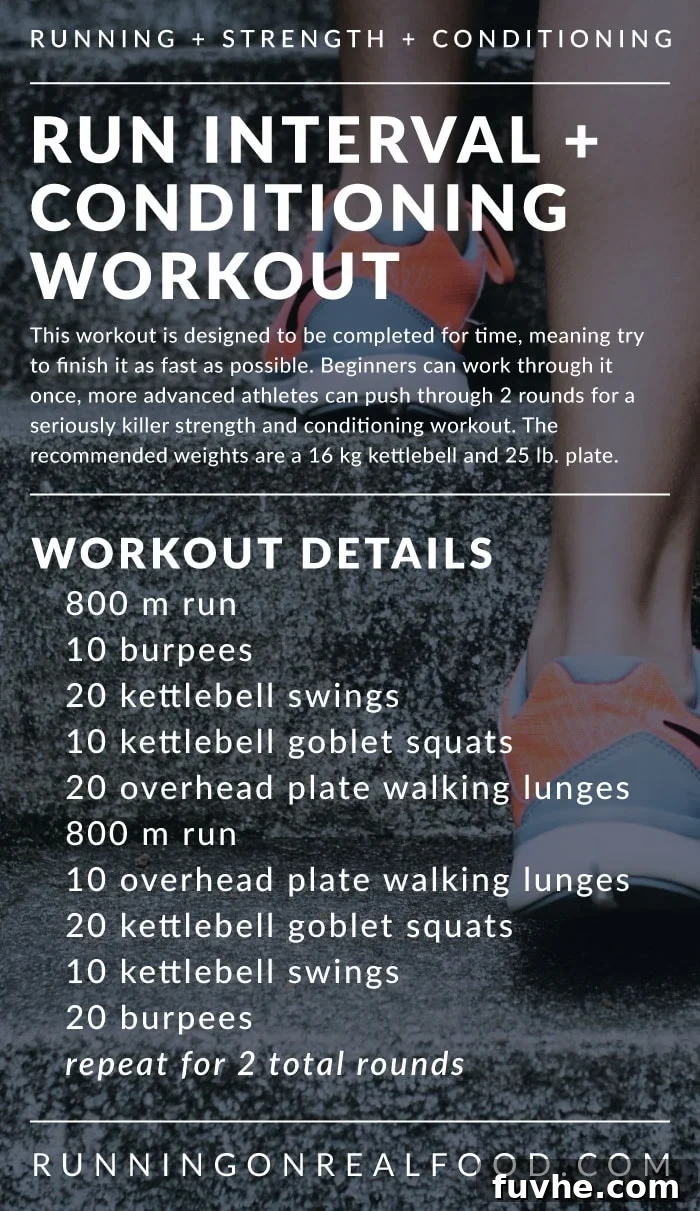
This workout is structured into two demanding rounds, with a strategic reversal of strength exercises in the second half. Focus on consistency and quality of movement throughout. Here’s your mission:
Repeat for 2 full rounds:
- 800 m Run: Push your pace and aim for consistent timing.
- 10 Burpees: Explosive full-body movement.
- 20 Kettlebell Swings: Power from the hips.
- 10 Kettlebell Goblet Squats: Deep squat, focus on form.
- 20 Overhead Plate Walking Lunges: Stability and unilateral strength.
- 800 m Run: Maintain intensity, fight fatigue.
- 10 Overhead Plate Walking Lunges: Second set of this challenging movement.
- 20 Kettlebell Goblet Squats: Engage core and lower body.
- 10 Kettlebell Swings: Drive with power.
- 20 Burpees: Finish strong with this cardio-intensive exercise.
Detailed Exercise Guide and Form Tips
Burpees: The Ultimate Full-Body Power Move
Burpees are a phenomenal full-body exercise that combines a squat, plank, push-up, and jump into one fluid movement, making them incredibly effective for cardiovascular conditioning and muscular endurance. To perform a burpee correctly, start in a standing position, squat down and place your hands on the floor, kick your feet back into a plank position, perform a push-up (optional, but highly recommended), jump your feet back to your hands, and finally, explode upward into a jump with your arms extended overhead. Focus on a controlled descent and an explosive ascent. They target your chest, shoulders, triceps, core, quads, hamstrings, and glutes, while simultaneously sky-rocketing your heart rate.
Kettlebell Swings: Dynamic Hip Power for Strength and Conditioning
The kettlebell swing is a powerful hip-hinge movement that builds explosive strength in the glutes, hamstrings, and lower back, while also enhancing cardiovascular fitness. Stand with feet shoulder-width apart, kettlebell on the floor in front of you. Hinge at your hips, keeping a flat back, and grasp the kettlebell with both hands. Hike the kettlebell back between your legs, then explosively drive your hips forward, squeezing your glutes to propel the kettlebell up to chest height. It’s not an arm lift; the power comes entirely from your hips. Control the descent as the kettlebell swings back between your legs, ready for the next powerful rep. This movement sculpts a powerful posterior chain and improves overall athleticism.
Kettlebell Goblet Squats: Core and Lower Body Strength Foundation
Goblet squats are excellent for developing lower body strength, improving squat mechanics, and engaging your core. Hold the kettlebell by its horns close to your chest, keeping your elbows tucked in. Stand with your feet slightly wider than shoulder-width, toes pointed slightly out. Initiate the squat by pushing your hips back and bending your knees, as if sitting into a chair. Descend until your thighs are parallel to the floor or deeper if your mobility allows, maintaining an upright torso and a tight core. Drive through your heels to return to the starting position. This exercise is fantastic for building foundational strength in your quads, glutes, and hamstrings, while the front-loaded weight forces strong core activation.
Overhead Plate Walking Lunges: Stability and Unilateral Strength
Walking lunges with an overhead plate add a significant challenge to an already effective leg exercise. This variation demands exceptional core stability, shoulder strength, and balance. Hold a weight plate overhead with fully extended arms, keeping your shoulders actively engaged and your core braced. Step forward with one leg, lowering your hips until both knees are bent at approximately a 90-degree angle, ensuring your back knee hovers just above the ground and your front knee is directly over your ankle. Push off your back foot to bring it forward, transitioning into the next lunge with the opposite leg. The overhead load intensely engages your shoulders and core stabilizers, while the walking motion enhances unilateral leg strength and coordination, making it a comprehensive lower body and core builder.
Running Intervals: Cardiovascular Prowess and Mental Toughness
The 800-meter runs in this workout are not merely transitions; they are integral to building your cardiovascular engine and mental resilience. These intervals should be pushed at a strong, challenging pace – think of it as a sustained sprint rather than a jog. Whether you’re on a treadmill or outdoors on a track or measured route, aim to maintain a consistent effort level throughout each 800m segment. The real test comes from transitioning directly from these high-intensity runs back into demanding strength movements. This rapid shift between cardiovascular and muscular exertion is key to improving your body’s ability to recover and perform under continuous stress, leading to significant gains in endurance and overall conditioning.
Customizing Your Workout: Exercise Substitutions
Flexibility is key in any workout program. If you find yourself without a kettlebell or a weight plate, fear not – you can still perform this powerful workout. Dumbbells can serve as excellent substitutes for all the listed exercises; simply adjust the weight to match the intensity. For instance, you can perform dumbbell swings, dumbbell goblet squats, and hold a single or two dumbbells overhead for the walking lunges. If your training space is limited and walking lunges aren’t feasible, reverse lunges are an equally effective alternative, targeting the same muscle groups without requiring much forward momentum. Advanced lifters might opt for a barbell for lunges, either on their back (back rack position) or held across the front of their shoulders (front rack position), adding an extra layer of stability and load. For those newer to strength training or looking to master the movement pattern, bodyweight walking lunges are a fantastic starting point, focusing purely on form and muscular engagement before adding external resistance.
Unlocking Peak Performance: Benefits of This Workout
This run intervals strength and conditioning workout is a potent catalyst for holistic physical development. It meticulously targets three critical components of fitness: strength, endurance, and overall conditioning. By seamlessly integrating high-intensity running with compound strength movements, your body is forced to adapt across multiple physiological systems. You’ll experience enhanced muscular endurance, allowing your muscles to perform under fatigue for longer durations. Your cardiovascular capacity will significantly improve, leading to a higher VO2 max and more efficient oxygen delivery to working muscles. Moreover, the metabolic stress induced by this circuit promotes fat loss and builds lean muscle mass, contributing to a more athletic and resilient physique. This workout doesn’t just make you stronger or faster; it makes you a more capable, well-rounded athlete, ready to tackle any physical challenge that comes your way.
Beyond the physical transformations, this workout also cultivates immense mental toughness. Pushing through the discomfort of transitioning from a hard run to demanding strength exercises, and vice versa, builds mental resilience that translates into all areas of life. You’ll learn to push past perceived limitations, focus under duress, and embrace the challenge, fostering a mindset of perseverance and self-belief.
Mastering the Challenge: Tips for Success
To truly conquer this workout and maximize its benefits, several strategies can enhance your performance and ensure safety. First, prioritize impeccable form over sheer speed or heavy weight. A slightly lighter weight performed with perfect technique will always yield better results and prevent injury than struggling with a weight that compromises your movement. Second, manage your pacing. While the goal is to complete the workout as fast as possible, it’s a marathon, not a sprint. Find a sustainable pace for your 800m runs and your strength exercises that allows you to maintain effort throughout both rounds. Don’t go out too hard and burn out prematurely. Minimize rest between exercises; active recovery or short, intentional breaks are preferable to prolonged pauses.
My personal experience with this workout involved using a 20 kg kettlebell and a 25 lb. weight plate, which provided a significant challenge for my fitness level. I completed the entire workout in just under 30 minutes, pushing hard and keeping all my 800m runs under 3:45. By the fourth run, my legs and lungs were screaming, but knowing I had only a few more strength exercises to conquer kept me going. This is where mental fortitude truly shines. If you’re a beginner, don’t be intimidated; scale it back to a single round or adjust the weights downward. For advanced exercisers, embrace the full two rounds, push your limits, and challenge yourself to finish with unwavering intensity. Regardless of your fitness level, completing this intense interval workout will leave you drenched in sweat, with muscles buzzing and your heart pounding – but ultimately, filled with a deep sense of accomplishment and pride. You’ll walk away knowing you gave it your all, and that feeling is truly invaluable.
Explore More Challenging Workouts
If you’ve loved the intensity and effectiveness of this conditioning workout, we have plenty more to challenge and inspire you. Dive into these additional high-performance routines to continue your fitness journey and discover new ways to build strength, endurance, and power:
35 Minute Treadmill and Barbell Workout // HIIT Treadmill Hill Workout // Barbell and Burpee 30 Minute EMOM // Legs and Hills Workout // High-Intensity Lower Body Workout