

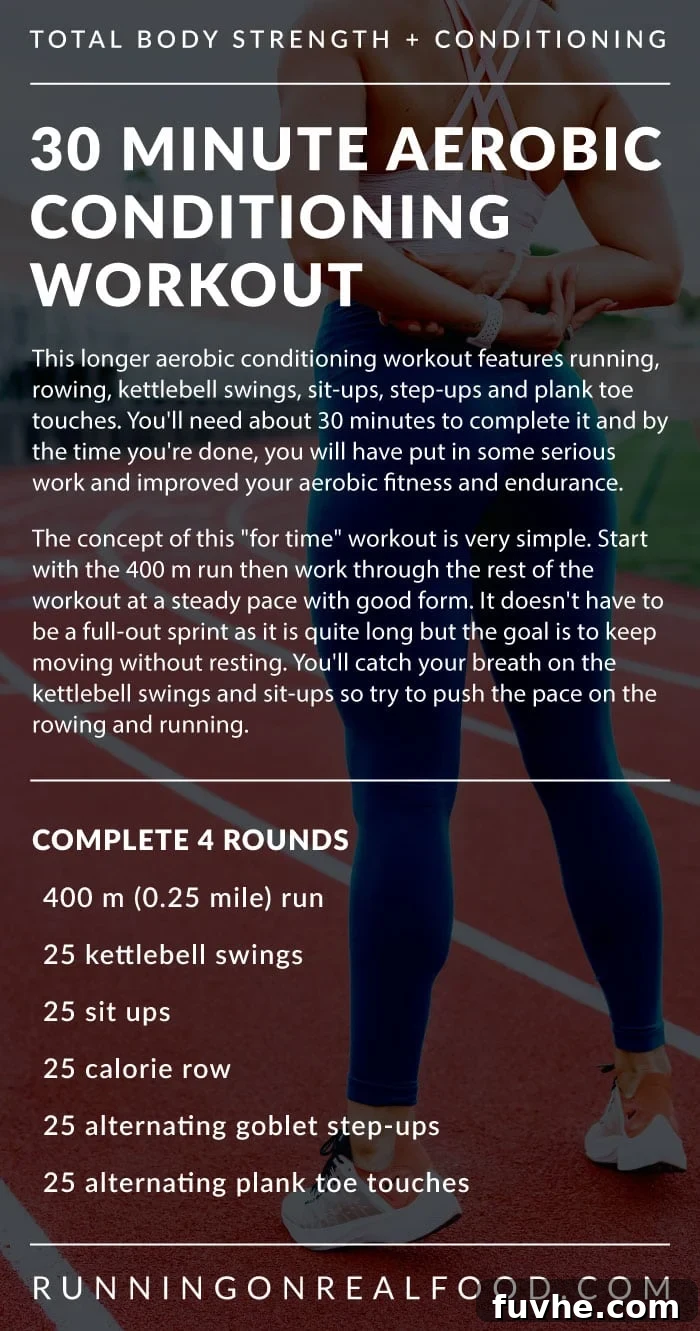
Welcome to your ultimate 30-minute aerobic conditioning workout, meticulously designed to elevate your cardiovascular fitness and build robust endurance. This comprehensive, full-body routine strategically combines running, rowing, kettlebell swings, sit-ups, goblet step-ups, and plank toe touches to deliver a powerful, high-impact training session. Whether you’re aiming to boost your stamina, enhance athletic performance, or simply inject dynamic energy into your fitness regimen, this workout promises significant results. Prepare to challenge your limits, push your pace, and emerge feeling stronger and more conditioned than ever before. While it’s designed to be completed in approximately 30 minutes, your actual time may vary based on your fitness level and intensity. The key is consistent movement and maintaining excellent form throughout.
This isn’t just another workout; it’s a strategically crafted conditioning session that targets multiple muscle groups and energy systems. By integrating both cardiovascular and strength-endurance movements, you’ll experience improved aerobic capacity, muscular stamina, and overall functional fitness. Dedicate this time to yourself, commit to each repetition, and embrace the journey towards a more resilient and powerful physique. Let’s get moving!
The Power of Aerobic Conditioning: Why It Matters
Aerobic conditioning, often synonymous with cardiovascular training, is a cornerstone of a healthy and fit lifestyle. It refers to your body’s ability to efficiently use oxygen to generate energy during sustained physical activity. Engaging in workouts like this one offers a multitude of benefits that extend far beyond simply “getting fit.”
Firstly, it dramatically improves your heart health. Regular aerobic exercise strengthens your heart muscle, allowing it to pump blood more efficiently and reduce your resting heart rate. This, in turn, lowers the risk of cardiovascular diseases, high blood pressure, and stroke. Secondly, aerobic conditioning boosts your endurance, meaning you can perform physical tasks for longer periods without feeling fatigued. This translates to better performance in daily activities, other sports, and even increased overall energy levels.
Beyond the physical, aerobic training has profound mental and emotional benefits. It’s a proven stress reliever, releasing endorphins that can improve mood, reduce anxiety, and even combat symptoms of depression. Furthermore, consistent aerobic activity can enhance cognitive function, sharpen focus, and promote better sleep quality. By incorporating a diverse range of exercises like running, rowing, and strength movements, this workout not only targets your aerobic system but also builds muscular endurance, functional strength, and calorie-burning potential. It’s an investment in your overall well-being, offering holistic improvements to your body and mind.
Executing Your 30-Minute Aerobic Conditioning Workout
To maximize the effectiveness of this conditioning routine, a strategic approach to performance is essential. Begin each round with the 400-meter run, aiming for a strong, purposeful pace. Following the run, transition smoothly through the remaining exercises, focusing on maintaining a steady rhythm and impeccable form. This workout is designed for continuous movement rather than an all-out sprint, especially given its length and multi-faceted nature. The primary objective is to minimize rest between exercises within each round, keeping your heart rate elevated and challenging your muscular endurance.
Think of the kettlebell swings and sit-ups as active recovery segments within each round. While you’re still working hard, these movements allow you to catch your breath slightly and prepare for the more intense cardiovascular bursts. Therefore, seize the opportunity during the rowing and running segments to push your pace and truly challenge your aerobic capacity. Don’t sacrifice form for speed; instead, strive for efficiency in your movements. Listen to your body, but also encourage yourself to move past comfort zones. The synergy between high-intensity cardio and strength-endurance exercises in this workout will build both your physical resilience and mental fortitude.
Pre-Workout Warm-Up: Preparing Your Body
Before diving into the main workout, a proper warm-up is crucial to prevent injury and optimize performance. Dedicate 5-10 minutes to light cardiovascular activity and dynamic stretching. This prepares your muscles, elevates your heart rate gradually, and increases blood flow.
- Light Cardio (3-5 minutes): Start with a gentle jog, brisk walk, or light rowing to get your blood pumping.
- Dynamic Stretches (5 minutes): Perform movements like arm circles, leg swings, torso twists, high knees, butt kicks, and walking lunges. These stretches move your joints through their full range of motion, improving flexibility and preparing your muscles for the demands of the workout. Focus on controlled movements, not holding static stretches.
The Comprehensive Workout Structure
This challenging and rewarding workout is structured around four complete rounds. Each round consists of a carefully selected sequence of exercises designed to tax your cardiovascular system and build muscular endurance. The continuous flow between exercises is key to maintaining a high heart rate and maximizing the conditioning benefits. Remember, the goal is to keep moving with purpose and good form, pushing through the fatigue to build true aerobic resilience.
- 400 m (0.25 mile) Run: Kick off each round with a burst of cardiovascular energy. Whether on a treadmill or outdoors, aim for a challenging yet sustainable pace that elevates your heart rate.
- 25 Kettlebell Swings: A powerful, full-body exercise that targets your glutes, hamstrings, and core, while also providing a significant cardiovascular challenge. Focus on a strong hip hinge and explosive drive.
- 25 Sit-Ups: An effective core exercise that builds abdominal strength and endurance. Maintain control throughout the movement, engaging your core and avoiding yanking on your neck.
- 25 Calorie Row: An incredible full-body cardio blast. Focus on a powerful leg drive, strong pull, and smooth recovery to maximize your calorie output efficiently.
- 25 Alternating Goblet Step-Ups: A unilateral exercise that builds lower body strength, balance, and stability. Hold a kettlebell or dumbbell at your chest (goblet style) and alternate leading legs as you step onto a box or bench.
- 25 Alternating Plank Toe Touches: A dynamic core and shoulder stability exercise that also adds a mobility component. Focus on control and a strong plank position.
Once you’ve completed all six exercises, take a brief moment to regroup if necessary, then immediately begin the next round. The cumulative effect of these rounds will significantly challenge your endurance, leading to noticeable improvements in your fitness over time. Stay focused, breathe deeply, and push through each repetition with intention.
Plank Toe Touches: Mastering the Movement
The alternating plank toe touch is a dynamic exercise that effectively combines core stability, shoulder strength, and hamstring flexibility. To execute this movement correctly, begin in a high plank position, ensuring your hands are directly under your shoulders, your body forms a straight line from head to heels, and your core is actively engaged. From this stable plank, push your hips back and up towards the ceiling, transitioning smoothly into a downward-facing dog position. As you reach the peak of this stretch, simultaneously reach your right hand across your body to touch your left foot (or as close as you can comfortably get). Focus on maintaining balance and control throughout this reach, avoiding excessive rocking of your hips.
Once you’ve touched your foot, smoothly return to the starting high plank position, ensuring your core remains engaged and your shoulders are stable. Immediately repeat the movement on the opposite side, reaching your left hand to your right foot. Continue to alternate for a total of 25 repetitions, which means 12-13 touches on each side. The key to maximizing the benefits of this exercise lies in the controlled transitions and the active engagement of your core. This movement not only strengthens your abdominal muscles and obliques but also improves shoulder stability and offers a dynamic stretch for your hamstrings. For a clear visual demonstration and to ensure perfect form, consider watching this helpful video example: Watch this video.
Scaling This Workout: Adapt and Conquer
This aerobic conditioning workout is highly versatile and can be effectively scaled to suit any fitness level, from beginners to advanced athletes. The goal is always to provide a challenging yet safe experience that promotes progress.
Modifications for Beginners or When Starting Out:
If you’re new to high-intensity training or returning after a break, reducing the overall volume is an excellent starting point. Consider the following adjustments:
- Reduce Rounds: Instead of completing 4 rounds, start with 2 or 3 rounds. As your fitness improves, gradually add more rounds.
- Decrease Repetitions: Lower the number of repetitions for each exercise from 25 to 15-20. This allows you to maintain good form and manage fatigue more effectively. For the row, aim for 15-20 calories.
- Adjust Distances: For the run, reduce the distance to 200-300 meters, or perform a brisk walk/jog if a full run is too much.
- Lighter Weights: For kettlebell swings and goblet step-ups, choose a lighter kettlebell or dumbbell that allows you to perform reps with perfect form. It’s always better to go lighter and focus on technique.
- Exercise Variations:
- Kettlebell Swings: Practice the hip hinge movement without weight, or use a very light dumbbell.
- Sit-ups: Perform crunches or reduce the range of motion.
- Goblet Step-Ups: Perform bodyweight step-ups or use a lower step/box.
- Plank Toe Touches: Focus on holding a strong high plank for a set duration, or perform standard plank reaches without the toe touch.
- Pacing: Allow for slightly longer rest periods between exercises or rounds if needed, but strive to progressively shorten these as your endurance improves.
Strategies for Advanced Athletes or When Seeking More Challenge:
For those looking to amplify the intensity and push their limits, there are several ways to make this workout even more demanding:
- Increase Speed and Intensity: The most straightforward way to make it harder is to simply go faster! Challenge yourself to complete the entire workout in under 30 minutes, or even significantly less if your fitness allows. Focus on minimizing transition time between exercises.
- Heavier Weights: For kettlebell swings and goblet step-ups, use a heavier kettlebell or dumbbell. Consider performing American kettlebell swings (overhead) instead of Russian swings (eye level) for an added challenge, but only if your form is impeccable.
- Increase Rounds or Reps: If 4 rounds feel too easy, add a 5th round. If 25 reps are comfortable, try 30 reps per exercise.
- Reduce Rest: Actively eliminate any rest between exercises within a round, and take only minimal, calculated rest between rounds.
- Add an Exercise: For truly advanced individuals, consider adding a seventh exercise to each round, such as burpees or push-ups, while still aiming for the 30-minute target.
Regardless of your starting point, remember that consistency and progressive overload are key to long-term fitness gains. Choose the scaling option that challenges you appropriately without compromising form, and continuously strive to improve over time.
Equipment Needed and Smart Alternatives
This workout is designed to be accessible, utilizing common gym equipment. However, knowing your options and alternatives ensures you can still get a fantastic workout even if certain equipment isn’t available. Here’s what you’ll need, along with creative solutions:
- Treadmill or Outdoor 400 m/0.25 Mile Route:
- Primary: A treadmill provides a controlled environment, making it easy to track distance and pace. An outdoor route offers fresh air and varied terrain.
- Alternatives:
- Elliptical or Arc Trainer: If running isn’t an option due to impact, these machines offer a low-impact cardiovascular workout. Aim for 1:30-2:00 minutes at a high intensity to match the effort of the run.
- Jumping Jacks/High Knees/Butt Kicks: For a no-equipment, space-constrained option, perform these movements for 1:00-1:30 minutes with high intensity.
- Stair Climber: 1:00-1:30 minutes on a stair climber at a challenging pace can substitute for the run.
- Kettlebell:
- Primary: A kettlebell is ideal for swings and goblet step-ups due to its unique weight distribution, which enhances grip strength and dynamic movement. I personally recommend a 16 kg (approximately 35 lbs) kettlebell for swings and step-ups for those with some experience, focusing on Russian kettlebell swings (to eye level). For an increased challenge, opt for a heavier kettlebell or transition to overhead (American) kettlebell swings, ensuring your shoulder mobility and core stability are adequate. Always select a weight that allows you to complete all 25 repetitions with perfect, unbroken form.
- Alternatives:
- Dumbbells: Hold one dumbbell by both hands for goblet step-ups and as a substitute for kettlebell swings (though the mechanics will be slightly different, focus on the hip hinge).
- Barbell: For step-ups, you can place an empty barbell on your back (as in a back squat) for added resistance, or hold a weighted plate.
- Resistance Band: While not a direct substitute for heavy swings, a heavy resistance band can be used for banded good mornings or glute bridges to target similar muscle groups for those unable to use free weights.
- Rowing Machine:
- Primary: A rowing machine (such as a Concept2) set to calories is an excellent full-body cardiovascular and strength endurance tool. It works virtually every major muscle group efficiently.
- Alternatives:
- Ski Erg or Assault Bike: These machines are fantastic alternatives, providing a similar high-intensity, full-body caloric burn. Aim for 25 calories on either machine.
- Second 400 m Run: If no specialized equipment is available, simply perform a second 400-meter run in place of the rowing calories. This will significantly increase the running volume.
- Cardio Machine of Your Choice: Hop on any available cardio machine (elliptical, stationary bike, stair climber) for 1:30-2:00 minutes at approximately 85% maximum effort. The key is to maintain high intensity to replicate the caloric output and cardiovascular demand of the row.
- Burpees: For a no-equipment option, perform 15-20 burpees with a chest-to-ground component. Burpees are a highly effective full-body conditioning exercise that will raise your heart rate rapidly.
Adaptability is key in fitness. Don’t let a lack of specific equipment deter you from completing a challenging and effective workout. With these alternatives, you can ensure your 30-minute aerobic conditioning session remains intense and beneficial, no matter your gym setup.
Post-Workout Cool-Down: Recovery and Flexibility
Just as important as the warm-up, a proper cool-down helps your body recover, improves flexibility, and reduces muscle soreness. Dedicate 5-10 minutes to static stretching after your workout.
- Light Cardio (2-3 minutes): A gentle walk or slow jog to gradually bring your heart rate down.
- Static Stretches (5-7 minutes): Hold each stretch for 20-30 seconds, focusing on major muscle groups worked during the workout: hamstrings, quads, glutes, chest, shoulders, and triceps. Examples include hamstring stretch, quad stretch, glute stretch (figure-four), chest opener, and triceps stretch. Breathe deeply and relax into each stretch.
Hydration and Nutrition: Fueling Your Fitness
To truly maximize the benefits of this aerobic conditioning workout, proper hydration and nutrition play a pivotal role. Before, during, and after your session, ensure you’re adequately hydrated by drinking plenty of water. Water is essential for maintaining energy levels, regulating body temperature, and aiding in muscle function.
Pre-workout, a small, easily digestible meal rich in complex carbohydrates and a bit of protein can provide sustained energy. Post-workout, focus on replenishing your energy stores and repairing muscle tissue with a balanced meal or snack containing both protein and carbohydrates. This crucial recovery window helps optimize your gains and prepares your body for your next challenging workout.
More Conditioning Workouts to Explore
If you’ve enjoyed the intensity and effectiveness of this 30-minute aerobic conditioning workout, you’re in luck – there are plenty more challenges awaiting you! Variety is not only the spice of life but also a key component of a well-rounded fitness program. Exploring different workout structures and exercises helps prevent plateaus, keeps your training exciting, and continually challenges your body in new ways. Each of these workouts offers a unique approach to building strength, endurance, and overall conditioning, ensuring you’ll find something to keep your fitness journey dynamic and engaging. Dive into these additional routines to further enhance your athletic capabilities:
- Strength and Conditioning EMOM Workout: This Every Minute On the Minute (EMOM) format pushes your work capacity and helps you manage your pace effectively.
- HIIT Strength and Conditioning Workout: Combine high-intensity interval training with strength elements for a powerful fat-burning and muscle-building session.
- 30 Minute EMOM Conditioning Workout: Another fantastic EMOM option, perfectly timed to deliver maximum results in a compact session.
- A CrossFit-Style Conditioning Workout: Experience the intensity and varied movements inspired by CrossFit, designed to test your limits.
- Run Intervals Strength and Conditioning Workout: Integrate running intervals with strength exercises for an effective blend of cardio and muscular endurance.
Remember to listen to your body, choose workouts that align with your current fitness level, and most importantly, enjoy the process of becoming stronger, fitter, and more resilient!