Full-Body Conditioning Workout: Unleash Your Inner Athlete with This CrossFit-Style Circuit
Are you ready to ignite your metabolism, build functional strength, and boost your cardiovascular endurance? Look no further! Today, we’re diving into a high-intensity, full-body conditioning workout designed to challenge every muscle group and get your heart pumping. Inspired by the dynamic and effective principles of CrossFit, this circuit focuses on compound movements that deliver maximum results in minimal time. Whether you’re a seasoned athlete or just beginning your fitness journey, this workout is easily adaptable to your current fitness level, requiring very little equipment. All you’ll need is a sturdy step or box for exhilarating burpee box jumps and a weight plate (or a suitable alternative like a dumbbell or kettlebell) for powerful overhead lunges. Prepare to push your limits, improve your overall fitness, and discover a workout that’s as fun as it is effective!
The Ultimate Full-Body Conditioning Workout Overview
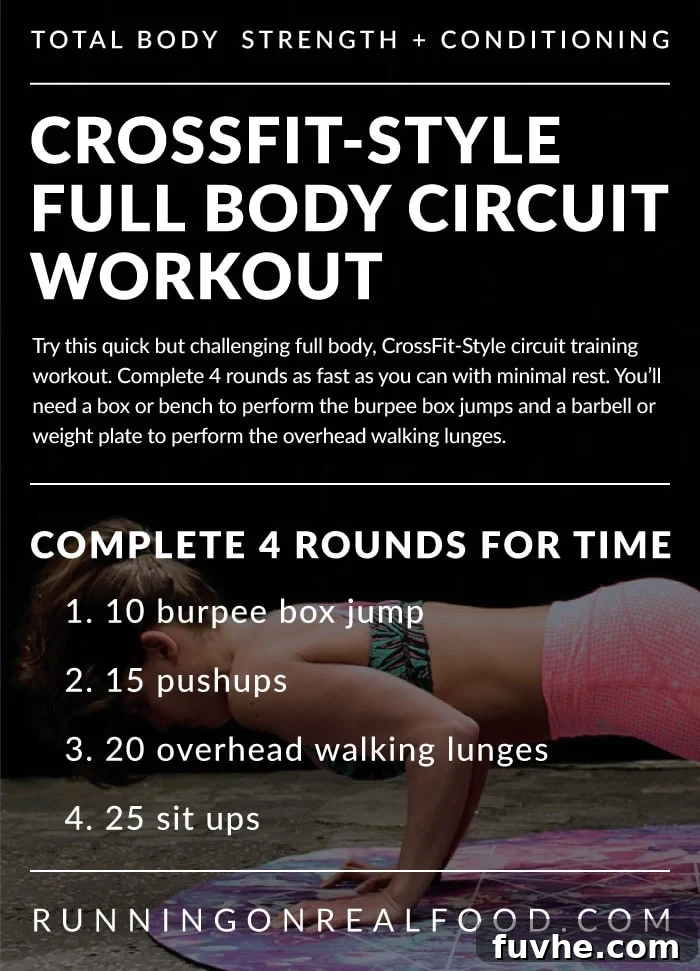
This CrossFit-style circuit is a prime example of metabolic conditioning (MetCon) – a powerful training method that combines strength and cardio elements to maximize calorie burn and enhance overall athletic performance. It’s designed to be performed “for time,” meaning your goal is to complete the entire workout as quickly as possible while maintaining impeccable form. This approach not only builds incredible stamina and power but also creates a significant “afterburn effect,” keeping your metabolism elevated long after you’ve finished.
The beauty of this workout lies in its simplicity and efficiency. It targets major muscle groups through functional movements, ensuring you’re building practical strength that translates into everyday life. By moving through rounds with minimal rest, you’ll continually challenge your cardiovascular system, turning your body into a lean, mean, calorie-burning machine. This isn’t just a workout; it’s a test of grit, determination, and consistency.
Workout Details: Push Your Limits
Your mission, should you choose to accept it, is to complete 4 rounds of the following exercises for time. Remember, the clock is ticking, but form is paramount! For those new to high-intensity training, we recommend starting with 2-3 rounds to get accustomed to the movements and pacing. More advanced individuals eager for an extra challenge can easily scale up to 5 or even 6 rounds to truly test their endurance and mental fortitude. During my last session, utilizing a step with five risers for the burpee box jumps and a 35-pound weight plate for the overhead lunges, I completed the circuit in just over 22 minutes. Now, it’s your turn to set your personal best!
- 10 Burpee Box Jumps: A explosive, full-body movement that combines a burpee with a plyometric jump.
- 15 Push-ups: A fundamental upper-body and core strengthening exercise.
- 20 Overhead Walking Lunges: A challenging lower-body and core stability exercise that also engages the upper body.
- 25 Sit-ups: A classic core-strengthening exercise to finish strong.
Master the Movements: Detailed Exercise Breakdown
Understanding the proper technique for each exercise is crucial for both maximizing effectiveness and preventing injury. Let’s break down each movement, providing detailed instructions, benefits, and scaling options to ensure you get the most out of your full-body conditioning workout.
-
Burpee Box Jumps: The Ultimate Calorie Burner
The burpee box jump is a powerhouse exercise that truly embodies the “full-body” concept. It’s a fantastic way to elevate your heart rate rapidly, build explosive power in your legs, and engage your core, chest, and triceps. This compound movement is a testament to functional fitness, combining a strength movement with a plyometric challenge.
How to Perform (1 Rep): Begin by standing in front of your box or step. Drop into a squat position, placing your hands on the floor just outside your feet. Kick your feet back into a plank position, ensuring your body forms a straight line from head to heels. Perform a push-up (chest to the floor is ideal, but scale as needed). As you come up from the push-up, quickly bring your feet forward towards your hands, springing up into a slight jump. Instead of a traditional jump, immediately explode upward onto your box or step, landing softly with both feet. Stand tall, extending your hips fully on top of the box. Step or jump back down, landing softly, and immediately transition into your next burpee. Focus on fluidity and efficiency between repetitions.
Scaling & Progression: For beginners, start with regular burpees without the box jump, or simply step onto the box instead of jumping. You can also perform the burpee without the push-up. To progress, use a higher box, or increase the speed and fluidity of your transitions.
Form Tip: Maintain a neutral spine throughout the burpee. Land softly on the box with slightly bent knees to absorb impact, preventing undue stress on your joints.
-
Push-ups: Fundamental Upper Body Strength
Push-ups are a cornerstone of upper body and core strength, targeting your chest, shoulders, triceps, and engaging your core for stability. They are a versatile exercise that can be scaled for nearly any fitness level, making them an essential component of any full-body conditioning routine.
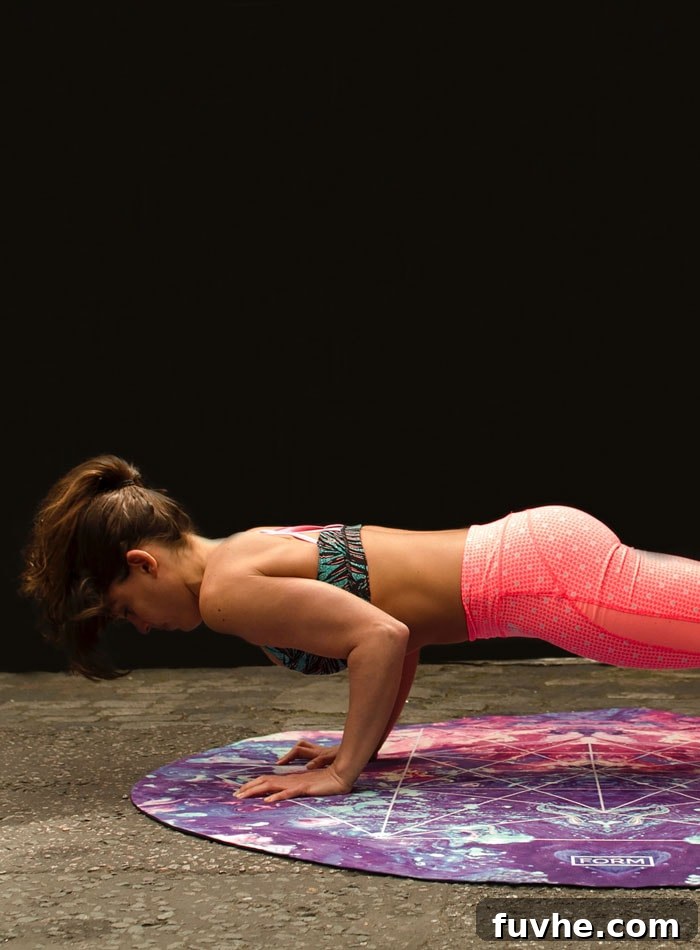
How to Perform (1 Rep): Start in a high plank position with your hands slightly wider than shoulder-width apart, fingers pointing forward. Ensure your body forms a straight line from your head to your heels, engaging your core and glutes. Lower your chest towards the floor by bending your elbows, keeping them tucked slightly towards your body (not flaring out wide). Go as deep as your strength allows, ideally until your chest lightly touches the floor. Push through your palms to extend your arms, returning to the starting plank position. Maintain core engagement throughout the entire movement to prevent your hips from sagging or rising too high.
Scaling & Progression: If full push-ups are challenging, start on your knees, ensuring your body remains straight from knees to head. Alternatively, perform elevated push-ups with your hands on a bench or sturdy surface; the higher the surface, the easier the push-up. To make them more difficult, try decline push-ups (feet elevated), or weighted push-ups.
Form Tip: Focus on keeping your elbows relatively close to your body to protect your shoulders and activate your triceps more effectively. Avoid letting your lower back arch or your hips sag.
-
Overhead Walking Lunges: Core, Balance, and Legs
Overhead walking lunges are an incredible full-body exercise that demand significant core stability, balance, and unilateral leg strength. By holding a weight overhead, you engage your shoulders, upper back, and deep core muscles to stabilize the load, while your legs and glutes work intensely through the lunge pattern. This exercise improves posture, strengthens stabilizers, and enhances coordination.
How to Perform (1 Rep per leg): Select a suitable weight plate, dumbbell, or even a barbell. Press the weight straight overhead, fully extending your arms and locking out your elbows. Ensure your biceps are next to your ears, and your shoulders are engaged. Maintain this locked-out position throughout the entire movement. Step forward with one leg, lowering your hips until both knees are bent at approximately a 90-degree angle. Your front knee should be directly over your ankle, and your back knee hovering just above the ground. Push off your back foot to bring it forward, stepping into the next lunge with the opposite leg. Continue alternating legs as you walk forward, keeping the weight stable and directly overhead.
Scaling & Progression: Begin with bodyweight walking lunges, focusing purely on balance and form. Once comfortable, add a light weight held at your chest (goblet lunge) before progressing to the overhead position. To increase difficulty, use a heavier weight or increase the duration of your lunges.
Form Tip: Keep your core braced and gaze forward to help maintain balance. Avoid allowing your lower back to arch excessively. The weight should feel like it’s “stacked” directly over your hips and feet.
-
Sit-ups: The Classic Core Finisher
The classic sit-up remains a highly effective exercise for strengthening your abdominal muscles. While often underestimated, when performed with good form, sit-ups build core strength crucial for stability in all other exercises and daily movements. They specifically target the rectus abdominis, the “six-pack” muscle, while also engaging the obliques.
How to Perform (1 Rep): Lie on your back with your knees bent and feet flat on the floor, hip-width apart. You can cross your arms over your chest (easier), place your hands lightly behind your ears with elbows out (standard), or hold a medicine ball, weight plate, or dumbbell on your chest for added difficulty. Engaging your core, initiate the movement by peeling your upper back off the floor, bringing your torso towards your thighs. Focus on using your abdominal muscles rather than pulling with your neck. Continue until your chest touches your thighs, or as close as possible. Slowly and with control, reverse the movement to lower your back to the starting position. Aim to perform all 25 repetitions as quickly as possible with excellent form and minimal rest.
Scaling & Progression: If full sit-ups are too challenging, start with crunches, lifting only your head and shoulders off the ground. You can also use an ab mat for back support. To make them harder, add weight to your chest, or try GHD (Glute-Ham Developer) sit-ups if available.
Form Tip: Avoid yanking on your neck. Keep your chin slightly tucked, maintaining a small space between your chin and chest. Focus on a controlled descent to maximize muscle engagement and prevent injury.
Maximizing Your Workout: Tips for Success
To truly get the most out of this challenging full-body conditioning workout, incorporating a few key practices into your routine will make a significant difference in your performance, safety, and overall results. Fitness is a journey, and consistent application of these principles will accelerate your progress.
The Importance of a Proper Warm-up
Never skip your warm-up! A dynamic warm-up prepares your muscles, increases blood flow, and improves joint mobility, significantly reducing your risk of injury. Spend 5-10 minutes performing light cardio and dynamic stretches before diving into the main workout. This could include jogging in place, jumping jacks, arm circles, leg swings, hip rotations, and light squats.
Cool-down and Recovery
Just as important as warming up is cooling down. After pushing your body, dedicate 5-10 minutes to static stretching, holding each stretch for 20-30 seconds. Focus on the major muscle groups worked: chest, shoulders, triceps, quads, hamstrings, and core. Proper recovery, including adequate sleep and nutrition, is vital for muscle repair and growth.
Form Over Speed: Your Golden Rule
While this workout is “for time,” never sacrifice good form for speed. Poor form can lead to inefficient muscle activation, decreased results, and, most importantly, serious injury. If you find your form breaking down, slow down, take a brief rest, or scale the movement. Consistency with correct technique will yield far better long-term results than rushing through reps.
Tracking Your Progress
To stay motivated and see how far you’ve come, keep a log of your workout times, the weights you used, and any scaling modifications. Over time, you’ll notice your completion times improving, your ability to handle heavier weights increasing, or your need for scaling decreasing. This tangible evidence of progress is incredibly motivating and helps you set new, challenging goals.
Your Next Fitness Challenge Awaits!
This full-body conditioning workout is more than just a sequence of exercises; it’s an opportunity to test your limits, build resilience, and take a significant step forward in your fitness journey. Embrace the challenge, enjoy the process, and celebrate every small victory along the way. Your body is capable of amazing things – it’s time to show it what it can do!
Loved this CrossFit-style workout and craving more high-intensity action? Here are some additional challenges to keep your fitness routine fresh and exciting:
Bodyweight and Running Workout For Time // 100-20-100 Reps For Time Workout // 35 Minute Treadmill and Barbell Workout // 3-Part CrossFit AMRAP Workout // 20 Minute CrossFit WOD // Full-Body 30 Minute EMOM Workout