

Welcome to the ultimate full-body athletic conditioning workout, meticulously designed to elevate your strength, endurance, and overall fitness. This comprehensive program seamlessly blends strength training with high-intensity interval training (HIIT) to deliver a powerful, efficient, and exhilarating fitness experience. Whether you’re an athlete looking to boost performance or simply aiming to achieve a higher level of functional fitness, this workout promises to challenge you and deliver remarkable results. In just 30-45 minutes, you’ll engage every major muscle group, significantly improve your cardiovascular health, and build explosive power. Get ready to push your limits and discover what your body is truly capable of.
Workout Overview and Benefits
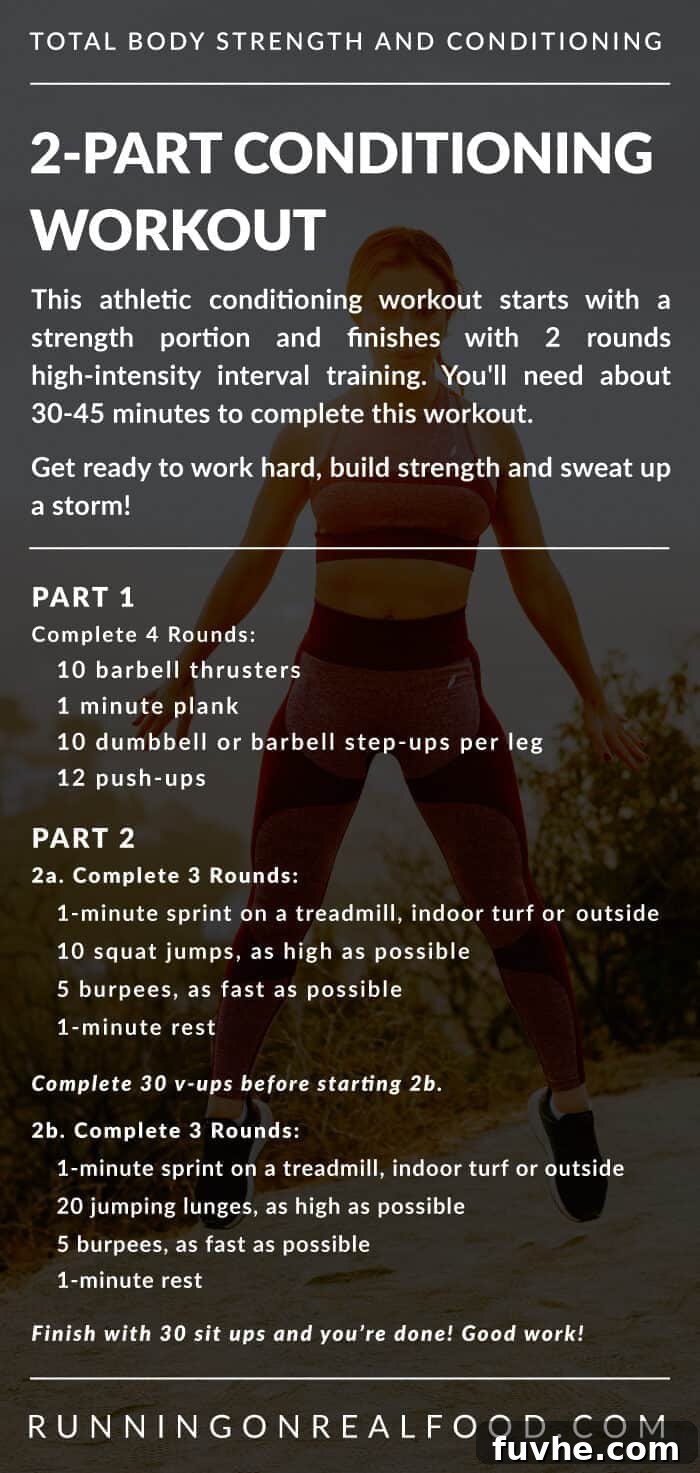
This dynamic athletic conditioning workout is structured into two distinct yet complementary parts. Part 1 focuses on foundational strength and muscular endurance through a circuit of compound movements. Part 2 then transitions into a high-octane interval training session designed to torch calories, enhance cardiovascular capacity, and build explosive power. The beauty of this program lies in its efficiency and effectiveness. By combining strength and HIIT, you not only build muscle and burn fat but also improve athletic performance across various disciplines. Expect to boost your stamina, increase your metabolic rate, and develop a more resilient and powerful physique. This routine is perfect for those seeking a challenging yet accessible way to achieve comprehensive fitness.
Detailed Workout Breakdown
To ensure optimal performance and prevent injury, always begin with a thorough warm-up, including light cardio and dynamic stretches. After completing the workout, cool down with static stretches to aid recovery. This workout is a testament to intelligent training, combining the best of strength and cardio for maximum impact.
Part 1: Strength and Endurance Circuit (Complete 4 Rounds)
Part 1 of this workout is all about building functional strength and muscular endurance. You will perform a circuit of four exercises, completing 4 rounds with minimal rest between movements and sets. This approach maximizes time under tension and keeps your heart rate elevated, blurring the lines between strength and cardio. Focus on controlled movements and proper form throughout.
- 10 Barbell Thrusters: This powerful full-body exercise combines a front squat with an overhead press. Start with the barbell racked across your shoulders, elbows high. Squat down with good form, keeping your chest up. As you stand up explosively, use the momentum to press the barbell overhead until your arms are fully extended. Lower the barbell back to the starting position in a controlled manner. Thrusters are excellent for developing leg, core, and shoulder strength, as well as improving cardiovascular endurance. If a barbell isn’t available, two dumbbells or kettlebells can be used effectively.
- 1 Minute Plank: The plank is a cornerstone exercise for core strength and stability. Position yourself as if you’re about to do a push-up, but rest on your forearms instead of your hands. Keep your body in a straight line from head to heels, engaging your core, glutes, and quadriceps. Avoid letting your hips sag or rise too high. Maintain a neutral spine and breathe deeply throughout the minute. For an increased challenge, consider placing a 15-25 lb weight plate on your upper back.
- 10 Dumbbell or Barbell Step-ups per Leg: Step-ups are fantastic for targeting your glutes, hamstrings, and quads, while also improving balance and coordination. Find a sturdy box, bench, or step. Holding a dumbbell in each hand or a barbell across your shoulders, step onto the box with one leg, driving through your heel to lift your entire body up. Step down slowly and with control. Alternate legs for each repetition, ensuring equal work on both sides. If you don’t have a step or box, reverse lunges can serve as an excellent alternative. Adjust weight based on your fitness level.
- 12 Push-ups: A classic bodyweight exercise that builds strength in your chest, shoulders, and triceps, while also engaging your core. Start in a high plank position with your hands slightly wider than shoulder-width apart. Lower your chest towards the floor by bending your elbows, keeping your body in a straight line. Push back up to the starting position, fully extending your arms. If traditional push-ups are too challenging, drop to your knees or perform them with your hands elevated on a bench. For an advanced variation, try decline push-ups with your feet elevated.
Part 2: High-Intensity Interval Training (HIIT)
Part 2 is where your cardiovascular system gets a serious workout. This high-intensity interval training segment is designed to push your aerobic and anaerobic thresholds, maximizing calorie burn and boosting endurance. The goal is to maintain a fast, aggressive pace during the work intervals and utilize the short rest periods to recover before the next round. Remember, good form is paramount, even when fatigued. Prepare to get your heart pumping and challenge your mental fortitude!
Don’t overlook the crucial core work integrated between rounds and as a finisher – it’s key for overall athletic performance and injury prevention.
2a. Explosive Power Circuit (Complete 3 Rounds)
- 1-Minute Sprint: Whether on a treadmill, an indoor turf track, or outdoors, commit to a full minute of all-out sprinting. Push your pace to its absolute maximum, challenging your cardiovascular system and leg endurance. The goal here is explosive speed and sustained intensity. If running isn’t an option due to injury or equipment availability, alternatives like rowing, assault biking, or ski erg can provide a similar high-intensity cardio burst. Regardless of your choice, ensure you are working at an extremely high effort level.
- 10 Squat Jumps: Immediately after your sprint, transition into squat jumps. Stand with your feet shoulder-width apart. Squat down, then explode upwards, jumping as high as possible. Land softly with bent knees to absorb the impact, and immediately descend into the next squat. This plyometric exercise builds explosive power in your legs and glutes. If jumping causes discomfort or is not feasible, perform goblet squats with a controlled, fast pace.
- 5 Burpees: The ultimate full-body conditioning exercise. From a standing position, drop into a squat, place your hands on the floor, and kick your feet back into a plank position. Perform a push-up (optional), then jump your feet back towards your hands, and finally, jump explosively into the air, reaching your hands overhead. Perform these as fast as possible while maintaining good form. If jumping is an issue, perform “no-jump burpees” by stepping your feet back and forward instead of jumping.
- 1-Minute Rest: Use this minute to catch your breath, hydrate, and prepare mentally for the next round. Keep moving lightly if possible, rather than stopping completely.
Before starting 2b., complete 30 V-ups. V-ups are an advanced core exercise that targets the entire abdominal region. Lie flat on your back with arms extended overhead. Simultaneously lift your torso and legs, reaching your hands towards your toes, forming a “V” shape with your body. Lower back down with control. If 30 V-ups are too challenging, perform 30 standard crunches or leg raises.
2b. Dynamic Leg Circuit (Complete 3 Rounds)
- 1-Minute Sprint: Just like in 2a., give it your all for a full minute of high-intensity sprinting. Push your limits and maintain that blistering pace. The cumulative effect of these sprints is crucial for developing robust cardiovascular fitness.
- 20 Jumping Lunges: Following your sprint, immediately dive into jumping lunges. Start in a lunge position, then explode upwards, switching your legs in mid-air to land in a lunge with the opposite leg forward. Continue alternating as quickly as possible, aiming for maximum height and speed. This exercise significantly boosts leg power and endurance. If jumping lunges are too intense or cause knee discomfort, scale down to reverse lunges, performing them with speed and control.
- 5 Burpees: Conclude this intense segment with 5 more fast-paced burpees. Remember to focus on efficient movement and explosive power with each repetition.
- 1-Minute Rest: Take this minute to recover and prepare for the final push. Focus on your breathing and ensure you’re ready to hit the next round with intensity.
Finish with 30 Sit-ups and you’re done! Sit-ups are a fundamental core exercise. Lie on your back with knees bent and feet flat on the floor. Place your hands behind your head or crossed over your chest. Engage your core to lift your upper body off the floor, bringing your chest towards your knees. Control the movement as you lower back down. This final core blast will leave your abs burning and your core stronger.
Important Workout Notes and Modifications
- Equipment Alternatives: Don’t have a barbell for thrusters? Two dumbbells or kettlebells will work just as effectively. If a step, box, or bench isn’t available for step-ups, perform reverse lunges instead. The key is to adapt, not to skip.
- Scaling for Intensity: For an added challenge during planks, consider placing a 15-25 lb weight plate on your upper back. Conversely, if an exercise is too difficult, don’t hesitate to modify it. For instance, knee push-ups or elevated push-ups are excellent ways to build strength towards standard push-ups.
- Injury Modifications: If you’re managing an injury, especially one that prevents jumping, there are always alternatives. For Part 2, you can substitute squat jumps with goblet squats, jumping lunges with controlled reverse lunges, and burpees with no-jump burpees (stepping back instead of jumping). Always prioritize your body’s safety and consult with a professional if needed.
- Cardio Alternatives: If running is not an option, you can still get a high-intensity cardio workout using a rower, an assault bike, or a ski erg. The principle remains the same: go hard and maintain a high effort level for the specified duration.
- Warm-up and Cool-down: Never skip your warm-up (5-10 minutes of light cardio and dynamic stretches) and cool-down (5-10 minutes of static stretching). These are crucial for preventing injuries, improving flexibility, and aiding muscle recovery.
- Listen to Your Body: Pay attention to your body’s signals. It’s okay to take extra rest if you need it, or to reduce the intensity. Consistency and proper form are more important than pushing through pain.
Explore More Conditioning Workouts
Congratulations on completing this challenging athletic conditioning workout! Consistency is key to achieving your fitness goals. If you’re feeling invigorated and ready for more demanding routines, we have a selection of other conditioning workouts designed to test your limits and help you continue on your fitness journey. Each workout focuses on different aspects of strength and endurance, ensuring a well-rounded and exciting training regimen. Dive into these powerful routines and keep building a stronger, more resilient you!
- All Legs Conditioning Workout
- Strength and Treadmill HIIT Workout
- Total Body Strength and Cardio Workout