

Embarking on the exhilarating journey of a Tough Mudder or any other obstacle course race (OCR) is an incredible way to challenge your physical and mental limits. These events are not just about raw strength or speed; they demand a unique blend of cardiovascular endurance, functional fitness, and unwavering resilience. This comprehensive training session is meticulously designed to help you build the stamina and power required to conquer every obstacle and cross the finish line with confidence.
Whether you’re a seasoned athlete looking to shave minutes off your time or just starting your fitness adventure with an OCR goal in mind, this guide will provide a robust framework for an effective and engaging Tough Mudder training plan. Allocate approximately one hour, or slightly more, to complete this demanding yet profoundly rewarding workout. It strategically integrates a significant 8 km (5 miles) of running with targeted strength exercises, placed at various intervals to mimic the unpredictable challenges you’ll face on race day. Getting focused on your training for an obstacle event like Tough Mudder is not only a fantastic goal but also a ton of fun and highly achievable for most fitness levels.
Conquer the Course: Your Essential Tough Mudder Training Workout
Preparing for an event like Tough Mudder requires a specific and integrated approach that differs significantly from traditional gym routines. This workout is expertly crafted to develop both your cardiovascular endurance and your functional strength simultaneously, perfectly mirroring the stop-and-go, varied demands of an obstacle course. You won’t need an arsenal of high-tech equipment; just a reliable treadmill for your precisely timed running intervals and a selection of weights suitable for dynamic exercises like deadlifts and goblet squats will be sufficient.
The genius of this training plan lies in its innovative structure: dynamic run intervals are strategically interspersed with powerful strength training exercises. This alternating pattern directly simulates the physical demands of navigating muddy terrains, scaling walls, crawling through tunnels, and traversing various obstacles that will challenge every muscle group. This integrated approach ensures that your body is not only conditioned to maintain pace over long distances but also possesses the explosive power, muscular endurance, and mental fortitude to overcome every physical challenge in your path. It’s a holistic preparation designed to forge a stronger, more resilient you, ready for anything Tough Mudder throws your way.
Why This Workout is Your Secret Weapon for OCR Success
Obstacle course races are unique challenges that test every major muscle group, your cardiovascular system, and even your mental grit simultaneously. A common pitfall in OCR training is to focus exclusively on either running long distances or solely on lifting heavy weights. While both are crucial, neither alone provides the complete conditioning necessary for an OCR.
This workout ingeniously combines both elements, preparing your body for the unique, high-intensity, stop-and-go nature of events like Tough Mudder. By alternating sustained running with bursts of strength exercises, we deliberately train your body to perform under fatigue – a critical skill when you’re halfway through a muddy course, needing to summon explosive strength for a wall climb or a heavy carry immediately after a challenging run segment. The selected exercises are not arbitrary; they are compound movements specifically chosen because they mimic the actions required for conquering common obstacles:
- Deadlifts: Essential for lifting, carrying heavy objects (like logs or sandbags), and even generating power for climbs. They build incredible posterior chain strength.
- Goblet Squats: Perfect for developing explosive leg power needed for jumping, bounding, and maintaining balance during varied terrain navigation. They also strengthen the core.
- Push-ups: Fundamental for upper body pushing strength, crucial for pushing yourself up and over walls, or navigating challenging terrains that require bodyweight management.
- Burpees: The ultimate full-body conditioning exercise. Burpees develop explosive power, cardiovascular endurance, agility, and mental grit – all indispensable qualities for navigating the unpredictable nature of Tough Mudder.
This synergistic approach ensures you build a well-rounded fitness base, making you a versatile and formidable contender on any obstacle course.
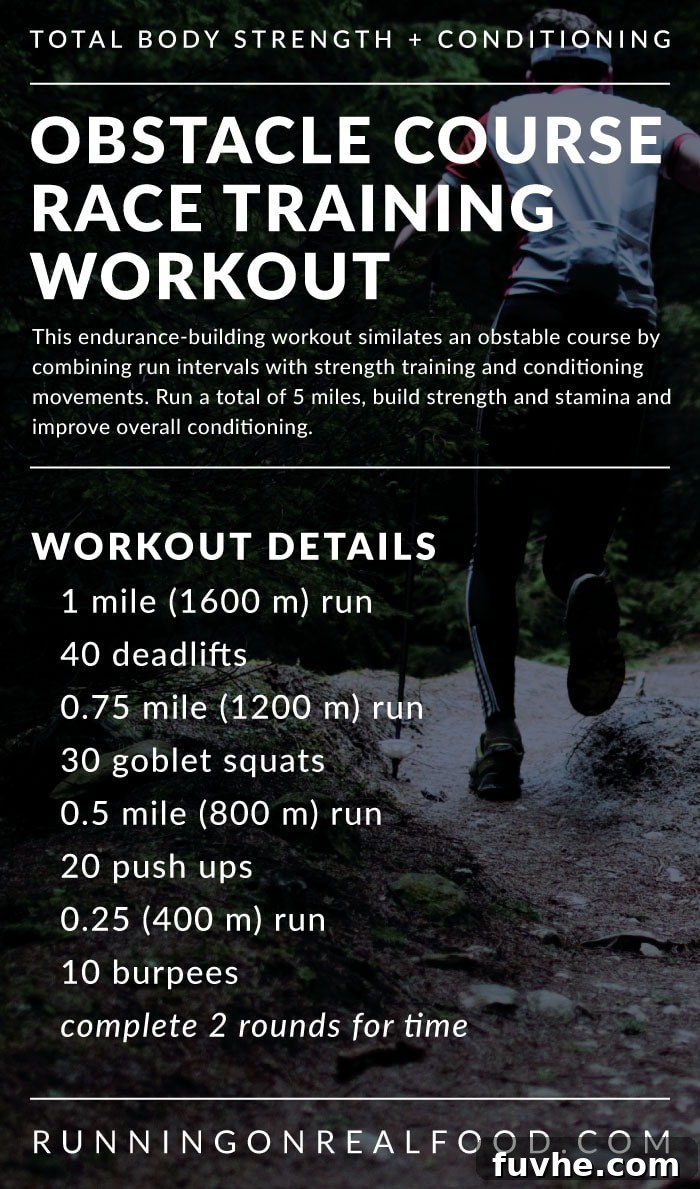
The Ultimate Tough Mudder Training Gauntlet: Workout Details
This challenging circuit is designed to push your limits, build unwavering resilience, and enhance your overall functional fitness. The primary objective is to complete two full rounds of the following sequence “for time,” meaning you should aim to finish as quickly as possible while rigorously maintaining excellent form throughout each exercise. Remember, consistency and proper execution are paramount to both optimizing performance and preventing potential injuries.
- 1 Mile Run: Begin each round with a substantial running segment to elevate your heart rate, warm up your muscles, and initiate the development of your cardiovascular endurance. This mile simulates the longer stretches between major obstacles on a Tough Mudder course, training your body to maintain a strong pace even as fatigue sets in. Focus on a steady, challenging rhythm.
- 40 Deadlifts: Immediately upon completing your run, transition into this powerful strength challenge. Deadlifts are a foundational exercise that builds immense posterior chain strength (glutes, hamstrings, lower back), which is absolutely essential for lifting, carrying heavy objects, and hauling yourself over various obstacles. Concentrate on engaging your core, maintaining a flat back, and driving through your heels to lift the weight.
- 0.75 Mile Run: This is a slightly shorter running interval, but it will feel different as your muscles are already pre-fatigued from the 40 deadlifts. This segment is crucial for simulating the real-world challenge of running efficiently after a demanding physical obstacle. Push through the initial discomfort and maintain your running form.
- 30 Goblet Squats: This exercise effectively targets your quadriceps, glutes, and core muscles, all of which are vital for explosive movements like jumping, climbing, and maintaining balance on uneven terrain. Hold the weight close to your chest, keep your chest upright, and aim for a deep, controlled squat, ensuring your hips drop below your knees if your mobility allows.
- 0.5 Mile Run: The pace might feel tougher during this segment, as your legs and cardiovascular system are accumulating fatigue. This shorter burst is strategically designed to keep your heart rate elevated and your cardiovascular system working hard as you prepare for the next strength challenge, mirroring the dynamic nature of an OCR.
- 20 Push-Ups: A classic bodyweight exercise that builds essential chest, shoulder, and triceps strength. This upper body pushing power is absolutely critical for pushing yourself up and over walls, crawling, and navigating obstacles that require significant upper body control. If standard push-ups are too challenging, perform them on your knees or against an incline (e.g., a bench or wall).
- 0.25 Mile Run: This is the shortest running interval within the circuit, designed to maintain metabolic stress, ensure continuous movement, and mentally prepare you for the final, high-intensity full-body exercise that awaits. It’s a quick push to the next challenge.
- 10 Burpees: The ultimate full-body conditioning exercise, a true test of grit and endurance. Burpees develop explosive power, cardiovascular capacity, agility, and mental toughness – all indispensable qualities for conquering Tough Mudder. Aim for fluid, powerful movements, exploding up from the squat and reaching your hands overhead with each jump.
Successfully completing two rounds of this demanding sequence will provide a comprehensive, full-body workout that effectively simulates the diverse physical demands and cumulative fatigue experienced during an actual obstacle course race. Remember to track your total time for each round to monitor your progress and challenge yourself to improve with each subsequent training session. Focus on steady improvement, not just speed.
No Time? Just Starting Out? Scale It Up or Down!
We understand that everyone’s fitness journey is unique, and sometimes, time constraints or current fitness levels can feel like major hurdles. The inherent beauty and genius of this Tough Mudder training workout lie in its exceptional scalability, making it genuinely accessible to individuals at all fitness levels, from absolute beginners taking their first steps towards a healthier lifestyle to advanced athletes seeking to fine-tune their OCR readiness. If your schedule is tight, or you’re just dipping your toes into the exhilarating world of fitness, there’s absolutely no need to feel intimidated.
You can effortlessly modify and adjust this workout to perfectly suit your current capacity and available time:
- Reduce Rounds: The simplest way to reduce the workout’s duration and intensity is to complete just one round instead of two. This still provides a significant training stimulus and allows you to familiarize yourself with the workout structure without overexertion.
- Adjust Run Intervals: Shorten the length of each run interval. For instance, you could reduce the initial 1-mile run to 0.5 miles, the 0.75-mile run to 0.4 miles, and so on. The goal is to maintain a consistent, challenging pace that pushes you without burning you out prematurely.
- Lower Repetition Count: Decrease the number of repetitions for each strength exercise. Instead of 40 deadlifts, try 20 or 30. For push-ups, aim for 10 or 15. The crucial aspect here is to select a number that allows you to maintain impeccable form throughout the entire set, ensuring quality over quantity.
- Modify Exercises: If a specific exercise proves too challenging in its standard form, do not hesitate to modify it. Perform push-ups on your knees, against an elevated surface (like a bench or wall), or even standing. If standard burpees are too intense, you can remove the push-up component (doing a squat thrust instead) or remove the jump component (stepping up rather than jumping).
- Take Longer Breaks: While the goal is to complete the workout for time, beginners can benefit from slightly longer rest periods between exercises or between rounds, allowing for more recovery.
The most important aspect of any training program, especially when starting or scaling, is to diligently listen to your body and prioritize proper form over sheer intensity or speed. Gradually increase the difficulty as your strength, endurance, and confidence improve. Remember, consistency in training, even with scaled workouts, will invariably yield far better and more sustainable results than sporadic, overly ambitious sessions that lead to burnout or injury.
Optimizing Your Performance: Weights, Pace, and Exercise Variations
Selecting the appropriate weights for your strength exercises and maintaining an effective running pace are absolutely crucial elements for maximizing the benefits of this Tough Mudder training program. Your choices in both these areas should always be highly personal, relative to your current fitness level, and adaptable to your evolving capabilities. As a point of reference, the original author utilized 115 lbs for deadlifts and a 25 lb dumbbell for goblet squats, demonstrating a formidable level of strength. When it came to running, they maintained an impressive pace between 8.0 mph and 8.5 mph for the first round and slightly adjusted to 7.5 mph and 8.0 mph for the second, wisely reflecting the impact of increasing fatigue. It’s vital to remember that these are benchmarks for inspiration, not strict rules to rigidly adhere to.
Strategic Weight Selection:
- Deadlifts: You have considerable flexibility here based on your equipment and comfort. A barbell offers the most potential for heavy lifting and progressive overload. A kettlebell provides a different grip challenge and can introduce dynamic swing mechanics. Dumbbells are excellent for unilateral work (if you choose to do single-arm deadlifts) or if barbells aren’t available. The key is to choose a weight that allows you to complete 40 repetitions with impeccable form, even as fatigue begins to set in. It should feel challenging by the final reps, but never compromise your technique, especially your back posture.
- Goblet Squats: Both dumbbells and kettlebells are ideal for goblet squats. Hold the weight against your chest, keeping your elbows tucked in and close to your body. Select a weight that enables you to perform 30 controlled repetitions, ensuring you can achieve full depth in your squat while maintaining an upright chest and stable core.
Effective Running Pace:
Your chosen running pace during the intervals should strike a balance: challenging enough to elevate your cardiovascular system but sustainable enough that you don’t burn out prematurely. A good rule of thumb is to aim for a pace where you can still speak in short sentences, but speaking full sentences would be difficult. As you progress through the workout, particularly into the second round, it is entirely natural and expected for your pace to drop slightly due to accumulated physiological fatigue. Rather than fixating on a specific speed, concentrate on maintaining a consistent perceived effort, especially if you’re not accustomed to immediately transitioning from strenuous strength work back into running. This realistic and adaptable approach more effectively prepares you for the varied and unpredictable demands of an actual OCR.
Adding Variety and Progressive Overload:
To keep your training dynamic, prevent plateaus, and continually challenge your body in new ways, consider incorporating these powerful variations and progressive elements into your routine:
- Goblet Squat Alternatives: Instead of traditional goblet squats, try Box Jumps for developing explosive leg power, which is absolutely crucial for clearing obstacles, or Jump Squats for similar benefits without the need for a box. Both enhance reactive strength and agility.
- Enhance Deadlifts: Elevate your deadlift by adding a High Pull at the top of the movement. This involves transitioning directly from your deadlift into an upright row. This variation adds a crucial upper body pulling component, excellent for developing grip strength and the ability to pull yourself over obstacles.
- Boost Upper Body Strength: Integrate dedicated Pull-ups or Chin-ups at the end of each round, or as a separate mini-challenge. These exercises are paramount for conquering monkey bars, rope climbs, and scaling high walls. If full pull-ups are currently too challenging, use an assistance band, a spotter, or perform jumping pull-ups to build strength.
- Exercise Swaps for Specific Needs: Feel completely free to customize any exercise to better suit your individual preferences, the equipment you have available, or to specifically target any perceived weaknesses. For instance, if you identify a need for more core stability, you might substitute push-ups with advanced plank variations, L-sits, or hanging knee raises. If your grip needs more work, incorporate farmer’s carries or dead hangs.
The overarching goal remains: to complete this robust and comprehensive workout as efficiently and effectively as possible. Continuously push your personal limits, but always, always prioritize impeccable technique and safety. Get moving, embrace the challenge, and revel in the progress you make towards becoming Tough Mudder ready!
Beyond the Workout: Holistic OCR Preparation for Tough Mudder Success
While this specific workout provides a fantastic and highly effective cornerstone for your Tough Mudder training, true obstacle course race success comes from adopting a more holistic and well-rounded approach. Integrating these additional elements into your broader training regimen will not only enhance your performance but also significantly reduce your risk of injury and boost your overall resilience:
- Grip Strength Training: Obstacles such as monkey bars, rope climbs, cargo nets, and hanging traverses demand formidable grip strength. Consistently incorporate exercises like dead hangs (hanging from a pull-up bar for time), farmer’s carries (walking with heavy dumbbells or kettlebells), and towel pull-ups into your routine to forge an iron grip.
- Mobility and Flexibility: A full and healthy range of motion in your joints is crucial for preventing injuries and allowing you to navigate obstacles more efficiently and safely. Dedicate time to dynamic stretching before workouts and static stretching during your cool-down. Yoga or Pilates can also be excellent additions for improving flexibility and core stability.
- Mental Toughness and Strategy: OCRs are as much a mental game as they are physical. Practice pushing through discomfort during your training sessions. Visualize success on race day, breaking down obstacles into manageable steps. Positive self-talk, breathing techniques, and having a race strategy (e.g., how to approach specific obstacles) can be powerful tools.
- Nutrition and Hydration: Fueling your body correctly before, during, and after training sessions and, crucially, on race day, is paramount for sustained energy and optimal recovery. Focus on whole, unprocessed foods rich in complex carbohydrates, lean proteins, and healthy fats. Stay consistently well-hydrated throughout the day, not just during workouts.
- Rest and Recovery: Allow your body adequate time to recover, repair, and rebuild stronger. Overtraining can lead to fatigue, burnout, and an increased risk of injury. Prioritize quality sleep (7-9 hours), incorporate active recovery days (light walks, gentle stretching), and consider practices like foam rolling or massage.
- Trail Running and Varied Terrain: If feasible, regularly incorporate outdoor trail running or running on varied terrain (hills, uneven ground, sand, grass) into your routine. This helps prepare your ankles, knees, and core for the unstable and unpredictable surfaces you’ll encounter in an actual OCR, significantly reducing the shock of race day.
- Partner Training: Many Tough Mudder obstacles require teamwork. If possible, train with friends who will also be participating. This not only builds camaraderie but also allows you to practice team-based strategies for obstacles.
Warm-Up and Cool-Down: Essential for Every Session
No workout, especially one as intense and demanding as this Tough Mudder training program, should ever begin without a proper warm-up or conclude without a dedicated cool-down. These two phases are not merely optional; they are absolutely crucial for preventing injury, optimizing performance, and significantly aiding post-exercise recovery.
- The Dynamic Warm-Up (5-10 minutes): Begin with light cardiovascular activity, such as a gentle jog on the treadmill or in place, followed by dynamic movements. Examples include arm circles (forward and backward), leg swings (front-to-back and side-to-side), torso twists, walking lunges with a reach, cat-cow stretches, and light plyometrics like jumping jacks or high knees. The purpose of a dynamic warm-up is to gradually increase your heart rate, improve blood flow to your muscles, enhance joint mobility, and prepare your nervous system for the strenuous activity ahead, reducing the risk of strains and sprains.
- The Static Cool-Down (5-10 minutes): Immediately after completing your workout, dedicate time to static stretching. This involves holding each stretch for approximately 20-30 seconds, without bouncing, and focusing on major muscle groups that were heavily engaged during your session. Prioritize stretching your hamstrings, quadriceps, glutes, hip flexors, chest, shoulders, and triceps. Static stretching during the cool-down helps to improve overall flexibility, restore muscles to their resting length, and can significantly reduce post-exercise muscle soreness (DOMS – Delayed Onset Muscle Soreness), aiding in a faster and more effective recovery.
Never skip these vital components of your training. They are just as important as the main workout itself for long-term progress and injury prevention.
Expand Your Training: More Workouts to Try
To further diversify your Tough Mudder training regimen and target different aspects of your fitness, consider integrating these complementary workouts. Each offers unique benefits that will contribute to your overall OCR readiness:
- 30 Minute Kettlebell HIIT Workout: Excellent for building explosive power, functional strength, and high-intensity cardiovascular conditioning in a time-efficient format. Kettlebells are fantastic for mimicking awkward carries and dynamic movements.
- All Legs Conditioning Workout: Focuses specifically on developing robust lower body strength and endurance, which are absolutely vital for sustained running, explosive jumps, climbing, and navigating challenging uphill and downhill terrains.
- Core and Upper Body Circuit Workout: Essential for developing the pulling and pushing strength needed to conquer monkey bars, rope climbs, and walls, while simultaneously strengthening your core for overall stability and injury prevention.
- Leg and Core Superset Workout: A powerful combination that effectively builds strength and endurance in your lower body and core, crucial for maintaining balance, generating power, and supporting your spine during strenuous activities.
Pin This Ultimate Tough Mudder Training Guide for Later!
Don’t let your commitment to training fall by the wayside. Pin this comprehensive guide to your fitness or workout board for easy access and stay motivated on your path to conquering Tough Mudder! This valuable resource will serve as a constant reminder of your goals and the steps you need to take to achieve them.
With unwavering dedication, consistent effort, and a smart, well-rounded training plan like this, you’ll not only be physically prepared and capable of tackling every challenge Tough Mudder presents but also mentally fortified to push through any adversity. Embrace the mud, relish the camaraderie with your teammates, and anticipate the incredible sense of accomplishment and triumph that awaits you at the finish line. Your journey to becoming a Tough Mudder is within reach!