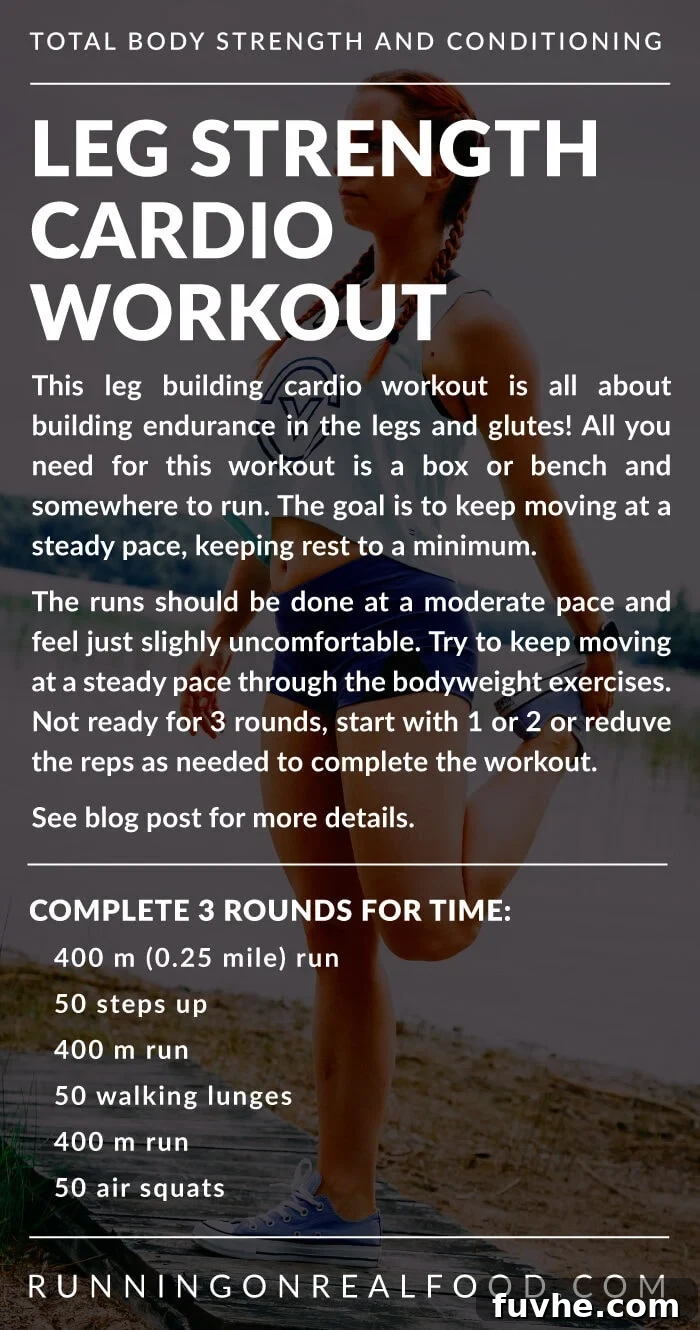
Are you ready to sculpt powerful legs, strengthen your glutes, and significantly boost your cardiovascular endurance? This dynamic leg strength and cardio workout is meticulously designed to challenge your lower body and elevate your fitness levels, all with minimal equipment. Whether you’re at home, in a hotel room, or enjoying the great outdoors, all you need is a sturdy box or bench and some space to run. This routine seamlessly blends high-intensity cardio intervals with targeted bodyweight exercises, making it an incredibly efficient way to achieve comprehensive fitness.
The Ultimate Leg & Cardio Endurance Workout
If you’re a fan of heart-pumping cardio and effective bodyweight exercises, then you’ve found your new favorite workout! This particular routine is exceptionally versatile and perfect for those who are constantly on the go or prefer to train outside of a traditional gym setting. Its simplicity is its strength: no complex machines, no heavy weights, just your body, a step surface, and the open road (or track!). You’ll be engaging in a powerful sequence that alternates between invigorating cardio bursts and focused lower-body bodyweight movements, pushing your muscles and cardiovascular system to new limits.
The core philosophy behind this workout is continuous movement with very little rest. The goal is not just to complete the exercises, but to move fluidly from one segment to the next, building incredible stamina and mental fortitude. By minimizing downtime, you maximize your calorie burn, enhance your endurance, and truly challenge your body to adapt and grow stronger. Prepare to keep your heart rate up and your muscles working hard throughout the entire session. This structured approach ensures a full-body conditioning effect, primarily targeting the large muscle groups in your legs and glutes, while simultaneously improving your aerobic capacity.
Here’s how this high-impact, low-equipment workout is structured:
Complete 3 Challenging Rounds:
- 400 meter (approximately 0.25 mile) Run: This initial cardio segment gets your heart rate soaring and blood pumping, preparing your muscles for the work ahead. Focus on a strong, consistent pace.
- 50 Step-Ups: An incredible exercise for building unilateral leg strength, glute activation, and stability. Ensure controlled movements, pushing through the heel.
- 400 meter (approximately 0.25 mile) Run: Another burst of cardio to maintain elevated heart rate and endurance, challenging your ability to recover and push through.
- 50 Walking Lunges: Excellent for targeting quadriceps, hamstrings, and glutes, while also improving balance and functional strength. Maintain good posture and a deep lunge.
- 400 meter (approximately 0.25 mile) Run: The final running segment of the round, designed to test your cardiovascular stamina and mental grit as you approach the end of the circuit.
- 50 Air Squats: A fundamental bodyweight movement that works the entire lower body, including quads, hamstrings, and glutes. Focus on depth and controlled descent.
Workout Strategy and Modification Tips
To ensure you get the most out of this powerful leg strength and cardio workout while also training safely and effectively, consider the following detailed notes and modification strategies:
- Lunges Variations for Space: If you find yourself in a confined space where walking lunges aren’t feasible, don’t despair! Reverse lunges are an excellent alternative. They offer similar benefits in terms of leg and glute activation, balance, and stability, without requiring forward movement. For both walking and reverse lunges, aim for a 90-degree bend in both knees, keeping your front knee aligned over your ankle and your torso upright.
- Mastering Your Running Pace: The 400-meter runs are designed to be challenging but sustainable. Aim for a “moderate” pace, which generally means you should feel a bit uncomfortable – your breathing should be heavy, but you should still be able to speak in short sentences. This isn’t a full sprint, but it’s also not a leisurely jog. This specific pace builds your aerobic capacity and endurance without leading to premature burnout in the subsequent rounds. Listen to your body and find that sweet spot of effort.
- Optimal Step-Up Technique: For step-ups, a bench or box approximately 20 inches high is ideal. This height provides a significant challenge to your leg and glute muscles without being excessively difficult. The goal is to complete 50 step-ups in total. This means 25 repetitions per leg. Feel free to alternate legs with each step, or complete 25 on one leg before switching to the other – choose the method that feels most balanced and challenging for you. Always drive through your heel on the elevated foot, engaging your glute and quad, and control your descent.
- Scaling for All Fitness Levels: This workout is highly adaptable. If three full rounds feel too daunting initially, begin with just one or two rounds. Even completing a single round with proper form is a fantastic achievement and a great starting point for building endurance. As your fitness improves, gradually increase the number of rounds.
- Adjusting Repetitions: Beyond modifying the number of rounds, you can also scale the workout by reducing the repetitions for the bodyweight exercises. Instead of 50 step-ups, lunges, and air squats, aim for 20-30 reps per exercise. This allows you to maintain the workout’s intensity and structure while gradually building up your strength and endurance towards the full rep count. Alternatively, if you’re looking for an even greater challenge, consider increasing the reps or adding a light pair of dumbbells to the step-ups, lunges, and squats.
Why This Workout is a Game-Changer for Your Fitness
This leg strength and cardio circuit isn’t just another workout; it’s a comprehensive approach to elevating your overall fitness. Here’s why it stands out and what significant benefits you can expect:
- Superior Cardiovascular Health: The integrated running segments are perfect for improving your heart health, lung capacity, and overall stamina. Regular cardiovascular activity lowers blood pressure, reduces the risk of heart disease, and boosts your energy levels throughout the day.
- Unrivaled Muscular Endurance: By combining high reps of bodyweight exercises with continuous movement, you’re not just building strength; you’re building endurance in your leg and glute muscles. This means your muscles will be able to perform for longer periods without fatigue, which translates to better performance in daily activities, sports, and other workouts.
- Effective Fat Burning & Metabolism Boost: The alternating high-intensity cardio and strength movements create a metabolic disturbance that keeps your body burning calories even after your workout is finished (EPOC – Excess Post-exercise Oxygen Consumption). This makes it an incredibly efficient routine for fat loss and maintaining a healthy body composition.
- Convenience and Portability: One of the greatest advantages is its minimal equipment requirement. This makes it an ideal choice for anyone with a busy schedule, limited access to a gym, or those who travel frequently. Your fitness journey doesn’t have to pause when you’re away from your usual setup.
- Functional Strength Development: Exercises like step-ups, lunges, and squats are highly functional, mimicking movements you perform in everyday life. Improving your strength and coordination in these areas can enhance your balance, agility, and reduce the risk of injury.
- Mental Toughness: Pushing through continuous rounds with little rest demands mental resilience. Each time you complete this workout, you’re not just strengthening your body; you’re also building incredible mental fortitude and discipline that spills over into other aspects of your life.
Prepare, Perform, and Recover: Maximizing Your Session
To ensure a safe, effective, and rewarding workout experience, it’s vital to incorporate proper warm-up and cool-down routines, along with mindful execution during the workout itself.
Before You Begin: The Importance of a Warm-Up
Never skip your warm-up! A proper warm-up prepares your body for the strenuous activity ahead, increasing blood flow to your muscles, raising your core body temperature, and improving joint mobility. This significantly reduces the risk of injury and enhances your performance. Aim for 5-10 minutes of light cardio followed by dynamic stretches:
- Light Jogging or Brisk Walk: 3-5 minutes to gently elevate your heart rate.
- Leg Swings: 10-15 forward/backward and side-to-side swings per leg to loosen hips and hamstrings.
- Dynamic Lunges with Torso Twist: 5-8 per side to warm up the hips, quads, and core.
- Arm Circles: Forward and backward to prepare your upper body for incidental movement.
- Bodyweight Squats: 10-15 reps with light depth to activate your glutes and legs.
During Your Workout: Focus on Form and Pace
While the goal is continuous movement, never sacrifice proper form for speed. Incorrect form can lead to injury and diminishes the effectiveness of the exercise. Focus on controlled movements, especially during the eccentric (lowering) phase of squats and lunges. Maintain a consistent, challenging pace for your runs, remembering the “conversational” test—you should be able to speak short sentences but not comfortably hold a long conversation.
Stay hydrated throughout your workout, especially if you’re training outdoors or in warmer conditions. Take sips of water during brief transitions, if needed, but try to keep moving to maintain the endurance challenge.
After Your Workout: The Crucial Cool-Down and Recovery
Just as important as the warm-up, a cool-down helps your heart rate gradually return to normal, reduces muscle soreness, and improves flexibility. Dedicate 5-10 minutes to static stretching, holding each stretch for 20-30 seconds. Focus on the muscles you’ve just worked:
- Quad Stretch: Standing or lying, pull your heel towards your glute.
- Hamstring Stretch: Seated or standing, reach for your toes.
- Calf Stretch: Against a wall, press your heel down.
- Glute Stretch (Figure-Four): Lying on your back, cross one ankle over the opposite knee.
- Hip Flexor Stretch: In a lunge position, gently push your hips forward.
Beyond stretching, ensure you prioritize overall recovery. This includes consuming nutrient-rich foods, particularly protein for muscle repair, and getting adequate sleep. Consistency in recovery is key to seeing continuous progress and preventing overtraining.
Explore More Leg & Glute Workouts
If you enjoyed the challenge and benefits of this workout, we encourage you to explore our other fantastic routines designed to build lower body strength, endurance, and overall fitness. Diversifying your workouts keeps things exciting and helps target different aspects of your muscle groups.
- All Legs Conditioning Workout
- Legs and Hills Workout
- Lower-Body Circuit Workout
- Leg and Core Strength Workout
- Leg and Core Superset Workout
Pin This Workout for Later!
Don’t let this incredible workout get lost! Pin it to your fitness board on Pinterest so you can easily come back to it whenever you’re ready for an intense leg and cardio challenge, whether you’re at home or on the road.