

Are you ready to redefine your fitness in just 30 minutes? This ultimate Kettlebell High-Intensity Interval Training (HIIT) workout is meticulously designed to challenge your cardiovascular endurance, build formidable muscular strength, and ignite your fat-burning potential. While undeniably tough, the true intensity of this session will be dictated solely by the effort you pour into each rep. It strategically integrates three distinct 3-minute, high-intensity intervals, each followed by a crucial 2-minute recovery period, and then cycles through for a total of two electrifying rounds – culminating in a power-packed 30-minute fitness experience.
To successfully conquer this dynamic conditioning workout, you’ll need a set of versatile kettlebells and a dedicated space allowing for fluid movement. Prepare to push your limits and discover a new level of strength and stamina.
Why Kettlebell HIIT? Unlocking Peak Performance
The synergy of High-Intensity Interval Training (HIIT) and kettlebell exercises creates an incredibly potent workout regimen, offering a multitude of benefits that transcend traditional training methods. HIIT is celebrated for its ability to deliver significant cardiovascular improvements, elevate your metabolic rate for hours post-workout (known as the EPOC effect or “afterburn”), and dramatically boost fat loss, all within a compressed timeframe. By alternating between maximal effort and brief recovery periods, your body learns to operate more efficiently, enhancing both aerobic and anaerobic capacities.
When you combine this with the dynamic power of kettlebell training, the results are compounded. Kettlebells are exceptional tools for developing functional strength, improving core stability, enhancing explosive power, and increasing overall body coordination. Unlike traditional dumbbells, the unique offset center of gravity of a kettlebell engages more stabilizing muscles throughout each movement, making every exercise a full-body challenge. This workout leverages both methodologies to deliver a comprehensive conditioning experience that is not only time-efficient but also remarkably effective for building a strong, resilient, and high-performing physique.
Pre-Workout Prep: The Importance of a Dynamic Warm-up
Before diving headfirst into this intense 30-minute kettlebell HIIT workout, a proper warm-up is not just recommended, it’s absolutely essential. A dynamic warm-up prepares your body for the physical demands ahead by increasing blood flow to your muscles, elevating your core body temperature, and improving joint mobility. This crucial preparatory phase significantly reduces the risk of injury, enhances your range of motion, and primes your nervous system for optimal performance, allowing you to get the most out out of every rep and every interval.
Dedicate 5-10 minutes to a dynamic warm-up routine. Incorporate movements such as light cardio (jogging in place, jumping jacks), joint rotations (ankles, knees, hips, shoulders, wrists), leg swings (front-to-back and side-to-side), arm circles, and bodyweight exercises like air squats, lunges, and plank variations. Focus on controlled, flowing movements that gradually increase your heart rate and prepare your entire body for the explosive power and sustained effort required by the kettlebell HIIT challenge.
How to Conquer This High-Intensity Kettlebell Workout
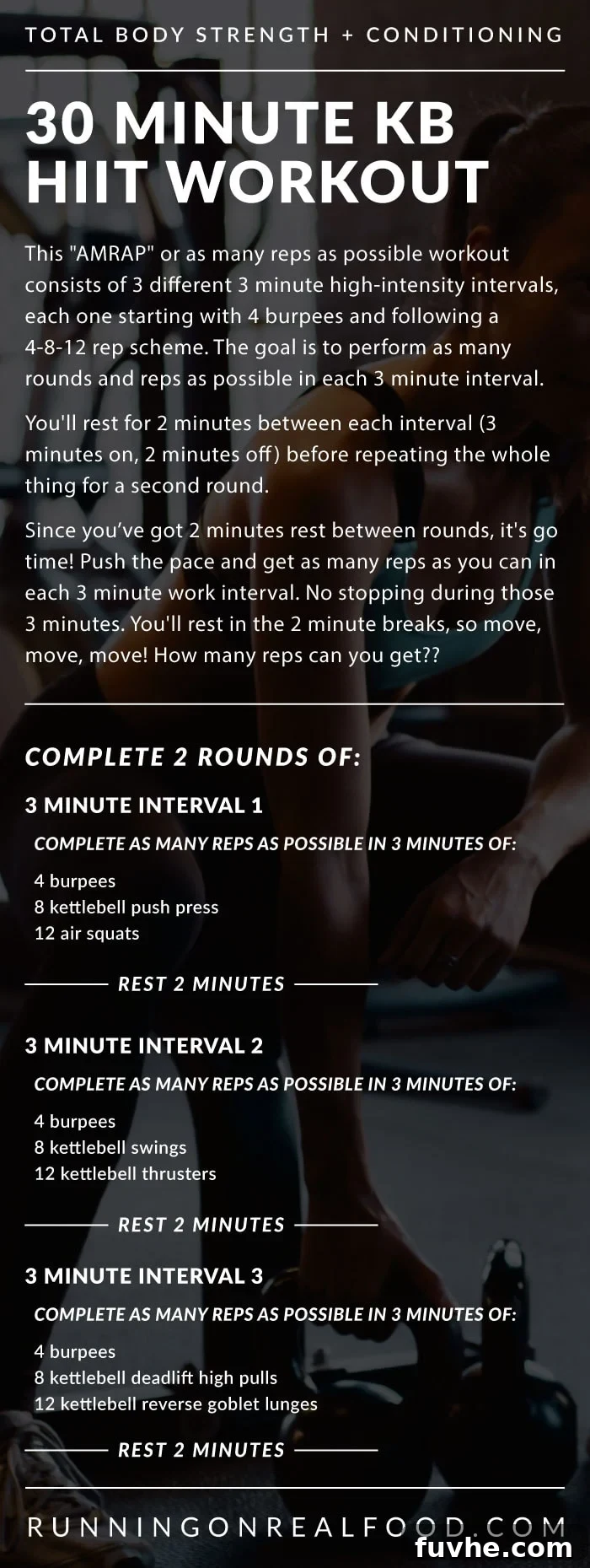
This workout is structured as an “AMRAP” session, which stands for “As Many Rounds As Possible.” Your primary objective within each 3-minute work interval is to complete as many full rounds and additional repetitions of the prescribed exercise sequence as you can, all while maintaining excellent form. Each interval begins consistently with 4 burpees, followed by an 8-rep kettlebell movement, and concluding with 12 reps of a bodyweight or kettlebell-assisted exercise. This consistent 4-8-12 rep scheme provides a clear framework for your effort.
The workout flows with a strict “3 minutes on, 2 minutes off” rhythm. You will push your limits for 3 continuous minutes, then enjoy a full 2 minutes of active recovery or complete rest. This cycle is then repeated for a second round, totaling 30 minutes of high-octane training. The generous 2-minute rest periods are your opportunity to fully recover, catch your breath, and mentally prepare to attack the next interval with renewed vigor. This means that during those 3-minute work blocks, there should be no stopping, no lingering, and no slowing down. Push the pace, maintain your form, and keep moving to maximize your reps and elevate your conditioning. The rest is earned, so make those work intervals count!
Detailed Workout Breakdown: Intervals and Movements
Each of the three intervals in this workout is strategically designed to challenge different aspects of your fitness, combining power, strength, and endurance. The constant presence of burpees ensures a full-body conditioning element throughout.
Interval 1 Deep Dive: Strength & Stamina Fusion
Perform as many rounds and reps as possible in 3 minutes of:
4 Burpees: The ultimate full-body conditioning exercise. Starting from a standing position, you’ll drop to the ground, perform a push-up, explosively jump your feet forward, and then leap vertically into the air. Burpees demand cardiovascular endurance, strength from your chest, shoulders, triceps, and legs, and incredible core stability. Focus on efficiency and a consistent rhythm.
8 Kettlebell Push Press: This movement targets your shoulders, triceps, and glutes, with significant core engagement. Start with two kettlebells racked at shoulder height. Use a powerful dip from your legs to drive the kettlebells overhead, locking out your arms. Control the eccentric phase as you lower them back to the rack position. Emphasize a strong, controlled dip and drive, leveraging your lower body to assist the press.
12 Air Squats: A fundamental lower-body exercise, the air squat builds strength in your quads, glutes, and hamstrings, while also improving hip mobility. Stand with feet shoulder-width apart, chest up, and descend as if sitting into a chair, ensuring your hips drop below your knees. Keep your weight in your heels and drive back up to full extension. Focus on depth and consistent tempo.
This first interval sets the tone with a blend of upper body pressing power, foundational lower body strength, and relentless full-body conditioning.
Rest 2 Minutes: Use this time to recover, take deep breaths, and mentally prepare for the next challenging sequence. Hydrate if needed.
Interval 2 Unleashed: Power & Full-Body Burn
Perform as many rounds and reps as possible in 3 minutes of:
4 Burpees: Once again, initiate the interval with four explosive burpees. Maintain the same high level of intensity and focus on crisp, efficient movement despite increasing fatigue.
8 Kettlebell Swings: The kettlebell swing is a powerhouse exercise for developing explosive hip drive, strengthening the posterior chain (glutes, hamstrings, lower back), and engaging your core. Stand with feet slightly wider than shoulder-width, hinge at your hips, and powerfully snap your hips forward to propel the kettlebell to chest height. It’s a hip-driven, not arm-driven, movement. Focus on a strong, controlled hinge and a powerful extension.
12 Kettlebell Thrusters: A truly full-body, high-endurance movement. Start with two kettlebells racked at your shoulders. Perform a full squat, and as you explode upwards from the bottom of the squat, use that momentum to drive the kettlebells overhead into a locked-out position. This exercise demands coordination, strength, and significant cardiovascular output. Focus on a fluid transition from the squat to the press, leveraging your legs.
Interval two shifts focus towards explosive power and higher metabolic demand, pairing hip-dominant power with a full-body compound movement that taxes both strength and stamina.
Rest 2 Minutes: Maximize this recovery period. Focus on controlled breathing to bring your heart rate down and prepare for the final push.
Interval 3 Domination: Explosive Pulls & Lower Body Grit
Perform as many rounds and reps as possible in 3 minutes of:
4 Burpees: The final set of burpees to kick off the last work interval. Dig deep and execute these with purpose, maintaining the foundational intensity of the workout.
8 Kettlebell Deadlift High-Pull: This explosive movement is fantastic for building power in your posterior chain and traps. Start with a heavier kettlebell on the floor. Hinge at your hips, keeping a flat back, and explosively stand up, pulling the kettlebell vertically towards your chin, leading with your elbows. It’s a powerful, hip-driven movement, similar to a swing but with a higher vertical pull. Ensure your back remains flat throughout the deadlift phase.
12 Reverse Kettlebell Goblet Lunges: This unilateral exercise challenges your balance, core stability, and builds strength in your quads, glutes, and hamstrings individually. Hold one kettlebell in the goblet position (against your chest). Step one leg back into a lunge, ensuring both knees bend to 90 degrees. Push off the back foot to return to the starting position. Alternate legs. Focus on controlled, stable movements and maintaining an upright torso.
The third interval introduces explosive pulling power and a challenging unilateral leg exercise, ensuring a comprehensive full-body stimulus right up to the end.
Rest 2 Minutes: This marks the end of the first round. Prepare to repeat the entire sequence for round two.
Repeat for 2 Total Rounds (30 Minutes Total): Dive back into Interval One with the same intensity and focus you had at the start. The second round will test your mental fortitude and physical endurance. Maintain your form, push for those reps, and embrace the challenge!
Choosing Your Arsenal: Essential Kettlebell Equipment
The beauty of this workout lies in its relative simplicity regarding equipment: all you truly need are kettlebells. However, to optimize your performance and ensure proper form across the varied movements, I highly recommend having access to at least two different kettlebell weights, ideally three, as detailed below:
- Two Lighter Kettlebells (for Push Press and Thrusters): For movements like the kettlebell push press and thrusters, where speed, rhythm, and performing unbroken sets are key, having two lighter kettlebells is ideal. I would suggest selecting weights in the range of 8-16 kg (18-35 lbs) depending on your current fitness level and strength. The goal is to choose a weight that allows you to move rapidly and continuously through the 8 reps without having to set them down or break up your set due to fatigue. If you struggle to maintain form or speed, opt for a slightly lighter weight.
- One Heavier Kettlebell (for Swings and Deadlift High-Pulls): For powerful, hip-driven movements such as the kettlebell swings and deadlift high-pulls, a single heavier kettlebell will allow you to generate more force and truly challenge your posterior chain. A weight between 16-24 kg (35-53 lbs) is generally recommended for these exercises. For men, starting around 20-24 kg is common, while women might start around 16 kg. The heavier weight allows for a more significant strength and power stimulus, which is crucial for these exercises.
- Versatility for Goblet Lunges: For the reverse kettlebell goblet lunges, you have the flexibility to use either one of your lighter kettlebells or the heavier one, depending on your preference and desired challenge. If you want to focus more on balance and endurance, a lighter bell works well. For an added strength challenge, especially for your legs and core, opt for the heavier kettlebell.
Always prioritize form over weight. If you’re unsure about what weight to start with, err on the side of caution and begin with a lighter kettlebell. You can always increase the weight as your strength and technique improve. Ensure your kettlebells have comfortable handles that allow for a secure grip during dynamic movements.
Maximizing Your Session: Key Workout Notes and Adaptations
To ensure this kettlebell HIIT workout is accessible and effective for everyone, regardless of equipment availability or fitness level, here are some crucial notes and adaptation strategies:
Equipment Alternatives: If you don’t have access to the recommended range of kettlebell weights, or if you simply prefer other tools, many of these exercises can be modified. For the kettlebell push press and thrusters, a barbell or dumbbells can be seamlessly substituted. Similarly, for the deadlift high-pulls, dumbbells or a barbell can be used effectively. Ensure that whatever equipment you choose, it allows for proper form and a similar range of motion to challenge your muscles effectively.
Scaling for All Fitness Levels:
- For Beginners: If you’re new to HIIT or kettlebell training, don’t feel pressured to match the prescribed pace. You can reduce the number of reps (e.g., 3 burpees, 6 kettlebell reps, 10 air squats), choose lighter kettlebells, or even extend your rest periods by 30-60 seconds if needed. Consider substituting challenging movements like burpees with plank jacks or step-backs to build foundational strength. It’s perfectly acceptable to complete only one full round (15 minutes) for your initial attempts, focusing entirely on mastering the form.
- For Advanced Athletes: If you find this workout too easy, challenge yourself by increasing your kettlebell weights (while maintaining impeccable form), aiming for more rounds and reps within each 3-minute interval, or even subtly shortening your rest periods (e.g., 90 seconds instead of 2 minutes, though stick to the original structure first to gauge your performance). You could also explore more complex variations of the exercises, such as a burpee with a tuck jump or adding a clean to your push press.
The 15-Minute Power Blast: Short on time but still want a phenomenal workout? Simply complete one full round of this circuit (all three intervals with rests). This “power blast” version is incredibly effective for a quick, intense conditioning session. The key is to truly push your limits within those 15 minutes, treating each 3-minute work block as an all-out effort, knowing that your recovery is just around the corner.
Form Over Speed: Always, without exception, prioritize proper exercise form over the number of reps or the speed at which you perform them. Incorrect form not only reduces the effectiveness of the exercise but significantly increases your risk of injury. If your form starts to break down, reduce the weight, slow down, or take a brief pause before resuming. Mastering the mechanics of each movement will lead to greater long-term gains and a safer training experience.
Post-Workout Recovery: The Cool-Down and Beyond
Just as important as your warm-up, a proper cool-down is a non-negotiable component of any effective workout routine, especially after a high-intensity session like this kettlebell HIIT. A cool-down helps to gradually lower your heart rate, bring your breathing back to normal, and promote muscle recovery by gently stretching and elongating the muscles that have just worked hard. This can reduce post-exercise soreness and improve overall flexibility.
Dedicate 5-10 minutes to a cool-down. Start with light cardio like walking in place to slowly bring your heart rate down. Then, transition into static stretches, holding each stretch for 20-30 seconds. Focus on the major muscle groups targeted in the workout: hamstrings (e.g., standing forward fold, lying hamstring stretch), quadriceps (e.g., standing quad stretch), glutes (e.g., figure-four stretch), chest (e.g., door frame stretch), and shoulders (e.g., cross-body arm stretch). Remember to breathe deeply and relax into each stretch.
Beyond stretching, proper post-workout nutrition and hydration are critical for optimal recovery. Replenish fluids lost through sweat by drinking water or electrolyte-rich beverages, and consume a balanced meal or snack containing protein and carbohydrates within 30-60 minutes after your workout to aid in muscle repair and glycogen replenishment. Listen to your body, ensure adequate rest, and celebrate your accomplishment!
Beyond This Challenge: Discover More Workouts
If you’ve loved the intense, sweaty burn and efficiency of this AMRAP kettlebell workout, then you’re undoubtedly ready for more! Expanding your workout repertoire with similar high-intensity and strength-focused routines will keep your training fresh, challenge your body in new ways, and help you continue smashing your fitness goals. Explore these other dynamic and effective workouts to keep your momentum going:
34 Minute Death by AMRAP Workout // 35 Minute Barbell and Treadmill Workout // 100-20-100 Reps for Time Workout // Leg and Core Strength Workout // Kettlebell and Barbell Conditioning Workout