

Embark on a transformative fitness journey with this ultimate total body strength and conditioning workout. Designed to sculpt every muscle, elevate your heart rate, and drastically improve your aerobic fitness, this dynamic routine promises a comprehensive challenge. You’ll need just a few essential pieces of equipment – a sturdy kettlebell, a reliable box or bench, and approximately 30 minutes of your time – to unlock a stronger, more resilient you. Prepare to push your limits and experience a full-body engagement like never before.
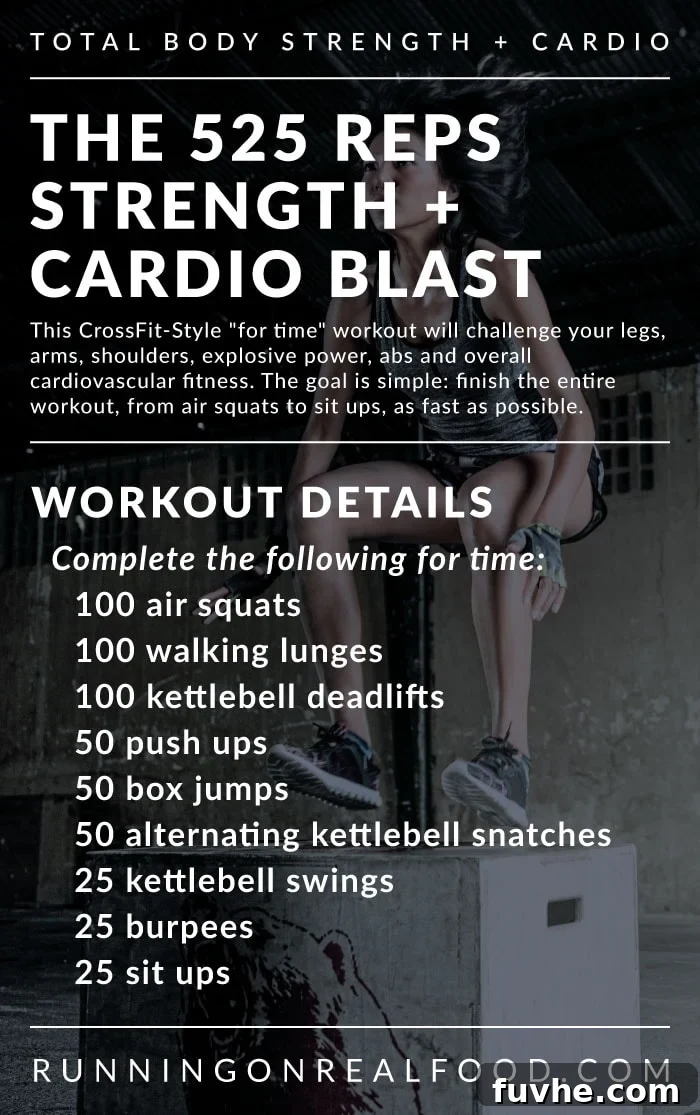
This isn’t just a strength workout; it’s a high-intensity, full-body experience that merges power with endurance. By rapidly moving through compound, functional movements, you’ll engage multiple muscle groups simultaneously, transforming what seems like a standard strength session into an intense cardio blast. This “for time” CrossFit-style challenge is engineered to test your physical and mental fortitude, leaving you drenched in sweat, muscles alight, and heart pounding, but ultimately feeling incredibly strong and accomplished.
Beyond the immediate physical exertion, this workout delivers profound benefits. It targets and strengthens your legs, arms, shoulders, and core, while simultaneously enhancing explosive power and cardiovascular endurance. The combination of strength and cardio in one efficient session maximizes calorie burn, improves metabolic rate, and builds a robust, functional physique ready for any challenge life throws your way. It’s an ideal choice for anyone looking to build lean muscle, increase stamina, and boost overall athletic performance in a time-efficient manner.
The Ultimate Total Body Strength and Cardio Workout: Unleash Your Potential
This particular workout stands out as one of my favorites due to its challenging yet incredibly rewarding nature. While I found myself needing to pause frequently during the push-ups, executing each one with full range of motion, the satisfaction of completing them was immense. The lunges and squats, conversely, felt more fluid, requiring only brief moments of rest. By the time I reached the burpees, my pace had slowed, but the determination to finish strong propelled me through every rep. This unique blend of personal challenge and diverse movements makes it a truly impactful routine.
The guiding principle of this workout is straightforward: complete all prescribed repetitions as quickly as possible while maintaining good form. It’s a race against the clock and against yourself. The goal is to move deliberately and powerfully through each exercise before progressing to the next. While strategic rest is permitted and often necessary, the aim is to minimize these breaks to achieve your best possible time. This “for time” format not only builds physical endurance but also mental toughness, pushing you to dig deep and find resilience when fatigue sets in.
Preparation is Key: Warm-Up and Cool-Down
Before diving into this high-intensity workout, a proper warm-up is crucial to prepare your muscles and joints, prevent injury, and optimize performance. Aim for 5-10 minutes of dynamic movements. This could include light cardio like jogging in place, jumping jacks, or high knees, followed by dynamic stretches such as arm circles, leg swings, torso twists, and cat-cow stretches. Focus on movements that mimic the exercises you’re about to perform, gradually increasing your heart rate and muscle temperature.
Equally important is a dedicated cool-down session after completing the workout. This helps lower your heart rate gradually, reduces muscle soreness, and improves flexibility. Spend 5-10 minutes performing static stretches, holding each stretch for 20-30 seconds. Target major muscle groups worked during the session, including hamstrings, quadriceps, glutes, chest, shoulders, and triceps. Examples include hamstring stretches, quad stretches, chest opener stretches, and triceps stretches.
Equipment Essentials
This workout is designed to be accessible, requiring minimal equipment that offers maximum versatility. A kettlebell is central to several movements, providing dynamic resistance that builds both strength and cardiovascular fitness. If you don’t have a kettlebell, a single dumbbell can often be substituted for many of the exercises, though the biomechanics might differ slightly. A stable box or bench is essential for box jumps and can also be used for step-ups or other exercises. Ensure it is sturdy enough to support your weight and stable on the ground to prevent accidents.
The Workout Challenge
Complete the following exercises for time. Remember to focus on form, move efficiently, and push your pace where possible to achieve your best score. Record your time and challenge yourself to improve it in future sessions!
- 100 Air Squats:
The air squat is a fundamental movement that strengthens your entire lower body and core. Stand with your feet shoulder-width apart, toes slightly pointed out. Keep your chest up, shoulders back, and core engaged. Initiate the movement by pushing your hips back as if sitting in a chair, allowing your knees to bend. Descend until your hips are below your knees (or as low as comfortable while maintaining good form). Drive through your heels to return to the starting position, fully extending your hips and knees at the top. Focus on maintaining a neutral spine throughout the movement.
Target Muscles: Quadriceps, Hamstrings, Glutes, Core.
Modification: Reduce range of motion, use a chair as a target, or perform sumo squats for variation. - 100 Walking Lunges:
Walking lunges are an excellent unilateral exercise that builds leg strength, improves balance, and enhances hip mobility. Start standing tall, then step forward with one leg, lowering your hips until both knees are bent at approximately a 90-degree angle. Ensure your front knee is directly above your ankle and your back knee hovers just above the ground. Push off your back foot to bring it forward, stepping into the next lunge with the opposite leg. Keep your torso upright and core tight throughout the movement.
Target Muscles: Quadriceps, Hamstrings, Glutes, Calves, Core.
Modification: Perform stationary lunges, reverse lunges, or use a wall for balance. - 100 Kettlebell Deadlifts:
The kettlebell deadlift is a powerful posterior chain exercise that strengthens your glutes, hamstrings, and lower back while teaching proper hip hinge mechanics. Stand with your feet hip-width apart, with a kettlebell placed between your feet. Hinge at your hips, keeping your back straight and chest up, to grasp the kettlebell handle with both hands. Your shins should be relatively vertical. Engage your core, drive through your heels, and extend your hips and knees simultaneously to stand up tall, pulling the kettlebell with you. Lower the kettlebell back down with control by reversing the motion, maintaining the hinge at your hips.
Target Muscles: Glutes, Hamstrings, Lower Back, Core, Forearms.
Modification: Use a lighter kettlebell or a single dumbbell. Focus on the hip hinge movement without heavy weight. - 50 Push-Ups:
The classic push-up is a phenomenal upper body and core strength builder. Start in a plank position with your hands slightly wider than shoulder-width apart, fingers pointing forward. Your body should form a straight line from head to heels. Lower your chest towards the floor by bending your elbows, keeping them tucked slightly towards your body. Descend until your chest nearly touches the ground, then powerfully push back up to the starting plank position, fully extending your arms. Maintain a tight core and avoid sagging hips or arching your back.
Target Muscles: Chest (Pectorals), Shoulders (Deltoids), Triceps, Core.
Modification: Perform push-ups on your knees, incline push-ups against a bench or wall, or reduce the range of motion. - 50 Box Jumps:
Box jumps are an explosive plyometric exercise that develops power, agility, and cardiovascular fitness. Stand facing a sturdy box or bench, about arm’s length away. Initiate the jump by slightly swinging your arms back and bending your knees, then explosively swing your arms forward and drive through your feet to propel yourself onto the box. Land softly on the entire foot, absorbing the impact by bending your knees and hips. Stand up tall on the box, then step or jump back down. Always ensure a stable landing and choose a box height appropriate for your skill level.
Target Muscles: Glutes, Quadriceps, Hamstrings, Calves, Core.
Modification: Perform step-ups onto the box or use a lower box height. - 50 Alternating Kettlebell Snatches:
The kettlebell snatch is a dynamic, full-body exercise that combines strength, power, and coordination. Start with the kettlebell on the floor between your feet. Hinge at your hips to grasp the kettlebell with one hand. In one fluid motion, pull the kettlebell off the floor, keeping it close to your body. As it rises, pull your elbow high, then punch your hand through the kettlebell’s path, rotating your wrist so the kettlebell “snatches” into an overhead lockout position with a straight arm. Lower the kettlebell with control, either by swinging it back through your legs or bringing it to your shoulder, then dropping it. Alternate hands after each rep, or after a set number of reps if preferred.
Target Muscles: Shoulders, Back, Glutes, Hamstrings, Core, Traps.
Modification: Perform kettlebell clean and jerks, or reduce the weight and focus on the clean or high pull movement. - 25 Kettlebell Swings:
The kettlebell swing is a powerful hip-hinge movement that builds explosive power in the posterior chain, improves grip strength, and elevates heart rate. Stand with feet slightly wider than shoulder-width apart, kettlebell on the floor in front of you. Hinge at your hips, keeping a flat back, and grasp the kettlebell with both hands. Hike the kettlebell back between your legs like a center in football. Then, explosively drive your hips forward, squeezing your glutes, to propel the kettlebell up to chest height. Allow the kettlebell to naturally swing back down, absorbing the force by hinging at your hips for the next rep. The power comes from your hips, not your arms.
Target Muscles: Glutes, Hamstrings, Lower Back, Core, Shoulders, Forearms.
Modification: Use a lighter kettlebell, focus on the hip hinge motion without swinging as high. - 25 Burpees:
The burpee is the ultimate full-body conditioning exercise, combining a squat, push-up, and jump into one continuous movement. Start standing. Drop into a squat position with your hands on the floor in front of you. Kick your feet back to a plank position. Perform one push-up (optional). Jump your feet back towards your hands. Explosively jump up, reaching your arms overhead. Repeat. This exercise is renowned for its ability to rapidly elevate heart rate and engage every major muscle group.
Target Muscles: Full Body (especially Legs, Chest, Shoulders, Core).
Modification: Remove the push-up, step back one foot at a time instead of jumping, or perform a “squat thrust” without the final jump. - 25 Sit-Ups:
Sit-ups are a classic abdominal exercise that targets the rectus abdominis. Lie on your back with your knees bent and feet flat on the floor, hands lightly behind your head or crossed over your chest. Engage your core and use your abdominal muscles to lift your upper body off the floor, bringing your chest towards your knees. Control the movement as you slowly lower your back down to the starting position. Focus on a controlled contraction and avoid pulling on your neck.
Target Muscles: Rectus Abdominis (Abs), Obliques.
Modification: Perform crunches, leg raises, or use an ab mat for added comfort and range of motion.
Progression and Consistency
To continually challenge yourself and see ongoing results, it’s essential to implement progressive overload. Once you can consistently complete this workout in under your target time, consider making it harder. You can do this by: increasing the weight of your kettlebell, adding more repetitions (e.g., 120 air squats instead of 100), reducing your rest times, or aiming for a faster completion time. Consistency is paramount; aim to perform this workout 2-3 times per week, allowing adequate recovery between sessions. Listen to your body and adjust as needed to prevent overtraining.
Beyond the Workout: Nutrition and Recovery
Remember that a successful fitness routine extends beyond the workout itself. Fueling your body with nutrient-dense foods is critical for performance and recovery. Prioritize lean proteins for muscle repair, complex carbohydrates for sustained energy, and healthy fats for overall well-being. Hydration is also key, so drink plenty of water throughout the day, especially around your workout. Adequate sleep is non-negotiable for muscle recovery, hormone regulation, and mental clarity. Aim for 7-9 hours of quality sleep per night to allow your body to rebuild and adapt to the training stimulus.
More Workouts to Fuel Your Fitness Journey
If you’ve found this total body challenge invigorating and effective, there’s a world of other routines waiting to help you further your fitness goals. Consistency is the cornerstone of progress, so keep exploring and pushing your boundaries. Here are some more dynamic workouts to integrate into your training regimen and continue building strength, endurance, and overall athleticism:
45 Minute Full-Body EMOM Workout // 30 Minute Kettlebell HIIT Workout // Total Body Countdown Workout // A CrossFit-Style Conditioning Workout