
Are you looking for an efficient yet incredibly effective way to build strength, enhance your core, and boost your cardiovascular fitness without spending hours in the gym? This ultimate leg and core superset workout is designed for just that. It’s a powerful combination that targets your entire lower body and strengthens your core, delivering significant results in a minimal amount of time.
The core principle of this workout is continuous movement with strategic rest. By keeping your heart rate elevated, you’ll not only challenge your muscular endurance but also improve your cardio fitness. This approach makes it a perfect choice for busy individuals who want to maximize their workout efficiency. What’s more, with a few simple modifications, this comprehensive leg workout can be easily performed right in the comfort of your home, making fitness accessible no matter your situation.
Unlocking Efficiency: Why Supersets Are Your Best Bet
Supersets are a game-changer for anyone looking to optimize their training. At their core, a superset involves performing two exercises back-to-back with little to no rest in between. This method offers a myriad of benefits that go beyond just saving time.
Firstly, supersets are excellent for muscle hypertrophy and strength development. By minimizing rest, you increase the overall volume of work in a shorter period, creating a potent stimulus for muscle growth. Secondly, they keep your heart rate consistently elevated, transforming your strength session into a powerful cardiovascular workout. This unique combination provides both aerobic and anaerobic benefits, improving your endurance and stamina.
Beyond the physical advantages, supersets combat workout boredom. The dynamic nature of moving quickly from one exercise to the next keeps your mind engaged and the session feeling fresh. For many, including myself, the primary draw of superset or circuit training is undeniable time-saving. Eliminating lengthy rest periods means more work in less time, making it an ideal strategy for integrating effective training into a demanding schedule. Moreover, the constant challenge to your aerobic system while lifting weights is phenomenal cross-training, particularly beneficial for runners or anyone seeking improved athletic performance.
Defining the Superset: Simple Yet Powerful
So, what exactly defines a superset in practical terms? It’s refreshingly simple: you perform one exercise, immediately followed by a second exercise, and then you rest before repeating the pair for the desired number of sets. That’s it! No complex formulas, just efficient sequencing. This particular leg and core superset workout is meticulously designed to hit your major lower-body muscles—quads, glutes, hamstrings, and the smaller stabilizing muscles—alongside a comprehensive activation of your core and abdominal muscles.
Your Ultimate Leg and Core Superset Workout: Structure and Flow
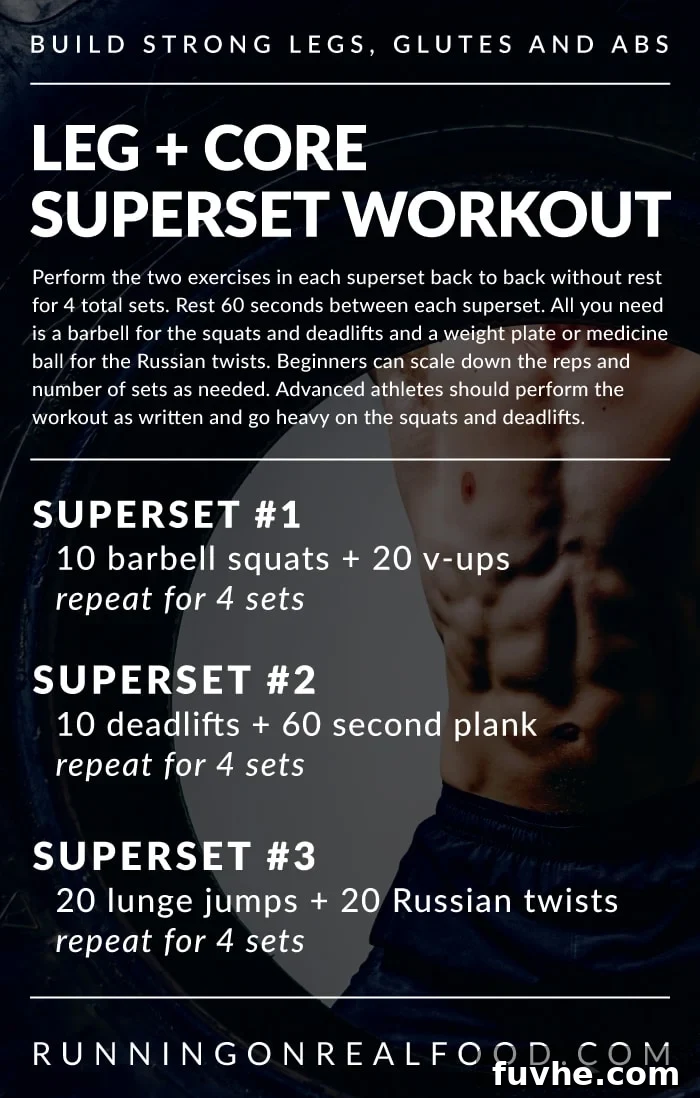
This dynamic workout is structured around three distinct supersets, each to be performed for a total of four challenging sets. You’ll tackle powerful combinations: barbell squats paired with V-ups, deadlifts followed by weighted planks, and finally, explosive jumping lunges combined with Russian twists. The key to maximizing the effectiveness of this routine is to move seamlessly from the first exercise in each superset to the second, with no rest in between. Once you’ve completed both exercises in a superset, you’ll earn a brief recovery period of 1 to 2 minutes before diving into the next set.
Remember, the goal is to maintain intensity and keep your heart rate elevated throughout the active phases. Completing all four sets for each superset ensures comprehensive muscle engagement and a significant metabolic boost.
Superset 1: Foundation and Core Power
- 10 Barbell Back Squats: The king of lower body exercises, targeting your quads, glutes, and hamstrings while demanding significant core stability. Focus on a deep, controlled descent and an explosive ascent.
- 20 V-Ups: A highly effective exercise for comprehensive core engagement, hitting both your upper and lower abs, as well as your obliques. Aim for smooth, coordinated movement, bringing your hands and feet together in a ‘V’ shape.
Superset 2: Posterior Chain and Static Strength
- 10 Deadlifts: A full-body powerhouse, primarily engaging your glutes, hamstrings, and lower back, crucial for overall strength and posture. Prioritize impeccable form to prevent injury and maximize muscle activation.
- 60 Seconds Plank: An isometric core exercise that builds incredible endurance in your entire trunk, including your rectus abdominis, obliques, and transverse abdominis. Maintain a straight line from head to heels, bracing your core firmly.
Superset 3: Explosive Power and Rotational Core
- 20 Jumping Lunges (10 per leg): An excellent plyometric exercise that builds explosive power in your legs, improves cardiovascular fitness, and challenges your balance. Land softly and explode upwards, alternating legs.
- 20 Russian Twists (10 per side): Fantastic for targeting your obliques and improving rotational core strength. Keep your feet off the floor and your core engaged, twisting from side to side with control.
Choosing Your Challenge: Selecting Optimal Weights
The effectiveness of this superset workout largely depends on selecting the right weights. Instead of simply aiming for the heaviest possible load, consider your workout’s specific objective. For this routine, the focus is on a blend of speed, power, and controlled eccentric movement, rather than maximal strength. I typically opt for weights that allow me to execute the lifting portions of the exercises with fluidity and dynamic power. The emphasis is on a controlled, slow eccentric (lowering) phase, followed by a powerful, fast concentric (lifting) phase.
The Power of Negatives: Why Eccentric Training Matters
Eccentric training, often referred to as “negative training,” involves extending the lowering phase of an exercise. For instance, during a squat, you would slowly lower your body over several seconds, then explode upward with maximum force. This deliberate slowing down of the eccentric phase is incredibly beneficial for building strength and promoting muscle growth. It places a different type of stress on the muscle fibers, leading to increased muscle damage (in a good way, prompting adaptation), greater strength gains, and improved control. It also enhances mind-muscle connection, forcing you to be more aware of each movement.
To specifically work on speed and power within this framework, I personally used 115 lbs for the barbell back squats and 145 lbs for the deadlifts. These weights allowed me to maintain excellent form while still generating significant power and controlling the negative phase effectively.
Elevate Your Strength: Adapting for Heavier Loads
If your primary goal shifts towards pure strength gains, you can certainly adjust the weights to be heavier. For a more strength-focused approach, this might mean increasing the barbell back squat to around 165 lbs and the deadlift to 185 lbs for someone with similar strength levels. The key is to select weights that are genuinely challenging for you, pushing your limits while still allowing you to complete all repetitions with impeccable form. Remember, you’ll be performing 4 sets of 10 repetitions for each weighted exercise, totaling 40 reps per movement. The chosen weight should make those final reps tough and uncomfortable, but never at the expense of proper technique.
Enhancing Core Challenge: Weights for Ab Exercises
For the Russian twists, incorporating a weight plate significantly increases the challenge to your obliques and rotational core strength. I typically use a 25 lb weight plate, but you can choose anything from a 10 lb to a 45 lb plate, or even a medicine ball if you prefer. The objective here is to perform the twists as quickly and powerfully as possible, tapping the weight down on either side of your body while keeping your feet elevated off the floor. This dynamic movement ensures maximum core activation and a strong metabolic burn.
Adapt and Conquer: At-Home Modifications for Your Leg and Core Workout
One of the greatest advantages of this superset workout is its incredible adaptability, allowing you to perform it effectively even if you don’t have access to a full gym. With a few smart substitutions, you can maintain the intensity and effectiveness of the routine using minimal equipment, or even just your body weight.
Limited Equipment (Kettlebell or Dumbbells)
If you have a kettlebell or a set of dumbbells at home, you have plenty of options to replicate the core movements:
- Barbell Back Squats: Instead of a barbell, perform goblet squats with a kettlebell or a single heavy dumbbell held vertically against your chest. You can also do dumbbell front squats by holding two dumbbells at your shoulders.
- Deadlifts: Substitute with dumbbell deadlifts, holding a dumbbell in each hand. For a posterior chain focus, consider Romanian Deadlifts (RDLs) with dumbbells or a kettlebell.
- Plank: If you have a weight plate or a dumbbell, you can still perform a weighted plank by placing it carefully on your lower back (ensure it’s stable and safe).
- Jumping Lunges: These can be performed as standard jumping lunges, potentially holding light dumbbells for added resistance.
- Russian Twists: Use your kettlebell or a dumbbell for the weighted component, holding it with both hands as you twist.
No Equipment At All
Even without any weights, you can still get a powerful and challenging workout:
- Barbell Back Squats: Replace with jump squats, focusing on maximum height and explosive power. If jump squats are too intense, regular bodyweight air squats with a slow eccentric phase are an excellent alternative.
- Deadlifts: This is arguably the hardest to replicate without equipment. If you have an exercise ball, hamstring curls are a great option for targeting the posterior chain. Without any equipment, focus on single-leg straight leg deadlifts, performing 10 repetitions per side. This will challenge your balance, hamstrings, and glutes. Bodyweight Good Mornings are another option to strengthen the posterior chain.
- Plank: Perform a standard bodyweight plank, focusing on extending the hold duration or trying variations like side planks or plank jacks for added challenge.
- Jumping Lunges: Continue with bodyweight jumping lunges to maintain the plyometric and cardio benefits.
- Russian Twists: Perform these without weight, focusing on a strong, controlled twist and touching both hands down on either side of you. Bicycle crunches can also be a good alternative to hit similar muscle groups.
No matter your equipment availability, the core principles of this workout—intensity, controlled movement, and minimal rest—can be applied to deliver exceptional results.
Why This Workout Deserves a Spot in Your Routine
This leg and core superset workout is more than just another exercise routine; it’s a strategically designed program to maximize your fitness gains in the shortest possible time. It delivers a potent combination of strength, power, endurance, and cardiovascular conditioning. By consistently challenging your major lower body muscle groups and your entire core, you’ll build functional strength that translates to better performance in everyday activities and other sports. The metabolic boost from superset training means you’ll be burning more calories during and after your workout. Its adaptability, whether in a gym or at home, removes barriers to consistency. Give this dynamic workout a try, and prepare to feel stronger, more powerful, and more efficient with your training time.
Looking for More Superset and Circuit Training Workouts? Try These:
- 30 Minute Full-Body Superset Workout
- Push, Pull, Legs and Core Superset Workout
- Full-Body Superset Workout
- Core and Cardio Circuit Workout
- 40 Minute Full-Body EMOM Workout