
Conquer the Incline: Your Ultimate 30-Minute Treadmill Hill Climb Workout for Speed & Strength
Are you pressed for time but determined to get an impactful workout? This 30-Minute Treadmill Hill Climb Workout is your secret weapon for maximizing fitness in minimal time. While it’s certainly not for the faint of heart, its intensity directly translates into impressive results. If you have only half an hour to dedicate to exercise, this dynamic routine promises a powerful blend of cardiovascular conditioning, leg strength, and mental fortitude.
Beyond simply burning calories, integrating incline training into your routine offers a multitude of benefits. You’ll not only achieve an outstanding cardiovascular workout, significantly boosting your heart health and endurance, but the consistent challenge of the hills will also meticulously sculpt and strengthen your legs and glutes. This workout is a comprehensive package designed to enhance your running performance, build resilient muscles, and elevate your overall fitness level.
Why Hill Training Is a Game-Changer for Runners
Hill training is one of the most effective and often underestimated methods to improve running performance and general fitness. Incorporating inclines into your treadmill routine transforms a standard run into a potent strength and endurance builder. Here’s why this 30-minute hill climb will revolutionize your workouts:
- Superior Cardiovascular Boost: Running uphill demands more from your heart and lungs, significantly improving your VO2 max and overall aerobic capacity. This means you’ll run stronger and longer, whether on the treadmill or outdoors.
- Unmatched Leg and Glute Strength: Every step on an incline targets key muscle groups including your quadriceps, hamstrings, calves, and especially your glutes. This focus on lower body strength translates to more powerful strides, improved stability, and reduced risk of injury.
- Enhanced Running Economy and Speed: By strengthening the muscles responsible for propulsion, hill training teaches your body to be more efficient. This improved efficiency can lead to faster paces on flat ground and greater endurance over distance.
- Reduced Impact, Increased Power: While challenging, running uphill can sometimes be less impactful on your joints than running downhill or on flat surfaces, as the incline naturally reduces stride length. You gain strength without excessive pounding.
- Mental Toughness: Conquering a series of challenging inclines builds incredible mental resilience. Pushing through discomfort on the treadmill prepares you to tackle physical and mental obstacles in all aspects of life.
- Metabolic Boost: The higher intensity of hill workouts significantly increases calorie expenditure during the session and contributes to a greater “afterburn effect” (EPOC), meaning your body continues to burn calories at an elevated rate long after you’ve finished.
Preparing for Your Ultimate Hill Challenge
To get the most out of this intensive 30-minute treadmill hill climb and ensure a safe, effective workout, proper preparation is key. A little planning goes a long way in maximizing your performance and enjoyment.
The Essential Warm-Up
Never skip your warm-up! Dedicate 5-10 minutes before diving into the main workout. Start with a light jog or brisk walk at 0% incline to gradually increase your heart rate and blood flow. Follow this with some dynamic stretches such as leg swings, arm circles, and torso twists. This prepares your muscles and joints for the demands of the upcoming inclines, reducing the risk of strain or injury.
Gear Up for Success
Ensure you’re wearing appropriate running shoes that provide good support and cushioning. Comfortable, moisture-wicking athletic apparel will keep you cool and dry as you push through the sweat. While not mandatory, a good pair of headphones and an upbeat playlist can significantly boost your motivation, as noted in the original workout details!
Hydration is Key
Hydrate adequately before your workout. Even 30 minutes of intense exercise can lead to significant fluid loss. Have a water bottle readily available on your treadmill to take sips during your brief recovery periods, especially between sets.
Cultivating a Winning Mindset
This workout is designed to be challenging. Approach it with a positive attitude and the understanding that discomfort is part of growth. Remind yourself that it’s only 30 minutes, and you are capable of pushing through. Mental resilience is as crucial as physical strength in conquering these hills.
Pace and Incline Suggestions: Scale As Needed
The beauty of this treadmill hill workout lies in its adaptability. You can (and should!) adjust the speed and incline to match your current fitness level, ensuring it remains challenging yet achievable for you. The suggested speeds below worked well for the author, proving challenging but entirely doable. Expect the second and third sets to significantly test your limits if you adhere strictly to these numbers.
This routine is designed for continuous movement over 30 minutes. You might feel the urge to stop when the inclines increase, but sticking with it is paramount. The 1-minute recovery periods at 0% incline are strategically placed to allow for sufficient recovery before tackling the next demanding ascent.
Finding Your Base Speed
Your base speed is the pace you maintain during the flatter, longer segments (0% incline). This should be a comfortable running pace that you can sustain for 5 minutes without feeling completely breathless, but still feel like you’re working.
- For Newer Runners or Power Walkers: If you’re new to running or prefer a vigorous power walk, start with a base speed of 5.0 to 6.0 mph. Adjust your speeds throughout the hill intervals accordingly, perhaps dropping by 1-1.5 mph for the steepest climbs. Even power walking this workout will provide excellent cardiovascular and strength benefits.
- For Intermediate Runners: A base speed between 6.5 and 7.5 mph is a good starting point. You’ll adjust speeds for the hills, likely dropping by 1-1.5 mph for the steeper inclines.
- For Experienced Runners with High Fitness Levels: You can aim for a base speed of 8.0 mph or even higher, similar to the author’s pace. Be prepared to reduce your speed for the hill segments, but aim to maintain a challenging pace.
Adjusting Inclines for Your Comfort Zone
If you find the initial 10% incline too daunting, you can modify the challenge by adjusting the inclines downwards. For instance, start with 6% or 8% instead of 10%, and then adjust all subsequent inclines down by 2% or 4% respectively throughout the intervals. The goal is to choose a level that presents a significant challenge without leading to premature burnout or compromising form. Don’t hesitate to experiment and find what works best for your body.
Remember, the most effective workout is one you can complete safely and consistently. Listen to your body, make adjustments as needed, and embrace the challenge. You can do anything for 30 minutes, so don’t be afraid to go for it!
The 30-Minute Treadmill Hill Climb Workout Details
This workout is designed to push you through three progressive parts, each building upon the last in intensity. There will be moments where you want to stop, where your legs burn and your lungs gasp for air. It’s during these moments that your mental drive, fueled perhaps by loud, motivating music, will be your greatest asset. The author finished feeling incredibly accomplished and, yes, very sweaty – a testament to the workout’s effectiveness. Give it a try and feel the transformation!
Part 1: The Initial Challenge
This first segment introduces you to the rhythm of hill intervals, alternating between a steady base pace and challenging inclines. Focus on finding your rhythm and maintaining good form.
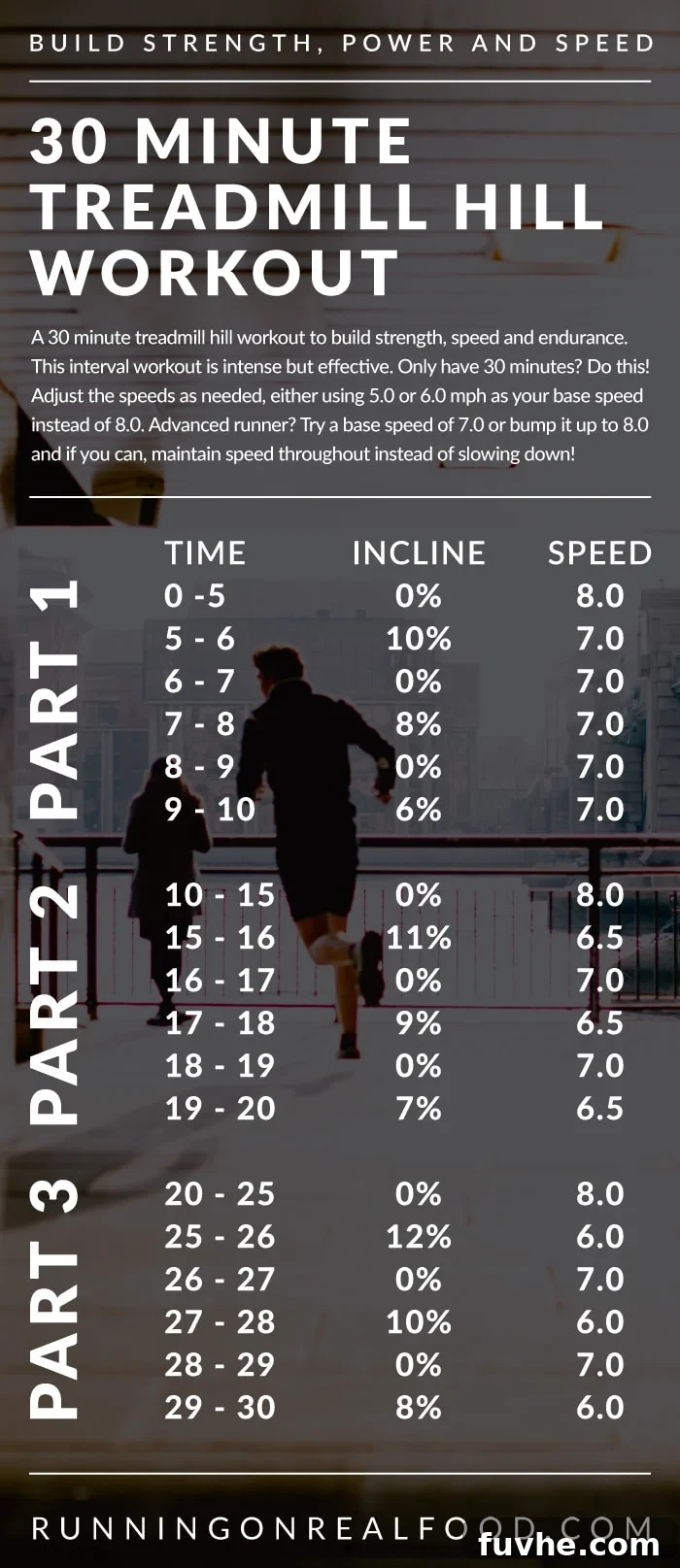
- 0-5 min: 0% Incline at 8 mph (Base Pace)
- 5-6 min: 10% Incline at 7 mph (Hill Climb 1)
- 6-7 min: 0% Incline at 7 mph (Active Recovery)
- 7-8 min: 8% Incline at 7 mph (Hill Climb 2)
- 8-9 min: 0% Incline at 7 mph (Active Recovery)
- 9-10 min: 6% Incline at 7 mph (Hill Climb 3)
Part 2: Increasing the Intensity
The second part ups the ante, with steeper inclines and slightly reduced speeds on the hills to manage the increased resistance. Your legs will start to feel the burn here.
- 10-15 min: 0% Incline at 8 mph (Base Pace Reset)
- 15-16 min: 11% Incline at 6.5 mph (Steeper Hill 1)
- 16-17 min: 0% Incline at 7 mph (Active Recovery)
- 17-18 min: 9% Incline at 6.5 mph (Steeper Hill 2)
- 18-19 min: 0% Incline at 7 mph (Active Recovery)
- 19-20 min: 7% Incline at 6.5 mph (Steeper Hill 3)
Part 3: The Final Push
This is where your determination truly shines. The inclines are at their peak, and your body will be working harder than ever. Push through these last ten minutes with everything you’ve got!
- 20-25 min: 0% Incline at 8 mph (Base Pace for the Finish)
- 25-26 min: 12% Incline at 6 mph (Peak Hill 1 – The Ultimate Challenge)
- 26-27 min: 0% Incline at 7 mph (Active Recovery)
- 27-28 min: 10% Incline at 6 mph (Peak Hill 2)
- 28-29 min: 0% Incline at 7 mph (Active Recovery)
- 29-30 min: 8% Incline at 6 mph (Peak Hill 3 – Finish Strong!)
Maximizing Your Results: Form and Focus
Beyond simply following the numbers, paying attention to your running form during hill climbs can significantly enhance the workout’s effectiveness and prevent injury. Focus on:
- Maintain Good Posture: Lean slightly into the hill from your ankles, not your waist. Keep your chest up, shoulders relaxed, and gaze forward.
- Engage Your Core: A strong core provides stability and helps transfer power from your legs.
- Arm Drive: Use strong, rhythmic arm swings to help propel you forward, driving your elbows back.
- Foot Strike: Aim for a mid-foot strike, landing lightly and pushing off the balls of your feet. Avoid slamming your feet down.
- Breathing: Focus on deep, controlled breathing. Inhale through your nose and mouth, exhale through your mouth.
Cool-Down and Recovery: The Final Lap
Just as the warm-up is crucial, so is the cool-down. Don’t abruptly stop after the last hill. Dedicate 5-10 minutes to cooling down:
- Light Walk: Reduce your speed to a brisk walk (3-4 mph) at 0% incline for 3-5 minutes to gradually lower your heart rate.
- Static Stretching: Once off the treadmill, perform static stretches focusing on your quads, hamstrings, calves, and glutes. Hold each stretch for 20-30 seconds.
- Refuel and Rehydrate: Replenish your energy stores with a balanced meal or snack containing protein and carbohydrates. Continue drinking water to rehydrate.
- Rest: Allow your body adequate rest and sleep to recover and adapt to the training stimulus.
Unlock Your Potential: The Power of 30 Minutes
This 30-minute treadmill hill climb workout proves that you don’t need hours at the gym to achieve significant fitness gains. It’s a testament to the power of high-intensity, structured training. By consistently challenging yourself with inclines, you’ll not only see improvements in your cardiovascular health and muscular strength but also build a profound sense of accomplishment and mental fortitude.
Whether you’re training for an outdoor race, aiming to boost your overall fitness, or simply seeking an efficient and exhilarating way to sweat, this workout is a potent tool in your arsenal. Embrace the hills, push your limits, and discover what you’re truly capable of in just half an hour.
Explore More Dynamic Treadmill and Fitness Workouts
If you enjoyed the challenge and benefits of this hill workout, you’re in luck! We have a curated selection of other effective routines designed to keep your fitness journey exciting and progressive:
- Treadmill Hill Training Workout: Dive deeper into hill-specific training with this focused routine.
- Core and Cardio Circuit Workout: Combine essential core work with invigorating cardio for a balanced session.
- 40 Minute Full-Body EMOM Workout: Experience the intensity of Every Minute On the Minute training for a comprehensive strength and conditioning challenge.
- 45 Minute Full-Body EMOM Workout: A slightly longer version of the EMOM, designed to push your endurance and strength further.
- 35 Minute Treadmill and Barbell Workout: Integrate treadmill cardio with effective barbell strength training for a powerful hybrid session.