Master the 100-20-100 Reps For Time Workout: Your Ultimate Full-Body Challenge
Are you ready to test your speed, endurance, and strength? The 100-20-100 reps for time workout is a dynamic and challenging routine designed to push your limits and get your heart pumping. This full-body circuit begins and ends with high-intensity cardio, sandwiching a demanding sequence of strength exercises that scale down from 80 reps to 20, then climb back up. Your mission? Complete it as fast as possible, leaving no rep untouched and no effort spared. Let’s dive into how you can conquer this formidable fitness test!
What Exactly is a “For Time” Workout?
In the world of functional fitness and CrossFit terminology, a “for time” workout signifies a challenge where the primary goal is speed. The clock starts when you begin the first movement and stops only after the final rep of the last exercise is completed. Unlike AMRAPs (As Many Rounds As Possible) or EMOMs (Every Minute On the Minute), a “for time” workout has a fixed set of movements and repetitions; your only variable is how quickly you can execute them. This particular routine isn’t intended to be an all-out sprint where form is sacrificed, but rather a steady, relentless pace that keeps rest periods to an absolute minimum. It’s a fantastic way to build mental toughness, improve cardiovascular endurance, and track your progress over time.
Why This 100-20-100 Workout Will Challenge You
This workout is strategically structured to hit multiple energy systems and muscle groups, ensuring a comprehensive full-body conditioning experience. The opening and closing 100 double unders (or 200 single skips) provide a powerful cardiovascular punch, elevating your heart rate and preparing your body for the work ahead, and then serving as a final metabolic burst to finish strong. The middle section, with its descending and ascending rep scheme (80, 60, 40, 20, 40, 60, 80), creates a unique fatigue pattern. You’ll tackle higher volume strength work early, face a significant mental hurdle with the lower rep, high-impact movements like burpee to box jumps and thrusters, and then push through rising rep counts as fatigue sets in. This design trains not only your physical capacity but also your mental resilience, teaching you to push through discomfort and maintain focus.
Unpacking the Workout Structure
The core concept of this workout is simple yet brutally effective: a high-rep cardio opener, a strength-focused middle section with a unique rep scheme, and a high-rep cardio finisher. This cyclical pattern ensures that your cardiovascular system is constantly engaged while your major muscle groups are thoroughly worked. It’s a true test of stamina, power, and coordination, making it an excellent benchmark workout to revisit and see how your fitness progresses.
Preparing for Success: Estimated Time & Pacing Strategies
Understanding how long this workout might take and developing a solid pacing strategy are key to a successful attempt. Your performance will naturally vary based on your fitness level, strength, and proficiency with movements like double unders.
Setting Your Target Time
From personal experience, completing this workout using 35 lb dumbbells for thrusters, 25 lb dumbbells for renegade rows, a 20-inch box, and a 16 kg kettlebell for deadlift high pulls took me approximately 24 minutes. This provides a realistic benchmark. For most individuals, aiming to finish this entire sequence in under 30 minutes is a great initial goal. If you’re more advanced or highly conditioned, challenge yourself to complete it in under 25 minutes. Remember, these are targets; the most important thing is to complete all the reps with good form.
Mastering Your Pace
While “for time” implies speed, it’s crucial not to start too fast and burn out prematurely. Consider this less of a sprint and more of a steady, relentless marathon. Break down larger rep sets into smaller, manageable chunks. For example, for the 80 mountain climbers or 80 jumping lunges, aim for sets of 10-20 reps with very brief rests in between. For highly taxing movements like the 40 burpee to box jumps, maintain a consistent rhythm without stopping, even if that rhythm feels slower than you’d like. Pacing is about efficiency and minimizing recovery time, not about rushing. Focus on your breathing, stay composed, and move with purpose through each exercise.
Essential Equipment for Your Workout
One of the beauties of this workout is that it requires minimal equipment, making it highly accessible for both home and gym environments. Scale the weights and equipment to perfectly match your current fitness level and available resources.
-
Dumbbells: Your Versatile Strength Tool
You’ll need one or two sets of dumbbells. I personally used 25 lb dumbbells for the renegade rows and 35 lb dumbbells for the thrusters, necessitating two sets. If you use the same weight for both movements, one set will suffice. If you prefer a barbell for thrusters, a 65 lb barbell is a good starting point for intermediate athletes. Dumbbells offer fantastic versatility, engaging more stabilizing muscles, while a barbell allows for heavier loads and different lifting dynamics. Choose what best suits your comfort and strength levels.
-
Kettlebell: Powering Your Pulls
A kettlebell ranging from 16-24 kg will be essential for the kettlebell deadlift high pulls. The unique design of the kettlebell allows for a powerful, explosive hip hinge and pull, engaging your posterior chain and shoulders. If you don’t have a kettlebell, a single heavy dumbbell can be a substitute, holding it by one end to mimic the kettlebell’s center of gravity.
-
Box or Bench: Elevate Your Explosiveness
A sturdy box or bench, approximately 20-24 inches high, is required for the burpee to box jumps. This element adds a plyometric component, testing your explosive power and coordination. Ensure your box is stable and secure to prevent accidents. If a box isn’t available, you can substitute with burpee broad jumps or tuck jumps over an imaginary line.
-
Skipping Rope: Ignite Your Cardio
A quality skipping rope is crucial for the double unders (or single skips). Double unders are a highly efficient, high-intensity cardio exercise that demands coordination and timing. If you’re still mastering them, 200 single skips serve as an excellent alternative. No skipping rope? Don’t worry! You can substitute with 100 jumping jacks or 100 high knees, maintaining the intense cardiovascular output.
Your Complete 100-20-100 Workout Blueprint
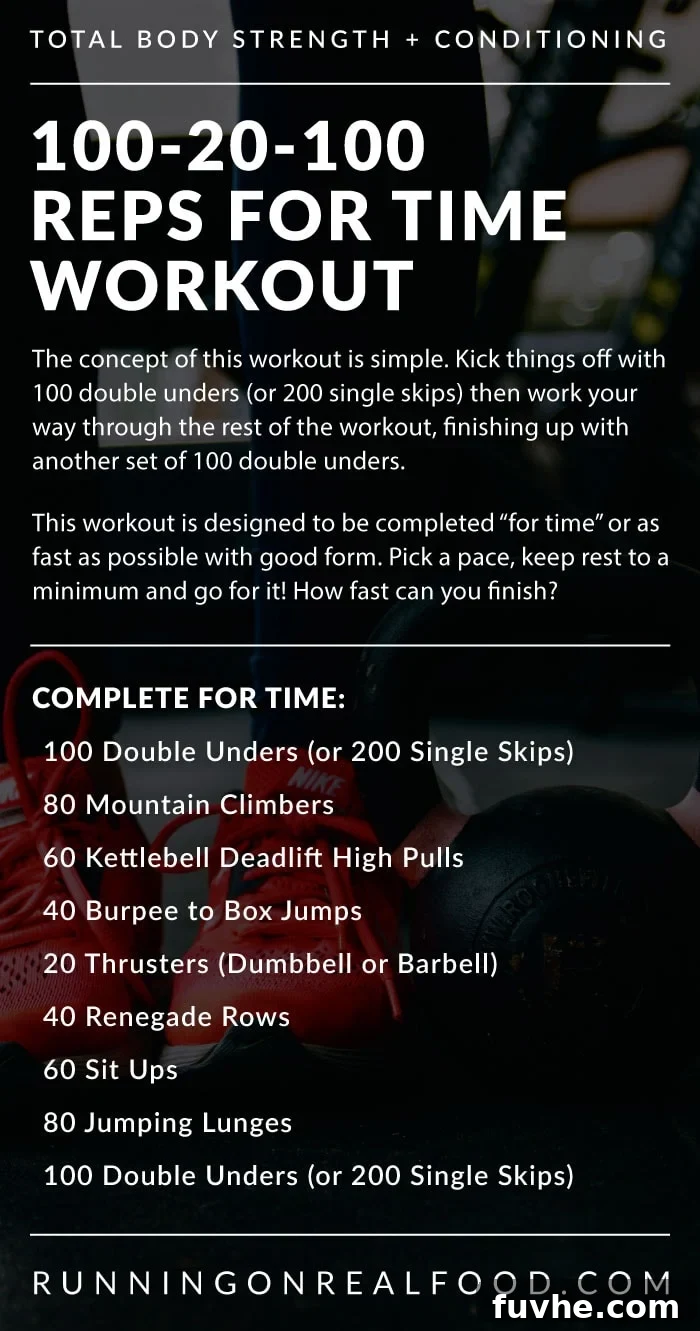
This workout is straightforward in its execution: one continuous circuit from start to finish. There are no rounds; you simply flow from one exercise to the next, ticking off the reps as you go. Focus on maintaining good form and a steady pace throughout the entire sequence. I’ve included links to video examples for movements you might be less familiar with to ensure proper technique.
Here’s the full workout:
- 100 Double Unders (or 200 single skips)
- 80 Mountain Climbers
- 60 Kettlebell Deadlift High Pulls
- 40 Burpee to Box Jumps
- 20 Thrusters (Dumbbell or Barbell)
- 40 Renegade Rows
- 60 Sit Ups
- 80 Jumping Lunges
- 100 Double Unders (or 200 single skips)
Detailed Breakdown of Each Movement
To ensure you get the most out of every rep, here’s a brief description and tip for each exercise:
Double Unders (or Single Skips)
Description: A jump rope exercise where the rope passes under your feet twice per jump. Single skips are a foundational alternative. This movement is a fantastic cardiovascular conditioner and coordination builder.
Tip: Keep your elbows tucked in close to your body and generate speed primarily from your wrists, not your shoulders. Maintain a consistent, light bounce.
Mountain Climbers
Description: Starting in a high plank position, rapidly bring one knee towards your chest, then switch, simulating running in place. This engages your core, shoulders, and hips for a dynamic cardio burst.
Tip: Keep your hips low and stable throughout the movement, engaging your core to prevent rocking. Focus on speed and rhythm.
Kettlebell Deadlift High Pulls
Description: A powerful, explosive movement starting with a kettlebell between your feet. Drive through your heels, extending your hips and knees while simultaneously pulling the kettlebell upward towards your chin, leading with your elbows. It’s a full-body exercise targeting the posterior chain, shoulders, and traps.
Tip: The power comes from your hips and glutes, not your arms. Use the momentum from your lower body to initiate the pull, then finish with your arms.
Burpee to Box Jumps
Description: Combine the full-body conditioning of a burpee with the explosive power of a box jump. Perform a burpee (chest to floor), stand up, and immediately jump onto the box, landing softly. Step or jump back down. This is a massive calorie burner and builds incredible power and stamina.
Tip: Find a rhythm and stick to it. Don’t rush the burpee, ensure a full range of motion, and use a powerful hip drive for the jump. Step down carefully to conserve energy and ensure safety.
Thrusters (Dumbbell or Barbell)
Description: A fluid, full-body movement combining a front squat with an overhead press. Squat down with the dumbbells (or barbell) racked on your shoulders, then powerfully stand up, using the momentum to press the weight overhead in one continuous motion. This exercise works your entire body, particularly legs, core, and shoulders.
Tip: Use the power from your legs and hips to drive the weight up. Think of it as pushing the ground away from you, then pressing the weight. Maintain a strong, upright torso throughout.
Renegade Rows
Description: Start in a high plank position with hands gripping dumbbells. Maintain a stable core and row one dumbbell up towards your chest, squeezing your shoulder blade, then lower it with control. Alternate sides. This exercise builds core stability and upper body strength, particularly in the back and shoulders.
Tip: Keep your body as still as possible, resisting the urge to twist your hips. Widen your stance if needed for more stability, and focus on slow, controlled movements.
Sit-Ups
Description: Lie on your back with knees bent and feet flat on the floor (or butterfly position). Engage your core to lift your torso up until your chest touches your thighs, then slowly lower back down. A classic abdominal exercise that targets your rectus abdominis.
Tip: Focus on using your abdominal muscles, not just momentum. For more intensity, reach your hands towards the ceiling as you sit up.
Jumping Lunges
Description: Start in a lunge position, then explosively jump up, switching your legs in mid-air to land in a lunge with the opposite leg forward. This plyometric exercise builds leg strength, power, and cardiovascular endurance.
Tip: Maintain an upright torso and land softly, absorbing the impact in your glutes and quads. Break these into smaller sets (e.g., 8 sets of 10) to maintain form and power as fatigue sets in.
Warm-Up and Cool-Down: Crucial for Performance & Recovery
Never skip your warm-up or cool-down! These vital components prepare your body for the intense effort ahead and aid in recovery afterward, helping to prevent injury and improve overall performance.
Pre-Workout Warm-Up (5-10 minutes)
Engage in light cardio like jogging or cycling for 2-3 minutes to increase blood flow. Follow with dynamic stretches such as arm circles, leg swings, torso twists, cat-cow stretches, and light air squats. Focus on movements that mimic the workout’s exercises to activate the specific muscle groups you’ll be using.
Post-Workout Cool-Down (5-10 minutes)
After finishing the last rep, bring your heart rate down with a few minutes of light activity, like walking. Then, perform static stretches, holding each for 20-30 seconds. Focus on the major muscle groups worked: quads, hamstrings, glutes, chest, shoulders, and triceps. Examples include quad stretches, hamstring stretches, glute stretches (like figure-four), and overhead triceps stretches.
Scaling and Progression: Make it Yours
This workout is highly scalable, meaning you can adjust it to match your current fitness level. If you’re a beginner, opt for single skips instead of double unders, choose lighter dumbbells, and step down from the box during burpee to box jumps. You can also reduce the rep counts slightly (e.g., 80-60-40-20-40-60-80 becomes 60-40-20-10-20-40-60) to build up your endurance. For progression, once you consistently hit your target times, aim to increase the weight of your dumbbells or kettlebell, improve your double under efficiency, or simply try to beat your previous “for time” record.
Beyond the Finish Line: My Personal Experience & Tips
Having personally tackled this workout, I can attest that the 40 burpee to box jumps and the 80 jumping lunges are significant mental and physical hurdles. For the burpee to box jumps, my strategy was to maintain a steady, unbroken pace – no stopping, just moving. It wasn’t about speed, but about consistency. For the jumping lunges, I found breaking them into quick sets of 10 with minimal rest extremely effective. This allowed me to maintain explosiveness and good form without completely exhausting my legs. Remember, this workout is as much a mental challenge as it is physical. Stay focused, trust your pacing, and celebrate every completed rep!
Explore More Challenging Workouts
If you enjoyed the intensity and challenge of this “for time” workout, you’re in luck! I have an extensive collection of killer routines designed to keep your fitness journey exciting and progressive. Dive into the links below or visit my workout archive to discover your next fitness adventure.
- Run Intervals Strength and Conditioning Workout
- Full-Body 30 Minute EMOM Workout
- 3-Part CrossFit AMRAP Workout
- 20 Minute CrossFit WOD
- 30 Minute Running and AMRAP Workout
- HIIT Strength and Conditioning Workout