

Unlock your full potential with this high-intensity, CrossFit-style Functional Fitness Conditioning Workout, expertly designed to deliver maximum results in minimal time. Whether you’re a seasoned athlete or looking to elevate your fitness journey, this challenging WOD (Workout of the Day) promises a comprehensive test of strength, endurance, and mental fortitude. The core principle? Complete it “for time”—push yourself to finish every repetition and every meter as quickly and efficiently as possible, while maintaining impeccable form. Prepare to ignite your metabolism, build resilient strength, and enhance your overall athletic conditioning with this powerful, full-body routine.
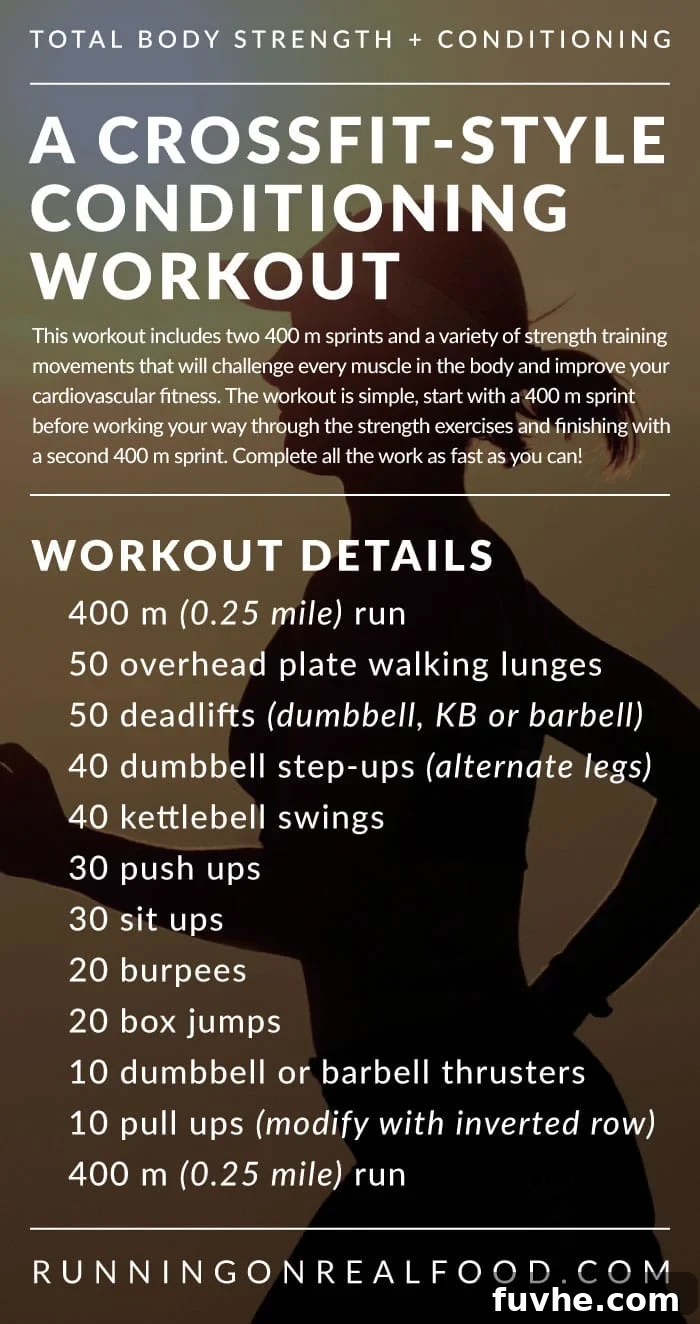
The Ultimate Conditioning Challenge: Workout Overview
This dynamic workout begins and ends with a heart-pounding sprint, bookending a series of diverse, functional movements. The structure is deliberately designed to challenge both your cardiovascular endurance and muscular stamina, pushing you to empty the tank from start to finish. Your mission is simple: attack each exercise with intensity, minimize rest, and focus on clean, controlled movements. Remember, speed is crucial, but never at the expense of proper technique. This isn’t just about finishing fast; it’s about performing at your peak.
Complete for time:
- 400 m (0.25 mile) run
- 50 overhead plate-walking lunges
- 50 deadlifts
- 40 dumbbell step-ups
- 40 kettlebell swings
- 30 push-ups
- 30 sit-ups
- 20 burpees
- 20 box jumps
- 10 barbell or dumbbell thrusters
- 10 pull-ups
- 400 m (0.25 mile) run
Why This Structure Works
The “sprint sandwich” approach forces your body to transition rapidly between high-intensity cardio and strength-based movements. This mimics real-world athletic demands and significantly boosts your metabolic conditioning. By pushing through the entire sequence with minimal recovery, you’ll improve your work capacity, enhance your muscular endurance, and build incredible mental toughness. Each exercise targets different muscle groups and energy systems, ensuring a truly comprehensive, full-body engagement.
Equipment You’ll Need
To successfully complete this functional fitness WOD, you’ll need access to a few essential pieces of gym equipment. While some exercises offer variations, having these items will allow you to perform the workout as prescribed:
- Open Space: For the 400m runs and walking lunges.
- Weight Plate: For overhead plate walking lunges.
- Barbell and Weight Plates: For deadlifts and thrusters (or heavy dumbbells).
- Dumbbells: For step-ups and thrusters.
- Kettlebell: For kettlebell swings.
- Plyo Box or Sturdy Bench: For box jumps and step-ups.
- Pull-up Bar: For pull-ups.
Ensure your equipment is in good condition and suitable for the weights you intend to use. Safety is paramount!
Pre-Workout: Prime Your Body with a Dynamic Warm-Up
Before diving into this intense WOD, a proper warm-up is non-negotiable. It prepares your muscles, joints, and cardiovascular system for the upcoming demands, reducing the risk of injury and optimizing performance. Spend 5-10 minutes focusing on dynamic movements that increase blood flow and mobility.
Suggested Warm-Up Routine:
- Light Cardio (2-3 minutes): Jogging, jumping jacks, or cycling to gently raise your heart rate.
- Dynamic Stretches (5-7 minutes):
- Arm Circles (forward and backward)
- Leg Swings (forward/backward and side-to-side)
- Torso Twists
- Cat-Cow Stretches
- Glute Bridges
- Bodyweight Squats
- Walking Lunges (no weight)
- Scapular Pull-ups (on the bar)
- Empty Barbell/PVC Pass-Throughs (for shoulder mobility)
The goal is to feel warm and limber, not exhausted. Pay special attention to areas that will be heavily engaged, such as your hips, hamstrings, shoulders, and core.
Exercise Spotlight: Mastering Each Movement
Understanding the mechanics and purpose of each exercise will not only improve your performance but also ensure safety. Here’s a brief breakdown of the movements in this WOD:
400m Run
The bookends of this workout are designed to test your cardiovascular endurance and mental grit. Start strong, find a sustainable pace, and be prepared to sprint that last 100 meters. Proper running form—relaxed shoulders, engaged core, light feet—is key to efficiency and preventing premature fatigue.
50 Overhead Plate-Walking Lunges
This compound movement challenges your leg strength, core stability, and shoulder mobility. Hold a weight plate overhead with arms fully extended, keeping your core tight and gaze forward. Step forward into a lunge, ensuring your front knee tracks over your ankle and your back knee gently taps the ground. Alternate legs for 50 total lunges (25 per leg). Focus on maintaining the plate directly over your head throughout the movement.
50 Deadlifts
A foundational strength exercise, deadlifts engage your entire posterior chain—glutes, hamstrings, and lower back—along with your core and grip. Maintain a flat back, chest proud, and initiate the movement by pushing the floor away with your feet. The bar should travel in a straight line, keeping it close to your body. Squeeze your glutes at the top. Form is paramount here to prevent injury, so choose a weight that allows for perfect execution for all 50 repetitions, even if it means dropping the weight and picking it back up.
40 Dumbbell Step-Ups
Unilateral exercises like step-ups are excellent for building balanced leg strength and improving hip stability. Hold a dumbbell in each hand. Step onto a box or sturdy bench, driving through the heel of your leading foot. Stand tall at the top, fully extending your hip and knee, then step back down with control. Alternate legs for a total of 40 steps (20 per leg). Ensure the box height is challenging but manageable, allowing for a full range of motion.
40 Kettlebell Swings
A powerful, explosive movement, kettlebell swings are fantastic for developing hip power, strengthening your glutes and hamstrings, and improving cardiovascular fitness. Initiate the swing with a strong hip hinge, propelling the kettlebell forward and up to chest or eye level using the force of your hips and glutes, not your arms. The movement should be powerful and fluid, like a pendulum. Keep your core braced and maintain a neutral spine. Focus on generating power from your hips.
30 Push-Ups
The classic upper body strength exercise, push-ups target your chest, shoulders, and triceps, while also engaging your core for stability. Start in a high plank position, hands slightly wider than shoulder-width. Lower your chest towards the floor, keeping your body in a straight line from head to heels. Push back up to the starting position, fully extending your arms. If needed, modify by performing push-ups from your knees, but strive for full range of motion.
30 Sit-Ups
Engage your core with these effective abdominal exercises. Lie on your back with knees bent and feet flat on the floor (you can butterfly your knees if preferred). Use your abdominal muscles to lift your torso towards your knees, touching the ground in front of your feet. Control the descent back to the starting position. Focus on a strong, controlled contraction of your core muscles.
20 Burpees
The ultimate full-body conditioning exercise, burpees combine a squat, plank, push-up, and jump into one dynamic movement. From a standing position, squat down and place your hands on the floor. Kick your feet back into a plank, perform a push-up (optional, but recommended), jump your feet back towards your hands, and finally jump explosively into the air with hands clapped overhead. Maintain rhythm and push through the fatigue!
20 Box Jumps
Develop explosive power and improve your athleticism with box jumps. Stand facing a sturdy box. Swing your arms and powerfully jump onto the box, landing softly with both feet. Stand up fully extended at the top, then step or jump back down. Ensure the box height is appropriate for your skill level to minimize injury risk. Focus on controlled landings and full hip extension at the top.
10 Barbell or Dumbbell Thrusters
Thrusters are a highly effective full-body movement that combines a front squat and an overhead press into one fluid motion. Hold a barbell in the front rack position or dumbbells at your shoulders. Perform a full squat, and as you explode upwards from the bottom of the squat, use that momentum to press the weight overhead. Lock out your arms at the top, then control the weight back down to the front rack position as you descend into the next squat. This exercise demands coordination, strength, and endurance.
10 Pull-Ups
A benchmark for upper body pulling strength, pull-ups target your back, biceps, and shoulders. Grip the pull-up bar with an overhand grip, hands slightly wider than shoulder-width. Hang with arms fully extended, then pull yourself up until your chin clears the bar. Control your descent back to the starting position. Focus on engaging your lats and maintaining a stable core. If you cannot perform strict pull-ups, modifications are available (see “Scale The Workout” below).
Choosing the Right Weight for Optimal Performance
Selecting the appropriate weight is crucial for maximizing the effectiveness of this WOD and preventing injury. The goal is to choose a weight that allows you to complete the prescribed repetitions with minimal rest, or ideally, unbroken sets. It should feel challenging, but you should still be able to maintain proper form throughout the movement. Err on the side of lighter weight if you’re unsure, especially when learning new movements. As you gain strength and technique, you can gradually increase the load, a principle known as progressive overload.
Suggested Weight Guidelines:
- OH Plate Walking Lunges:
- Women: 15-25 lbs (7-11 kg) plate
- Men: 25-45 lbs (11-20 kg) plate
- Focus on core stability and shoulder endurance; the weight is secondary to holding it overhead.
- Deadlifts:
- Women: 95-115 lbs (43-52 kg)
- Men: 125-155 lbs (57-70 kg)
- Choose a weight you can confidently perform 5-10 unbroken reps with perfect form before fatigue sets in. It’s better to do more sets with good form than fewer with bad.
- DB Step-Ups:
- Women: 20 lbs (9 kg) dumbbells (10 lbs per hand)
- Men: 25-35 lbs (11-16 kg) dumbbells (12.5-17.5 lbs per hand)
- The challenge here is the unilateral work and endurance. Ensure you can step up powerfully.
- KB Swings:
- Women: 16 kg (35 lbs) kettlebell
- Men: 20-24 kg (44-53 lbs) kettlebell
- Prioritize technique and hip drive over heavy weight. A lighter bell with explosive movement is more effective than a heavy one with poor form.
- Thrusters (Barbell or Dumbbell):
- Women: Use the same DB as step-ups, or 45-65 lbs (20-29 kg) barbell
- Men: Use the same DB as step-ups, or 65-95 lbs (29-43 kg) barbell
- Thrusters are metabolic! Choose a weight you can cycle efficiently for 5+ reps if needed, but for 10 reps, aim for unbroken.
Always remember that these are suggestions. Listen to your body, and don’t hesitate to adjust the weights based on your current strength levels and energy on any given day.
Make This WOD Harder: Advanced Variations
Once you’ve conquered the standard workout and consistently achieve fast times, you might be ready to dial up the intensity and introduce new challenges. Here are several ways to make this already demanding WOD even more formidable:
- Increase Sprint Distance: Instead of 400 m, make the introductory and concluding sprints 800 m. This significantly boosts the cardiovascular demand and tests your endurance threshold even further.
- Add Plank Holds: Integrate a 60-second plank hold immediately before and after each 400 m (or 800 m) sprint. This challenges your core stability under fatigue and adds an extra layer of difficulty to the cardio portions.
- Complete Multiple Rounds: Instead of just one round, complete two full rounds of the entire workout. This doubles the volume and provides an epic test of stamina and resilience. Be prepared for a much longer and more grueling session.
- Introduce Mid-Workout Sprints: Add two additional 400 m sprints within the workout—one after the kettlebell swings and another after the box jumps. This will break up the strength movements with bursts of high-intensity cardio, mimicking the fluctuating demands of competitive functional fitness.
- Increase Repetitions or Weight: For certain exercises, you could add 5-10 more reps or slightly increase the weight, provided it doesn’t compromise form. This is a subtle yet effective way to add difficulty.
Only attempt these advanced variations when you have a solid foundation and feel confident in your ability to maintain excellent form throughout the increased challenge.
Scale The Workout: Making It Accessible for Everyone
The beauty of functional fitness, especially CrossFit-style WODs, lies in their scalability. This workout can be easily modified to suit any fitness level, ensuring everyone can participate safely and effectively. The key is to challenge yourself appropriately without overexertion or risking injury. Don’t view scaling as a sign of weakness; it’s a smart strategy for progressive training.
Scaling Options for Each Movement:
- Runs: If running 400m is too intense, you can briskly walk, power walk, or even substitute with a row (500m) or bike (1000m) for cardio.
- Overhead Plate Walking Lunges:
- Reduce the weight of the plate, or perform bodyweight walking lunges.
- Alternatively, perform standard walking lunges (holding the plate at your chest).
- Deadlifts:
- Decrease the weight significantly.
- Perform fewer repetitions.
- Switch to kettlebell deadlifts or sumo deadlifts for a potentially easier form.
- Dumbbell Step-Ups:
- Reduce the height of the box or step.
- Use lighter dumbbells or perform bodyweight step-ups.
- Kettlebell Swings:
- Use a lighter kettlebell.
- Focus on the hip hinge movement with a lighter weight or even a PVC pipe until comfortable.
- Push-Ups:
- Perform push-ups from your knees.
- Elevate your hands by placing them on a bench or box (incline push-ups).
- Do wall push-ups.
- Sit-Ups:
- Reduce the range of motion.
- Perform crunches.
- Burpees:
- Eliminate the push-up portion.
- Step back into the plank instead of jumping (walk-out burpees).
- Reduce the final jump to a small hop or simply stand up.
- Box Jumps:
- Reduce the height of the box.
- Perform box step-ups instead of jumps.
- Step onto a low step or plate.
- Thrusters:
- Reduce the weight of the barbell or dumbbells.
- Perform front squats and overhead presses separately (not as one fluid movement) or with a lighter weight.
- Use a PVC pipe or broomstick to practice the movement pattern.
- Pull-Ups:
- Use a resistance band for assistance (banded pull-ups).
- Utilize an assisted pull-up machine.
- Perform jumping pull-ups (jump to get your chin over the bar, then slowly lower).
- Substitute with bodyweight rows or bent-over dumbbell/barbell rows.
Choose the modifications that allow you to complete the workout with good form and a challenging but sustainable intensity. The goal is consistent effort and gradual improvement.
Post-Workout: Cool Down and Recovery Strategies
Just as important as your warm-up is your cool-down. After such an intense conditioning workout, taking 5-10 minutes to bring your heart rate down and gently stretch your muscles is crucial for recovery and flexibility. This helps flush out metabolic byproducts, reduces muscle soreness, and improves overall mobility.
Suggested Cool-Down Routine:
- Light Cardio (2-3 minutes): A slow walk or light jog to gradually lower your heart rate.
- Static Stretches (5-7 minutes): Hold each stretch for 20-30 seconds, breathing deeply.
- Hamstring stretch
- Quad stretch
- Glute stretch (e.g., pigeon pose or figure-four stretch)
- Calf stretch
- Chest stretch
- Triceps stretch
- Shoulder stretch
- Child’s pose for back release
Beyond the cool-down, focus on proper recovery:
- Hydration: Replenish fluids by drinking plenty of water.
- Nutrition: Consume a balanced meal or snack with protein and carbohydrates within 30-60 minutes post-workout to aid muscle repair and glycogen replenishment.
- Rest: Allow your body adequate sleep to recover and adapt to the training stimulus.
More Workouts to Fuel Your Fitness Journey
If you’ve enjoyed the intensity and effectiveness of this CrossFit-style conditioning workout, you’re in luck! The world of functional fitness offers an endless variety of challenges to keep your training exciting and progressive. Explore these additional workouts to continue building strength, endurance, and overall athletic capability:
20 Minute CrossFit WOD // 3-Part CrossFit AMRAP Workout // 3 CrossFit-Style Workouts // CrossFit EMOM Workouts // 45 Minute E2MOM Workout // Sprints and Burpee Cardio Workout // Legs and Hills Workout
Keep pushing your limits, staying consistent, and enjoying the incredible benefits of functional fitness!