Unlock your full fitness potential with this dynamic cardio and strength circuit training workout. Designed to sculpt an all-around fitter physique, boost muscular strength, and significantly elevate your stamina, this routine is a cornerstone for anyone looking to transform their fitness journey. Whether you’re a seasoned athlete or just embarking on your path to better health, this versatile workout adapts to your environment and fitness level. All you need is a willingness to push yourself and a few basic pieces of equipment – many of which can be found in a home gym, a public park, or any standard fitness facility. Forget the excuses; prepare to challenge your body and mind with a regimen built for results.
The Ultimate Cardio and Strength Circuit Training Workout: Boost Your Full-Body Fitness
This comprehensive workout masterfully blends high-intensity cardiovascular bursts with targeted strength training, creating a synergistic effect that amplifies calorie burn, builds lean muscle, and enhances endurance. It’s more than just a sequence of exercises; it’s a strategic approach to functional fitness, preparing your body for the demands of everyday life and advanced physical challenges. The circuit format keeps your heart rate elevated, ensuring you maximize every minute of your training session. This isn’t just about moving; it’s about moving efficiently, powerfully, and continuously.
Essential Equipment for Your Circuit
To successfully execute this powerful circuit, you’ll need minimal equipment, making it highly accessible. The primary tools for this workout include:
- Kettlebell or Dumbbell: For foundational movements like swings and goblet lunges. If you don’t have a kettlebell, a dumbbell can serve as an excellent substitute for many exercises, though the ballistic nature of the kettlebell swing offers unique benefits. Choose a weight that challenges you but allows for good form throughout your reps.
- Plyometric Box, Bench, or Sturdy Step: Essential for box jumps, this piece of equipment provides a stable surface for explosive movements. Ensure it’s robust enough to support your weight and stable on the ground to prevent any wobbling or slipping during your jumps. If you’re working out outdoors, a low wall or sturdy park bench can often serve this purpose effectively.
The beauty of this workout lies in its adaptability. While specific equipment is recommended for optimal results, creative substitutions can be made if you’re working with limited resources. The core principles of cardio and strength remain, regardless of minor equipment adjustments.
Designing Your Intensity: The 400m Repeats
The cardiovascular component of this circuit is built around invigorating 400-meter runs. These aren’t leisurely jogs; they are meant to be performed at a challenging pace, pushing your cardiovascular limits. When performed on a treadmill, a speed of 8.0 mph often translates to a run of just under 2 minutes for 400 meters, a brisk effort that will leave you feeling accomplished and slightly breathless. However, don’t be afraid to adjust this pace to match your current fitness level. The goal is to feel “wiped” by the end of each sprint, indicating you’ve exerted a significant effort.
The true test of this workout comes immediately after these demanding runs. The transition from a high-intensity sprint directly into a strength exercise without significant rest is a deliberate challenge designed to improve your muscular endurance and mental fortitude. This specific structure trains your body to perform under fatigue, mimicking real-life scenarios and elevating your overall conditioning. As you progress, consider increasing your running speed to continually challenge your aerobic capacity, perhaps targeting 8.5 mph or higher, aiming for even faster 400m completion times.
The Comprehensive Circuit Workout Details
This workout is structured into multiple rounds, each designed to push your limits and maximize your fitness gains. The combination of intense cardio and compound strength movements ensures a full-body challenge, targeting major muscle groups while keeping your heart rate soaring. Focus on maintaining proper form throughout each exercise, even as fatigue sets in. This is where true strength and discipline are built.
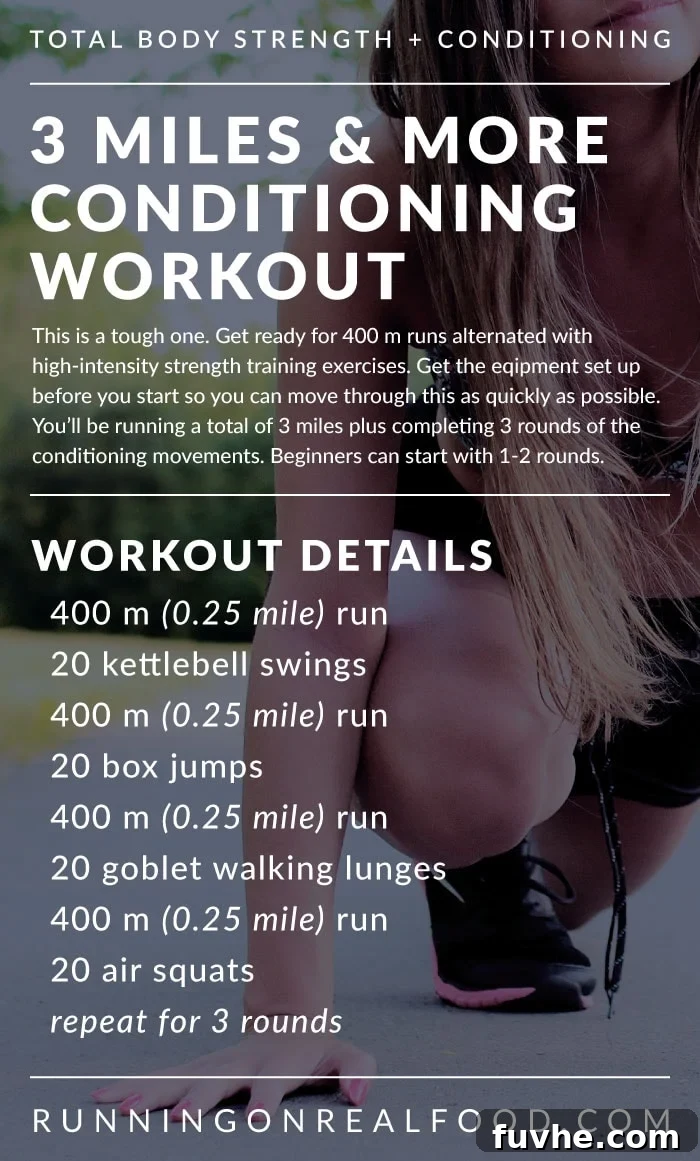
Complete 3 Challenging Rounds:
Each round is a relentless sequence of cardio and strength. Move efficiently and with purpose between exercises, minimizing rest periods to maintain the high intensity that drives results.
- 400 Meter Run: Initiate each segment with a powerful sprint. Push your pace to a challenging level, aiming for speed and endurance. This quick burst ignites your metabolism and prepares your muscles for the strength work ahead.
- 20 Kettlebell Swings: Following your run, immediately transition into 20 explosive kettlebell swings. This dynamic exercise is fantastic for developing posterior chain power (glutes, hamstrings) and core strength. Focus on a strong hip hinge and a powerful snap at the top, allowing the kettlebell to float to chest height. If using a dumbbell, perform goblet swings or two-hand dumbbell swings.
- 400 Meter Run: Back to the pavement or treadmill for another intense 400-meter dash. Dig deep and maintain the challenging pace established in your first run. Your legs will feel the burn from the swings, making this run an even greater test of endurance.
- 20 Box Jumps: Explosiveness is key here. Jump onto a sturdy box, bench, or step, landing softly with both feet. Step or jump down with control. Box jumps are excellent for building lower body power, improving agility, and testing your coordination. Ensure your landing is quiet and controlled to protect your joints.
- 400 Meter Run: The third 400m segment. Your legs are probably feeling heavy, but this is where mental toughness kicks in. Remind yourself of your goals and push through, maintaining as much speed as possible.
- 20 Goblet Walking Lunges: Hold a kettlebell or dumbbell in a goblet position (cupped at your chest) and perform 20 walking lunges (10 per leg). This exercise targets your quadriceps, hamstrings, and glutes while engaging your core for stability. Focus on a deep lunge, ensuring your front knee tracks over your ankle and your back knee hovers just above the ground.
- 400 Meter Run: The final 400m sprint of the round. Empty the tank on this one. Leave nothing left, knowing that a brief strength segment is all that remains before a hard-earned rest between rounds.
- 20 Air Squats: Conclude the strength portion of each round with 20 bodyweight air squats. These are fundamental for lower body strength and mobility. Focus on a full range of motion, descending until your hips are below your knees, keeping your chest up and back straight. This provides a muscular endurance challenge, testing your ability to perform high-volume bodyweight movements under fatigue.
Scaling and Progression: Adapt the Workout to Your Level
Fitness is a journey, not a race. This workout is designed to be highly scalable, allowing individuals of all fitness levels to participate and progress safely. Don’t feel pressured to complete all three rounds from day one. Listen to your body and adjust accordingly:
- Reduce Rounds: If you’re new to high-intensity circuit training, start with 1 or 2 rounds. Focus on mastering the movements and building your foundational endurance before adding more volume. Gradually increase to 3 rounds as your strength and stamina improve.
- Adjust Repetitions: For an initial modification, you can reduce the number of repetitions for the strength exercises. Instead of 20, try 10-15 reps, ensuring you still maintain excellent form. This can be particularly helpful if you’re limited on time or just starting out.
- Modify Exercises:
- Kettlebell Swings: If the full swing is too challenging, practice deadlifts with the kettlebell or dumbbell to build hip hinge mechanics.
- Box Jumps: Step-ups onto the box or bench are an excellent way to build strength and confidence before progressing to jumps. Lower the height of the box if needed.
- Goblet Walking Lunges: Perform stationary goblet lunges or bodyweight walking lunges if balance or weight is an issue.
- Air Squats: If deep squats are difficult, use a chair or bench to squat to, gradually increasing depth as mobility improves.
- Pacing the Runs: While the goal is intensity, it’s okay to start with a brisk jog for the 400m segments and gradually increase your speed as your cardiovascular fitness improves. The key is consistent effort.
The ultimate objective is to complete the entire circuit as fast as possible while maintaining good form. This encourages quick transitions between exercises, minimizing rest, and maximizing the conditioning effect. Rest only when absolutely necessary, and then get right back into the action. This approach will significantly boost your work capacity and leave you feeling accomplished.
Maximize Your Results: Tips for Success
To get the most out of this challenging workout and ensure long-term progress, consider these crucial tips:
- Warm-Up Properly: Before diving into the circuit, perform a 5-10 minute dynamic warm-up. This could include light cardio (jogging, jumping jacks), dynamic stretches (leg swings, arm circles), and bodyweight movements (light squats, lunges). A proper warm-up prepares your muscles, increases blood flow, and reduces the risk of injury.
- Focus on Form: Quality over quantity. Always prioritize correct exercise form over speed or heavy weights. Poor form can lead to injury and diminishes the effectiveness of the exercise. If your form starts to break down, take a brief rest or reduce the intensity.
- Stay Hydrated: Drink plenty of water before, during, and after your workout. Proper hydration is critical for performance, muscle function, and recovery, especially during high-intensity sessions.
- Nutrient Timing: Fuel your body with appropriate nutrition. A balanced meal rich in carbohydrates and protein a few hours before your workout will provide sustained energy. Post-workout, consume protein and carbohydrates to aid muscle repair and recovery.
- Listen to Your Body: While it’s important to challenge yourself, know the difference between pushing your limits and pushing into pain. If you experience sharp pain, stop the exercise immediately. Recovery is just as important as the workout itself.
- Track Your Progress: Keep a workout log. Note down your running speeds, weights used, and total completion time for the circuit. This allows you to monitor your improvements, stay motivated, and strategically plan your progression. Seeing tangible results is a powerful motivator!
- Active Recovery: On your rest days, consider light activities like walking, gentle stretching, or foam rolling to aid muscle recovery and reduce soreness.
Why This Cardio and Strength Circuit is a Game-Changer
This particular workout structure offers a myriad of benefits that extend beyond typical training routines:
- Superior Cardiovascular Health: The intermittent 400m runs keep your heart rate elevated, improving your VO2 max and overall heart health.
- Enhanced Muscular Endurance: Performing strength exercises under fatigue, immediately after a sprint, trains your muscles to withstand longer periods of exertion.
- Increased Fat Loss: The high-intensity nature of circuit training, combining cardio and strength, creates a significant “afterburn effect” (EPOC), meaning your body continues to burn calories at an elevated rate long after the workout is finished.
- Full-Body Conditioning: From the explosive power of box jumps to the core stability of goblet lunges and the endurance of sprints, every major muscle group is challenged.
- Time Efficient: Maximize your results in a shorter amount of time. Circuit training is notoriously efficient, delivering comprehensive benefits without extended gym sessions.
- Mental Toughness: Pushing through the discomfort of alternating sprints and strength exercises builds incredible mental resilience and discipline, skills that translate into all areas of life.
- Versatility: Easily adaptable for both indoor gym settings and outdoor environments, ensuring you can stick to your fitness routine regardless of location.
Explore More Dynamic Workouts to Try
If you enjoyed the challenge and effectiveness of this cardio and strength circuit, you’ll love exploring other innovative workouts designed to push your limits and diversify your routine. Consistency is key, but variety keeps your body adapting and your mind engaged. Check out these additional challenging workouts to keep your fitness journey exciting and progressive:
- 30 Minute Aerobic Conditioning Workout: Perfect for building a solid endurance base.
- 34 Minute Death by AMRAP Workout: A relentless test of your strength and stamina in an “As Many Rounds As Possible” format.
- Bodyweight and Running Workout For Time: Combining fundamental bodyweight movements with running for a comprehensive challenge.
- 30 Minute Running and AMRAP Workout: A powerful fusion of running intervals and bodyweight strength for maximum impact.
Don’t let your fitness journey stagnate! Incorporate these varied routines to continually challenge your body in new ways. Each workout offers a unique set of benefits, ensuring you develop a well-rounded and resilient physique.
Ready to commit? Pin the image below to easily save this incredible workout for your next training session and make it a regular part of your fitness arsenal!