
Are you searching for an incredibly effective and time-efficient way to challenge your lower body, ignite your metabolism, and boost your overall conditioning? Look no further! This high-intensity lower body circuit workout is expertly designed to push your legs, glutes, and cardiovascular system to their limits, leaving you feeling accomplished and invigorated. Prepare to break a sweat and experience a profound full-body burn!
The beauty of this workout lies in its dynamic combination of powerful strength training exercises and an intense cardiovascular component. Rowing, often hailed as a full-body exercise, engages nearly every major muscle group, making it an exceptional complement to targeted lower-body strength movements. When paired with high-intensity strength exercises, you create a metabolic powerhouse that delivers remarkable results and is fully scalable to any fitness level, from eager beginners to seasoned athletes.
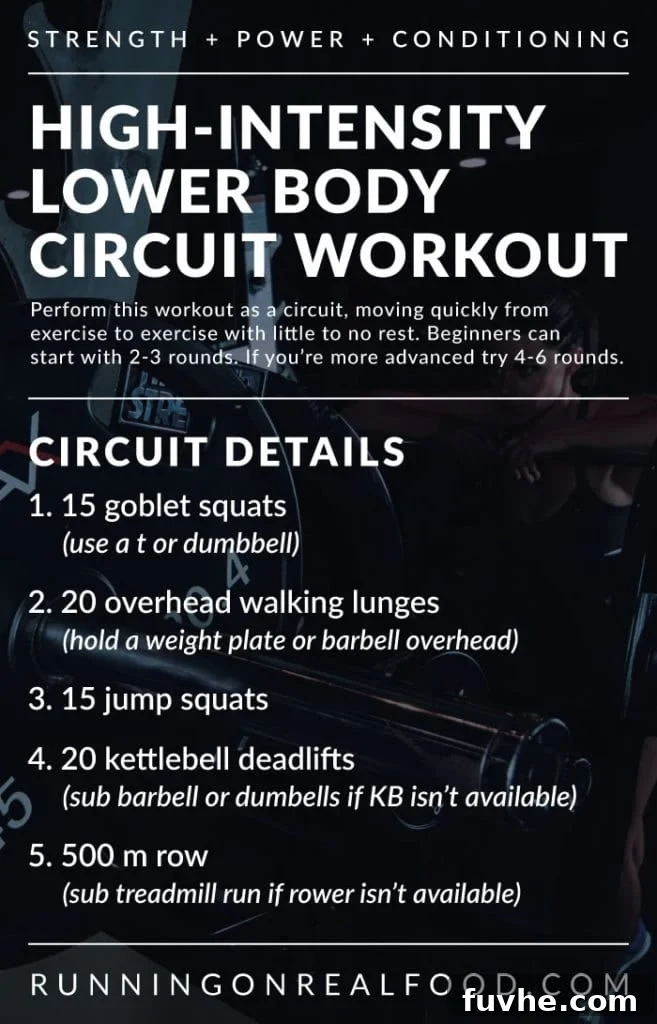
This strength and conditioning circuit workout is meticulously structured around five demanding stations. While the primary focus is on challenging your legs and glutes, the inclusion of exercises like overhead walking lunges and the rower ensures a comprehensive, full-body engagement. You’ll navigate through foundational movements such as goblet squats, overhead walking lunges, explosive jump squats, powerful kettlebell deadlifts, and finally, a heart-pounding 500-meter row. Your lower body will be absolutely on fire, only to be followed by the full-body conditioning of the rower, leaving every muscle group feeling thoroughly worked. The ultimate objective is to complete each round with focus and intensity, moving through the circuit as efficiently as possible while maintaining impeccable form.
Workout Details: Unleash Your Lower Body Power
To maximize the benefits of this high-intensity lower body circuit, aim to complete 5 rounds. Remember, quality of movement always triumphs over speed. Focus on controlled execution and proper form for each repetition.
- 15 Goblet Squats: This compound exercise is fantastic for building lower body strength, particularly in the quads, glutes, and core. Hold a dumbbell or kettlebell against your chest, feet shoulder-width apart, toes slightly out. Descend by pushing your hips back and bending your knees, keeping your chest upright and elbows inside your knees. Go as deep as your mobility allows, then drive through your heels to return to the starting position. Maintain a strong, neutral spine throughout the movement.
- 20 Overhead Walking Lunges (10 per leg): An incredible exercise for developing unilateral leg strength, core stability, and shoulder mobility. Hold a weight (plate, dumbbell, or barbell) directly overhead with arms locked out. Step forward into a lunge, ensuring your front knee tracks over your ankle and your back knee hovers just above the ground. Push off your back foot to bring it forward, transitioning directly into the next lunge. Keep your core tight and your gaze forward to maintain balance and proper posture.
- 15 Jump Squats: This plyometric exercise is designed to build explosive power in your legs and glutes while significantly elevating your heart rate. Begin in a regular squat stance. Descend into a squat, then powerfully explode upwards, leaving the ground. Land softly with bent knees to absorb the impact, immediately transitioning into the next repetition. Focus on controlled landings to protect your joints and maximize the elastic recoil for the next jump.
- 20 Kettlebell Deadlifts: A cornerstone exercise for developing the posterior chain (glutes, hamstrings, lower back) and improving grip strength. Stand with a kettlebell between your feet. Hinge at your hips, keeping your back flat and chest up, to grab the kettlebell. Drive through your heels, squeezing your glutes, to stand tall. Lower the kettlebell back to the ground with control by reversing the hip hinge. This exercise is about hinging, not squatting, so ensure your hips move back significantly.
- 500 m Row: This full-body cardio blast is the perfect finisher for each round, engaging your legs, core, and upper body. Focus on the sequence: drive with your legs, lean back slightly from your hips, and then pull with your arms. Reverse the motion smoothly for the recovery: arms extend, lean forward, then bend your knees. Maintain a strong, consistent pace, aiming to complete the distance as quickly as possible without sacrificing technique.
The total number of rounds you complete for this circuit can be adjusted to suit your current fitness level and the time you have available. Beginners might start with 2-3 rounds, focusing on mastering the form for each exercise. Intermediate athletes can aim for 4-5 rounds, gradually increasing intensity or weight. Advanced individuals might push for 5-6 rounds, using heavier weights and minimizing rest between stations. Choose your challenge, stay committed, and prepare to elevate your fitness!
Equipment Substitutions: Adapt and Conquer
Don’t let limited equipment be a barrier to an incredible workout. This circuit is highly adaptable, allowing you to achieve similar benefits with common alternatives. Always prioritize proper form regardless of the equipment you use.
- For Goblet Squats: If a kettlebell isn’t available, a single dumbbell can be held vertically against your chest. Alternatively, if you have access to a barbell, a barbell front squat or even a back squat can serve as excellent substitutes, targeting similar muscle groups with slightly different loading patterns. Ensure your form is impeccable for barbell variations.
- For Overhead Walking Lunges: Instead of a specific weight plate, you can use a single dumbbell held vertically overhead, or even a lighter barbell. The key is to keep your arms locked out and engage your core to maintain stability. If space is a concern or you prefer a stationary alternative, alternating reverse lunges (with or without weight) are an excellent option that still heavily recruits the glutes and quads while challenging balance.
- For Kettlebell Deadlifts: A pair of dumbbells, one in each hand, can perfectly replicate the movement pattern of a kettlebell deadlift. If you have a barbell, standard deadlifts are an exceptional choice, allowing for heavier loads and greater overall strength development. For barbell deadlifts, consider starting with 95-125 lbs for those with some experience, or a weight that allows you to maintain perfect form. For kettlebells, a 24-32 kg (53-70 lbs) range is often suitable for intermediate to advanced users.
- For the 500 m Row: If you don’t have access to a rowing machine, an intense 500-meter sprint on a treadmill (or outdoors, if conditions permit) provides a fantastic cardiovascular and lower-body challenge. Focus on maintaining a high speed and powerful stride to mimic the intensity of the row. Alternatively, a cycling sprint or a set of high-intensity burpees could also serve as a cardio-intensive substitute.
When selecting weights for any exercise, always choose a load that challenges you by the last few repetitions but still allows you to maintain perfect form throughout the entire set. Progress gradually as your strength and endurance improve.
Unlock Your Potential: Benefits of This High-Intensity Lower Body Circuit
Incorporating this type of workout into your routine offers a multitude of physical advantages beyond just building strong legs:
- Exceptional Cardiovascular Conditioning: The combination of plyometric jump squats and the intense rowing interval significantly elevates your heart rate, improving your endurance, stamina, and overall heart health.
- Enhanced Muscular Strength and Endurance: By targeting large muscle groups in your lower body and core, this circuit builds both raw strength and the ability of your muscles to perform repeated actions over time, translating to better performance in daily life and other sports.
- Boosted Metabolism and Fat Loss: High-intensity workouts are renowned for their “afterburn effect,” meaning your body continues to burn calories at an elevated rate even after your workout is complete. This makes it a highly effective strategy for fat loss.
- Improved Functional Fitness: Exercises like squats, lunges, and deadlifts mimic everyday movements, making you stronger and more efficient in activities like lifting groceries, climbing stairs, or playing with children.
- Time Efficiency: In a world where time is a precious commodity, circuit training offers a powerful workout in a shorter duration, perfect for busy schedules.
- Mental Resilience: Pushing through challenging circuits like this builds mental toughness, discipline, and a sense of accomplishment, positively impacting other areas of your life.
Maximize Your Workout: Tips for Success
To get the most out of this high-intensity lower body circuit and ensure your safety, consider these essential tips:
- Warm-Up Thoroughly: Always start with 5-10 minutes of light cardio (like jogging or cycling) followed by dynamic stretches (leg swings, arm circles, bodyweight squats) to prepare your muscles and joints for the demands of the workout.
- Prioritize Form Over Speed: While the goal is to move efficiently, never sacrifice proper technique for faster completion. Incorrect form can lead to injuries and diminish the effectiveness of the exercises. If your form falters, reduce the weight or take a short break.
- Listen to Your Body: Pay attention to any pain signals. Some muscle soreness is normal, but sharp or persistent pain is a sign to stop and assess. Adjust the intensity or take a rest day if needed.
- Stay Hydrated and Fuelled: Drink plenty of water before, during, and after your workout. Ensure you’re consuming a balanced diet to support muscle recovery and energy levels.
- Breathing is Key: Maintain controlled breathing throughout each exercise. Typically, exhale on the exertion phase and inhale on the recovery phase.
- Progression is Essential: As you get stronger, challenge yourself by increasing the weight, adding more rounds, or slightly reducing rest periods. Consistency is the foundation of progress.
Conclusion: Ignite Your Fitness Journey
This high-intensity lower body circuit training workout offers an unparalleled opportunity to transform your strength, endurance, and overall fitness. By combining powerful compound movements with a demanding cardiovascular element, you’re not just working out; you’re building a more resilient, capable, and energetic version of yourself. Whether you’re aiming to boost your athletic performance, improve your body composition, or simply feel stronger and more vibrant, this circuit provides the blueprint. So, grab your equipment, commit to the challenge, and prepare to feel the incredible power of your lower body in action. Your journey to a stronger, fitter you starts now!
More Workouts to Try
If you loved this circuit and are looking for more ways to challenge your body, explore these other effective workouts:
- CrossFit EMOM Workouts for Conditioning
- 30 Minute HIIT Workout
- Killer Full-Body HIIT Workout
- 5 Rounds Full-Body Strength Workout