

Prepare to unleash your inner athlete with one of the most brutally effective and incredibly rewarding cardio workouts you can possibly tackle. This isn’t just any routine; it’s a high-octane sprint and burpee conditioning challenge designed to push your limits, elevate your fitness, and leave you feeling accomplished. I recently put myself through this exact gauntlet during a lunch break, and I was in and out of the gym remarkably fast – but don’t let the brevity fool you. This workout delivers a profound impact, demanding everything you’ve got and leaving a satisfying burn in its wake.
The beauty of this particular workout lies in its simplicity and accessibility. You don’t need a myriad of fancy equipment or a dedicated gym filled with complex machines. All you require is a suitable space for running and enough room to perform burpees safely and effectively. Whether you prefer the controlled environment of a treadmill, the measured precision of an outdoor track, or the dynamic challenge of using clearly marked 400 and 800-meter distances outdoors, this routine is adaptable to almost any setting. It’s a testament to how powerful foundational bodyweight and cardio exercises can be when combined strategically.
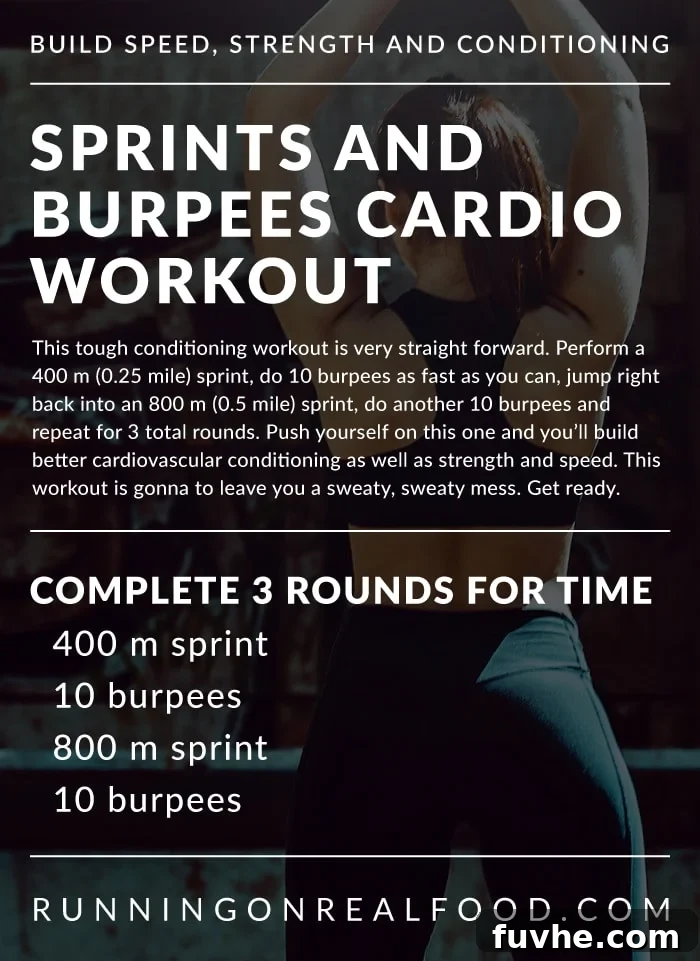
Workout Overview: Your Ultimate Cardio Challenge
This burpee and sprint conditioning workout is structured to maximize intensity and efficiency, targeting both your anaerobic and aerobic systems. It’s a high-intensity interval training (HIIT) protocol that will test your endurance, speed, and mental grit. The core of the workout involves alternating between challenging sprints and dynamic bodyweight burpees, repeated for multiple rounds. It’s designed to be completed as fast as possible (AFAP), making every second count and pushing you to find your maximum sustainable effort.
The Circuit Breakdown
You will complete a series of challenging exercises, transitioning quickly from one to the next. The structure is straightforward yet incredibly demanding:
- 400 Meter Sprint: Begin with a blazing 400-meter run. This is a quarter-mile dash, intended to be performed at a near-maximal effort. Focus on speed, form, and driving hard from the start.
- 10 Burpees: Immediately after your sprint, transition into 10 burpees. These should be performed with excellent form but without sacrificing pace. Every repetition counts towards building full-body strength and spiking your heart rate.
- 800 Meter Run: Following the burpees, it’s straight back to running, but this time for a longer distance – an 800-meter run. While still challenging, your pace for this segment might be slightly less aggressive than the 400m sprint, but it should still be a hard, uncomfortable effort designed to build cardiovascular endurance.
- 10 Burpees: Conclude this segment with another set of 10 burpees. Maintain good form even as fatigue sets in.
Once you’ve completed this entire sequence, that marks the end of one round. The goal is to complete a total of 3 Rounds for Time. This means you’ll repeat the entire 400m run, 10 burpees, 800m run, 10 burpees sequence two more times, aiming for the fastest possible cumulative time. Log your time to track your progress and challenge yourself to beat it in future sessions.
Mastering the Pace: Finding Your Optimal Intensity
The essence of this workout is speed and intensity. It’s not about cruising; it’s about pushing your physiological limits. When it comes to “how fast to run,” the answer is simple: as fast as you can safely maintain throughout the entire workout. This doesn’t mean starting at a full-out sprint for the first 400m and then fading into a walk. It means finding a challenging pace that allows you to sustain a high level of effort across all three rounds.
For context, when I performed this workout, I aimed for roughly 9.5 mph for the 400-meter sprints and dialed it back slightly to 9.0 mph for the 800-meter runs. These are simply guidelines; your ideal pace will depend entirely on your current fitness level. A good rule of thumb is that by the end of each running segment, you should feel significantly challenged, breathing hard, and experiencing that “good pain” that signifies effective training. This is where adaptation happens, where your body gets stronger and faster. Don’t shy away from discomfort; embrace it, as it’s a clear indicator that you’re working hard enough to elicit meaningful results.
The Power Duo: Benefits of Sprints and Burpees
Combining sprints and burpees in a workout like this creates a synergistic effect, delivering a comprehensive range of fitness benefits. Individually, each exercise is a powerhouse; together, they form an unstoppable force for physical transformation.
Benefits of Sprints:
Sprinting is a foundational exercise for developing explosive power, speed, and endurance. It’s a form of high-intensity training that rapidly elevates your heart rate and engages fast-twitch muscle fibers. Regular sprinting can lead to:
- Enhanced Cardiovascular Health: Sprints significantly improve your heart’s efficiency and overall cardiovascular fitness.
- Increased Speed and Agility: By training your body to move quickly, sprints directly translate to improvements in athletic performance.
- Fat Burning: The high-intensity nature of sprints creates an “afterburn effect” (EPOC), where your body continues to burn calories at an elevated rate long after the workout is over.
- Muscle Growth and Definition: Sprints build powerful leg and glute muscles, contributing to a more athletic physique.
- Improved Insulin Sensitivity: High-intensity exercise can help improve how your body uses glucose, beneficial for overall metabolic health.
Benefits of Burpees:
The burpee is often considered the king of bodyweight exercises, providing a full-body workout that challenges strength, stamina, and coordination. It combines a squat, a plank, a push-up, and a jump into one fluid movement. Burpees offer:
- Full-Body Conditioning: Engages almost every major muscle group – chest, shoulders, triceps, core, quads, hamstrings, and glutes.
- Cardiovascular Endurance: Rapidly spikes your heart rate, providing excellent cardio benefits even without a treadmill.
- Strength Building: Acts as a compound exercise, building functional strength across multiple planes of motion.
- No Equipment Needed: Can be performed anywhere, making it incredibly versatile for home workouts or travel.
- Metabolic Boost: The dynamic nature of burpees significantly increases your metabolism, aiding in calorie expenditure.
When combined, sprints and burpees create a highly effective HIIT routine that targets both anaerobic power (sprints) and muscular endurance with cardiovascular demand (burpees), leading to superior fitness gains in a minimal amount of time.
Elevate Your Challenge: How to Make It Harder
If you’re looking to consistently challenge yourself and progress your fitness, there are numerous ways to intensify this already demanding workout. As you grow stronger, consider integrating these advanced modifications to keep your body adapting and improving:
- Burpee Box Jumps instead of Burpees: Instead of a standard vertical jump at the end of the burpee, jump onto a sturdy box. This adds an explosive plyometric element, increasing power output and challenging your balance.
- Burpee Pull-Ups instead of Burpees: Position yourself under a pull-up bar. After the push-up portion of the burpee, jump up to grab the bar and perform a pull-up before returning to the floor for the next rep. This significantly amplifies upper body and back engagement.
- Run on an Incline: If using a treadmill, increase the incline during your running segments. For outdoor runs, seek out routes with hills. Running uphill drastically increases the muscular demand on your legs and cardiovascular system.
- Add 20 Walking Lunges after Each Set of Burpees: Introduce a lower body strength and endurance challenge by immediately following each set of 10 burpees with 20 walking lunges (10 per leg). This will tax your quads and glutes further.
- Add 25 Kettlebell Swings in Between Each Round: After completing the entire sequence (400m, 10 burpees, 800m, 10 burpees) but before starting the next round, perform 25 powerful kettlebell swings. This adds a fantastic posterior chain and cardiovascular challenge.
- Add 25 Barbell or Dumbbell Thrusters in Between Each Round: For a full-body strength and conditioning booster, perform 25 thrusters (combining a front squat with an overhead press) with either dumbbells or a barbell between each round. Choose a weight that allows you to maintain good form but is challenging.
Preparation and Recovery: Critical Components
No high-intensity workout should be approached without proper preparation and followed by adequate recovery. These steps are crucial for injury prevention, performance optimization, and long-term fitness.
Dynamic Warm-Up:
Before you even think about hitting your first sprint, spend 5-10 minutes on a dynamic warm-up. This prepares your muscles, joints, and cardiovascular system for the intense work ahead. Examples include:
- Light jogging or marching in place.
- Arm circles and leg swings.
- Torso twists and hip circles.
- Bodyweight squats and lunges.
- High knees and butt kicks.
- Walking spider lunges to open up the hips.
Static Cool-Down:
Once you’ve completed your final burpee and caught your breath, dedicate 5-10 minutes to a cool-down. This helps reduce muscle soreness, improves flexibility, and brings your heart rate back to resting levels. Focus on static stretches, holding each for 20-30 seconds. Target major muscle groups used in the workout:
- Hamstring stretches (e.g., standing toe touch or seated hamstring stretch).
- Quad stretches (e.g., standing quad stretch).
- Calf stretches.
- Hip flexor stretches.
- Chest and shoulder stretches.
- Child’s pose for back and overall relaxation.
Proper Form for Peak Performance and Safety
Executing exercises with correct form is paramount, especially in a high-intensity workout. Poor form can lead to injury and diminish the effectiveness of the movement. Focus on quality over quantity, even when pushing for speed.
Burpee Form Mastery:
- Start Standing: Feet shoulder-width apart.
- Squat Down: Lower into a squat position, placing your hands on the floor in front of you.
- Jump Back to Plank: Kick your feet back into a high plank position. Ensure your body forms a straight line from head to heels.
- Perform a Push-Up: Lower your chest to the floor, keeping your elbows tucked in (modify on knees if needed).
- Jump Feet Forward: Explode your feet back towards your hands, landing in a squat position.
- Explode Up: Jump vertically, extending your arms overhead. Ensure a full hip extension.
Running Form Essentials:
- Posture: Run tall, with a slight forward lean from the ankles, not the waist. Shoulders relaxed and back, chest open.
- Arm Swing: Keep elbows bent at roughly 90 degrees. Arms should swing forward and back, not across your body.
- Foot Strike: Aim for a mid-foot strike, directly under your hips. Avoid heavy heel striking or over-striding.
- Cadence: Focus on a quick, light turnover of your feet.
- Breathing: Maintain deep, rhythmic breathing, using your diaphragm.
Integrating This Workout Into Your Routine
Given its high intensity, this sprint and burpee cardio workout is best performed 1-2 times per week, allowing for adequate recovery between sessions. It’s an excellent addition to a well-rounded fitness regimen that includes strength training, other forms of cardio, and flexibility work. Listen to your body; if you’re feeling overly fatigued or sore, give yourself an extra day of rest or opt for a lower-intensity activity. Consistency, combined with smart programming, is key to long-term success.
Embrace the challenge, push your limits, and enjoy the profound fitness benefits of this dynamic and demanding workout. You’ll be amazed at how quickly your speed, endurance, and overall conditioning improve!
Explore More Intense Workouts
- 30 Minute EMOM Conditioning Workout
- Full Body Conditioning Workout
- Tabata Sprints + Full Body Conditioning Workout